Detention is an accessorial fee shippers pay when a carrier’s container or equipment is held beyond the allowed free time outside the port or terminal. This guide is for shippers, freight forwarders, and logistics professionals who need to understand what detention charges are, how they differ from demurrage, and how shippers can reduce or dispute them.
A detention charge is a type of accessorial fee billed to shippers when shipping containers are held at a receiving location beyond dwell time or “free time.” Dwell time is a period of time, usually one to two hours, for shippers to load or unload freight for a pickup or after a delivery.
Truckload drivers are paid detention when shippers or consignees go over the allocated dwell time.This is to reimburse drivers who are forced to wait to return shipping containers to the port of entry. Detention pay is passed on to shippers as a part of their overall freight bill.
Shippers agree to this free time along with scheduled pickup and delivery appointments listed in the Bill of Lading (BoL). A BoL is a legally binding contract between a shipper and carrier to ship freight.
The BOL includes the following freight transportation details:
Detention charges are typically between $35 and $50 an hour for every hour containers are held past free time. Shippers should confirm their carrier’s accessorial fees like detention before signing a BoL. This helps shippers prepare for common trucking accessorial fees that could be included in their freight bill.
Free time and detention billing terms vary by carrier, equipment type, terminal rules, and contract terms. Shippers should confirm how long free time lasts, when billing begins, and whether charges apply to containers, chassis, or driver detention before booking freight.
Detention and demurrage are different charges. Detention applies when equipment is held outside the terminal beyond free time, while demurrage applies when a container stays inside the terminal beyond the allowed window.
Demurrage charges can result from port congestion, equipment shortages, documentation issues, or pickup delays that keep a container inside the terminal beyond free time. It’s the shipper’s responsibility to rent a chassis prior to booking a freight pickup from a port, and they are responsible for accessorial payment as a result.
Shippers can avoid detention charges by preparing the dock before arrival, scheduling appointments accurately, and sharing complete pickup and delivery instructions with carriers. These steps reduce wait time, speed up loading and unloading, and help prevent free-time overruns.
Dock operations should run smoothly to avoid transportation delays and unnecessary fees. This means adequate amounts of labor and equipment must be on site and ready for use when trucks arrive.
Schedule pickups and deliveries well in advance to prepare staff, dock space, and equipment for the truck’s arrival. Doing so will ensure your staff is ready to receive freight within the allotted dwell time.
You should also share the correct pickup and delivery times to help prevent delays. Make sure your carrier has clear instructions regarding check-in, dock assignment, and paperwork.
Another tool that will help you avoid detention charges is a pre-pickup checklist.
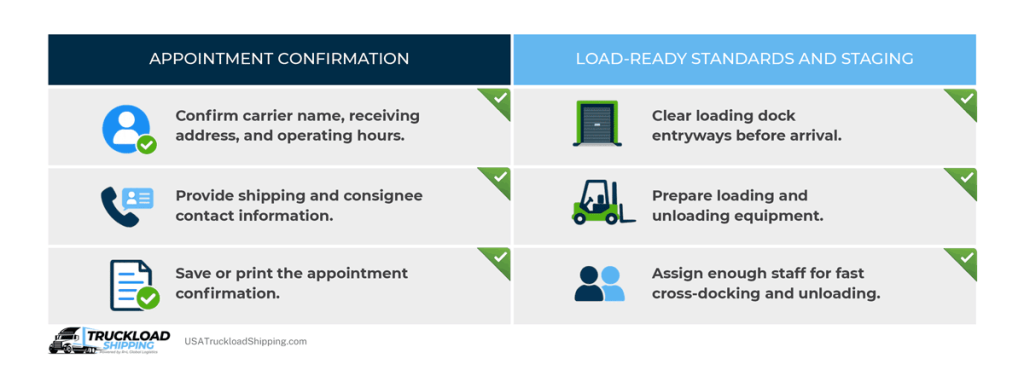
Using this checklist will ensure you receive and unload freight to avoid loading dock delays that lead to accessorials.
Shippers should dispute detention billing errors as soon as they identify them. Strong disputes usually include appointment records, timestamps, shipment documents, and evidence showing when free time began and ended.
We’ve created a checklist to document and present evidence to dispute wrongful detention charges.
Present this information to your truckload carrier or the port terminal that sent your invoice to start your claim.
If you are disputing detention or demurrage charges with an ocean carrier, file your dispute with the Ocean Carrier Equipment Management Association (OCEMA) Best Practice for Detention and Demurrage Process Committee. The OCEMA is a U.S. based association that oversees ocean freight at U.S. ports and rents container chassis equipment to shippers.
Need help reducing accessorial costs? Talk with our truckload team about appointment planning, port coordination, and detention-risk reduction. They’ll also be able to find the best shipping service for your needs.
Call USA Truckload Shipping’s freight experts today at (866)-353-7178 or submit your request for proposal. You can also get in touch with us by sending your freight questions through our contact form.
Who pays detention charges?
The person responsible for delaying the return of a container must pay detention charges. This person can be the importer or shipper.
How long is free time before detention?
Free time ranges between the first two hours of wait time or between five to seven days or more. After this point, detention fees are charged.
Can detention charges be disputed?
Detention charges can be disputed if you find them unreasonable or inaccurate. Winning disputes consists of factual evidence, like discharge timestamps and receipts, that proves you did not exceed the allotted free time.
Sources:
Welcome To OCEMA, Ocean Carrier Equipment Management Association
Electronic data interchange (EDI) and application programming interface (API) are two freight-data integration methods used in transportation management systems. EDI works best for standardized, high-volume document exchange with carriers, while APIs support faster, more flexible data sharing across TMS, customer portals, tracking tools, and other logistics systems.
A transportation management system (TMS) is a software used to integrate freight shipping data between a shipper and carrier or third-party logistics (3PL) provider.
TMSs help shippers and logistics companies optimize supply chain management by:
EDI and API are two types of software used to complete supply chain management tasks.
EDI is a standardized method for exchanging shipping documents and structured freight data between business partners, such as shippers, carriers, brokers, and 3PLs. EDI functions as a business-to-business data exchange method that lets trading partners share standardized freight information.
An API is a system-to-system connection that lets software applications exchange freight data in near real time across tools such as TMS platforms, customer portals, visibility systems, and billing platforms. APIs let shippers connect their TMS with carriers, 3PLs, customer portals, visibility tools, and other supply chain systems.
We’ve made a chart to compile the main differences between EDI and API systems.
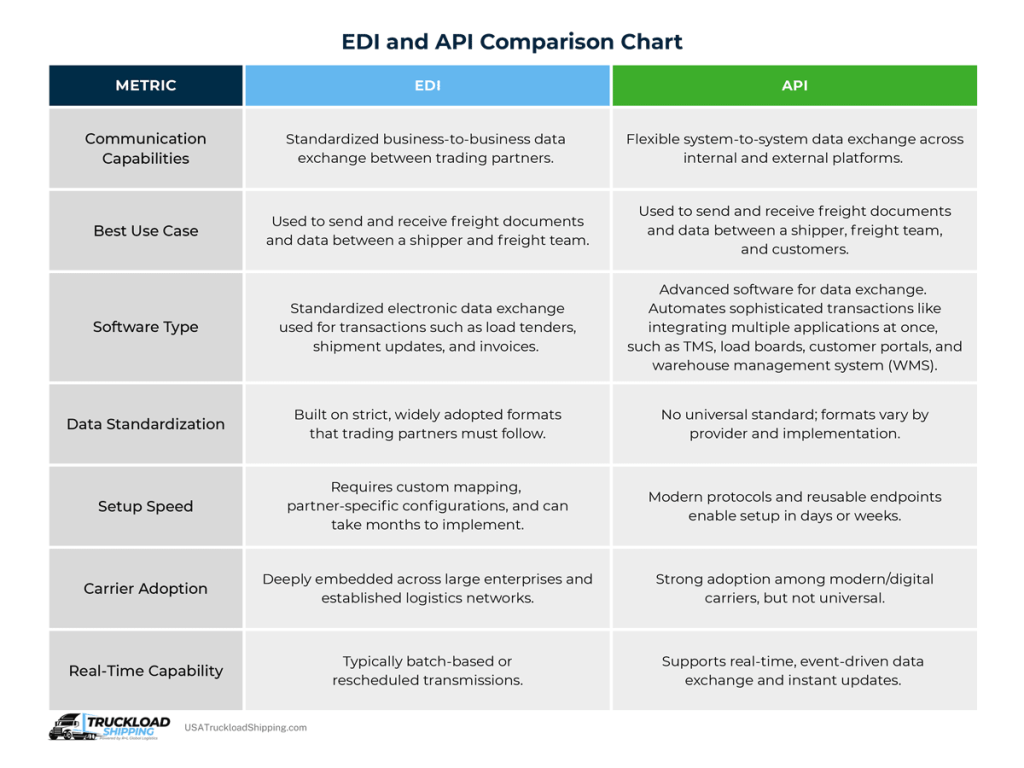
EDI remains the most widely used method for standardized freight document exchange, while APIs give shippers faster and more flexible integrations across modern logistics systems.
Now that you know what distinguishes these freight programs, let’s discuss how to use EDI and API to simplify your logistics strategy.
Shippers use EDI and API to communicate with their freight team to start, track, and complete a shipment.
EDI uses standardized transaction sets in freight workflows, so activities like load tendering, shipment updates, and invoicing can be sent in a consistent format across partners. An EDI transaction code identifies a standardized document type used to exchange a specific set of freight data.
Many freight APIs use REST-based connections to exchange shipment data between systems. Depending on the workflow, those integrations may pass identifiers such as PRO numbers for LTL shipments or reference numbers used inside a TMS.
Let’s take a look at the most common services featured in a TMS.
Load tendering is a process to request freight shipping rates and book loads from carriers. Shippers and freight brokers use load tendering to submit freight quotes from individual or multiple carriers or 3PLs to find the best-fit truckload rate.
EDI 204 is the transaction code for a motor carrier load tender and includes the following collective data:
EDI 990 is the transaction code used to approve or deny loads. Carriers use EDI 990 to send shippers a response to EDI 204, or load tendering.
A shipment status is an update on a freight shipment’s condition, location, and delivery time. Both EDI and API display real-time shipment status updates for both shippers and carriers to analyze a shipment’s progress to delivery.
Shippers and carriers use EDI 214, the Transportation Carrier Shipment Status message, to exchange shipment milestone updates and delivery status information. For API, shipment status updates are monitored using PRO numbers that are generally paired with a Standard Carrier Alpha Code (SCAC), a two to four digit letter code, to identify the freight company shipping the cargo.
Invoicing is a process to send and receive freight bills and payments. On an EDI system, shippers and carriers use the EDI 210 transaction code to create and send invoices, set up routing information, and view payment history in a TMS.
With APIs, invoicing data can move between a TMS, billing platform, customer portal, and payment system, giving shippers more flexible ways to manage invoice and payment workflows.
While both methods support freight operations, many shippers use EDI and API together. This hybrid approach combines standardized document exchange with faster, more flexible data sharing across the supply chain.
To implement a TMS, set up your business and carrier or 3PL’s information to effectively communicate your logistics needs and monitor how/when they are met.
Use our TMS implementation checklist to gather the required freight documents and data to build your logistics strategy.
Once this information is ready, you can work with a carrier or 3PL to configure your TMS and support your freight transportation strategy.
As a 3PL, we understand each component of a supply chain, from importing, warehousing, and truckload shipping. Our Freight Team of professional freight brokers and over 22,000 vetted carriers are trained to operate transportation management systems, simplify truckload rates, and deliver freight on time, every time.
Submit your freight details and receive an instant freight quote to price your shipment, or call our Freight Experts at (866)-353-7178 to get started.
Sources:
Standard Carrier Alpha Code: The Transportation Industry’s Carrier Identifier, SCAC
Get Operating Authority (Docket Number), Federal Motor Carrier Safety Administration, 2026
How To Comply with Federal Hazardous Materials Regulations, Federal Motor Carrier Safety Administration, 2024
Key Takeaway:
Trucking team drivers are two CDL-licensed drivers who share one truck so the shipment can keep moving with minimal downtime. Shippers typically use team drivers for expedited freight, tight delivery windows, and high-consequence loads where speed matters more than the lowest rate.
Team driving is a logistics strategy that assigns two drivers to one truck so freight can stay in transit longer with fewer extended stops. One driver operates the vehicle and the other driver rests before the two switch roles, keeping the vehicle in motion until the delivery is complete.
Solo drivers are a standard logistics practice to deliver small or large loads, like less-than-truckload (LTL) or full truckload (FTL), respectively. Solo drivers can also handle expedited freight, but team drivers usually move long-haul, time-sensitive shipments faster because the truck can stay in motion for more hours each day.
We’ve created a chart to define the main differences between truckload team drivers and solo truck drivers.
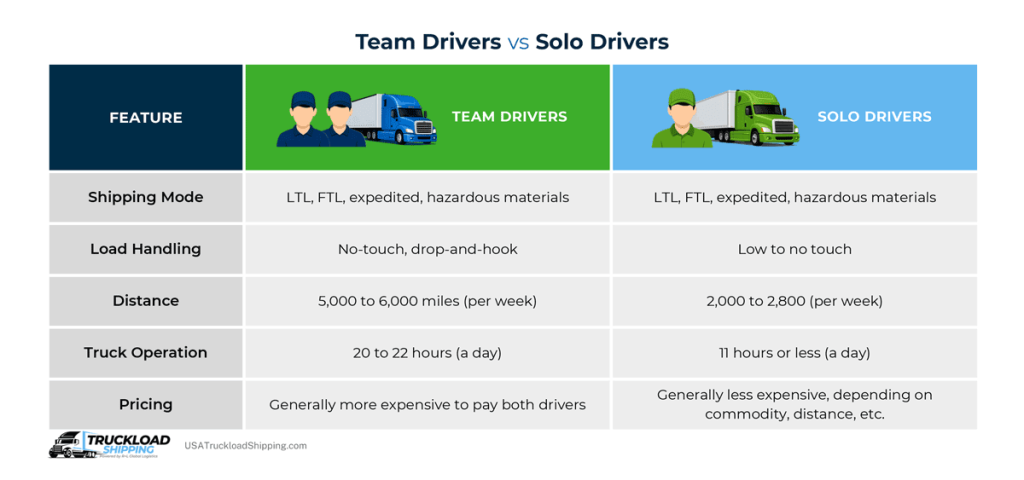
Team drivers cover more distance in less time than solo drivers due to the pair working in tandem shifts. The Federal Motor Carrier Safety Administration (FMCSA), an agency of the U.S. Department of Transportation (DOT), enforces driver welfare and freight transportation to ensure team drivers deliver freight both quickly and safely.
Carriers and their drivers must comply with the FMCSA Behavior Analysis Safety Improvement Categories (BASICs) for driver and road safety.
The FMCSA BASICs include:
Each category audits a motor carrier and their truck drivers’ federal compliance, Hours-of-Service (HOS). HOS is a FMCSA regulation that ensures no truck driver operates a vehicle longer than 11 hours. Team drivers comply with this rule through the Sleeper Berth Provision.
According to the FMCSA’s Sleeper Berth Provision, drivers must split driving duty by:
FMCSA specifies that team drivers must rest at least ten hours before going on duty. This helps drivers maintain driver fitness to deliver freight safely and on time.
In the next section, we’ll review if team driving is best for your freight and timeline requirements.
Trucking team drivers are best used to deliver urgent or time-sensitive freight. Perishable commodities like medicine or emergency supplies are best transported by team drivers.
Let’s look at the benefits of team drivers and when they are a worthy investment to secure your load.
A tight delivery window is a restricted timeframe to pickup, ship, and deliver freight. Tight delivery windows can range from within a couple hours in a single day or within a few days.
Expedited shipping is a shipping mode best used to quickly deliver goods in short delivery windows. Trucking team drivers excel at expedited freight services by taking turns operating a truck to avoid stops and deliver freight within a few days or less.
High-consequence deadlines happen when a late delivery would create a major business, safety, or service problem. These shipments often include medical freight, critical replacement parts, hazardous materials, or goods tied to strict delivery appointments.
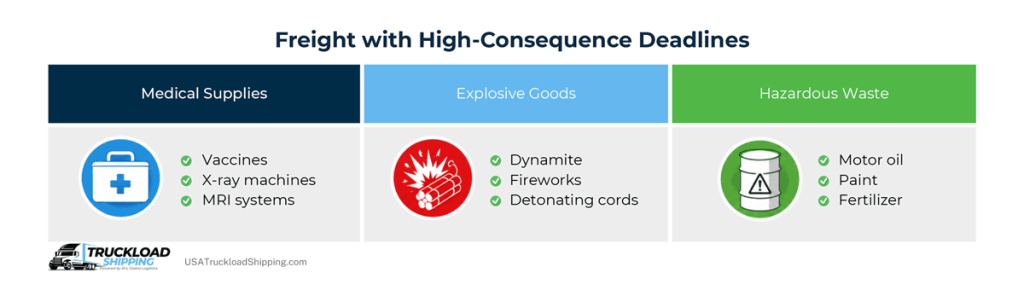
Team drivers normally deliver no-touch or drop-and-hook freight to streamline pickup or delivery. This shipping method allows urgent or sensitive freight to be handled, loaded, and unloaded efficiently and on time.
To make choosing between team drivers and a solo driver easier, we’ve provided a decision table showing the best scenarios to use each.
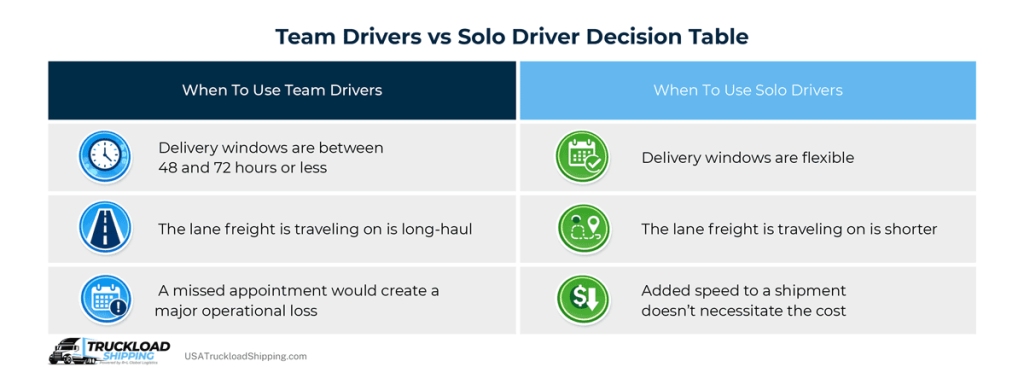
In most cases, team drivers make sense when delivery speed outweighs cost, while solo drivers are the better fit when the shipment can move on a more flexible timeline.
Team drivers usually cost more than solo drivers because the carrier is assigning two drivers to the same shipment. Although exact cost can vary, shippers are likely to spend between two and a half and three times more on team drivers than solo drivers.
Let’s look at a couple of factors that contribute to pricing team drivers and how to work them into your freight budget.
Team drivers drive trucks for any shipping mode, like dry van, reefer, flatbed, or intermodal. However, not every carrier offers team driving services, and market capacity can limit availability.
The freight market is a collection of freight industry data signalling loose or tight freight capacity to meet customer demand. When the market is loose, there are more available team drivers and trucks at any given moment with optimal rates for shippers to choose from. When the market is tight, team-driver availability shrinks and rates increase.
Team drivers cover thousands of miles more than solo drivers per week based on the load, lane, and distance of the shipment.
Like solo drivers, carriers bill shippers per mile for team drivers to expedite freight. The rate-per-mile is determined by factors like mode type, fuel prices, and spot and contract rates. These truckload rates fluctuate based on the lane and distance your team drivers travel.
Team driving often costs more because the carrier has to cover the cost of paying two drivers and facilitating the resources for faster transit.
Time-sensitive, high-value, or long-haul shipments benefit the most from team drivers. This kind of cargo requires near 24/7 movement, and team drivers can help shippers achieve this level of speed.
Goods that can benefit from team driving include:
If your freight is time-sensitive, high-value, or moving long-haul on a tight deadline, team driving may be the better option.
Team drivers are worth considering when transit time, appointment performance, or operational risk matters more than the lowest cost. If your shipment has a flexible timeline, solo service may be the better fit. Here at USA Truckload Shipping, we’re ready to ship to meet your transportation needs. We have a variety of transportation services you can choose from, including expedited shipping.
Call our freight team today at (866)-353-7178 or submit your request for proposal. You can also get in touch with our team by sending your questions through our contact form.
Sources:
Commercial Driver’s License Program, Federal Motor Carrier Safety Administration, 2025
FMCSA Homepage, U.S. Department of Transportation
Get Road Smart About the 7 Basics of Safety, Carrier, Safety, Accountability
Summary of Hours of Service Regulations, Federal Motor Carrier Safety Administration, 2022
Key Takeaway:
Carrier onboarding is the process shippers use to vet, approve, and prepare freight carriers to move shipments safely and compliantly. A strong onboarding process verifies operating authority, insurance, safety status, payment setup, and service expectations before the first load moves.
Carrier onboarding is a process shippers use to vet, approve, and train carriers to provide freight transportation. Shippers vet carriers or third-party logistics (3PL) companies with a freight broker or on their own with the Safety and Fitness Electronic (SAFER) System, which is a Federal Motor Carrier Safety Administration (FMCSA) resource.
The FMCSA is an agency of the U.S. Department of Transportation (DOT) that regulates carrier safety, compliance, and freight transportation. Shippers can use SAFER to verify a carrier has met FMCSA compliance regulations.
The carrier onboarding process typically has two phases:
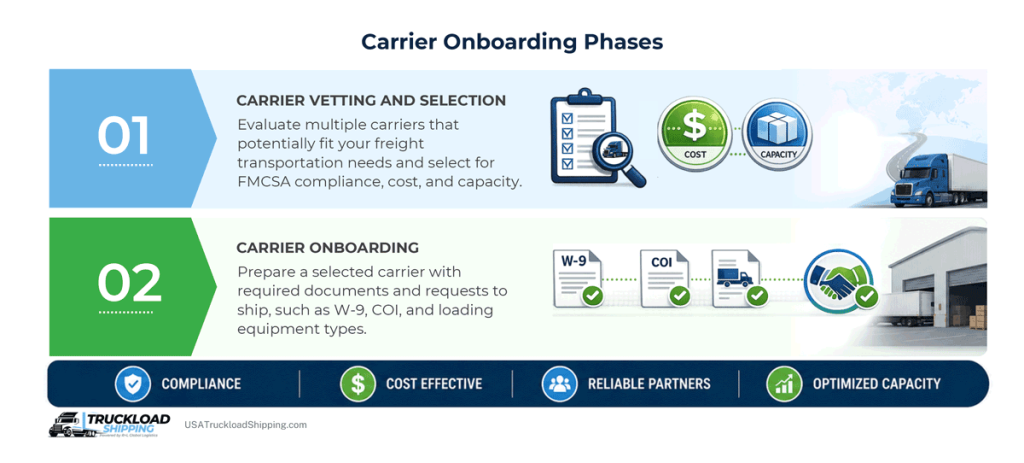
Carrier setup usually refers to the documentation package a carrier submits to a shipper for approval, including operating authority, insurance, tax forms, and contact details.
Carriers are equipped to support a shipper’s supply chain with a shipper’s standard operating procedures (SOPs). An SOP is a step-by-step process for carriers to follow a shipper’s supply chain operations.
SOPs are run with digital software that manages shipping documents and data shared between the shipper and carrier.
A shipper’s SOP can include:
In the next section, we’ll go over why shippers onboard carriers.
Shippers onboard carriers to confirm that a transportation provider is legally authorized, properly insured, operationally capable, and aligned with service expectations before moving freight. This reduces compliance risk, improves execution, and helps build a more reliable carrier network.
Onboarding a reliable carrier can lead to the following benefits:
Effective carrier onboarding reduces avoidable delays, improves compliance control, and makes carrier performance easier to manage over time.
You can check a carrier’s operating authority and safety status by verifying their Motor Carrier (MC) number, U.S. Department of Transportation (USDOT) number, and the FMCSA’s SAFER system.
An MC number can be six or seven digits and is used to verify a carrier’s operating authority. This number proves a company is operating as a for-hire carrier and is transporting federally regulated commodities.
A USDOT number is six to eight digits and assigned to carriers so their safety performance can be monitored. This includes tracking inspections, crashes, and audits. You can use this number to determine how compliant a carrier is with safety procedures.
FMCSA’s SAFER is a free and public database that provides extensive safety records, inspection histories, and compliance data on various carriers. You can use this resource to further investigate your carrier’s adherence to safety.
The documents required for carrier onboarding include a carrier agreement, Certificate of Insurance (COI), W-9 form, and MC/DOT operating authority. We’ll explain each document in the following sections.
A carrier agreement is a legal contract between a shipper and a carrier that defines how freight will be moved, paid for, and managed. In the arrangement, shippers agree to tender freight for transport, while the carrier agrees to move freight under specific terms, pricing, and service expectations.
Carrier agreements usually include:
This document is essential because it provides a formal understanding for you and your carrier to follow.
A Certificate of Insurance (COI) is a document from a carrier’s insurance provider that serves as proof of a carrier’s active insurance. Whether it’s carrier liability, freight insurance, shippers should obtain a COI to verify their carrier’s policies.
A COI should state the following information:
Shippers can request a COI from the carrier or ask for their insurance provider’s information to obtain the document.
The carrier onboarding process includes payment details for shippers to pay their invoices or carriers to pay approved freight claims, if applicable.
Shippers should request the following payment information:
In the next section, we’ll discuss how to keep a scorecard to measure carrier performance.
A carrier scorecard should measure reliability, capacity, service consistency, and equipment fit before approval. Core metrics include on-time pickup, on-time delivery, tender acceptance, transit consistency, capacity availability, and equipment suitability.
The table we’ve provided will explain these metrics and what to measure in more depth.
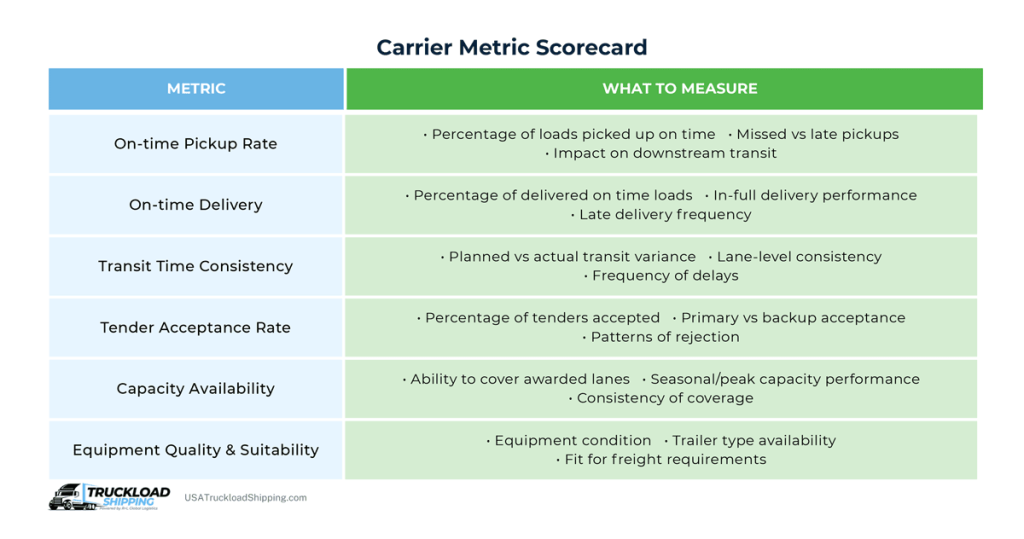
Some scorecard data may come from internal shipment history rather than public carrier profiles, so shippers often need to collect performance details during qualification and after initial loads.
A carrier onboarding checklist should include the carrier’s MC or USDOT number, Certificate of Insurance, W-9, contact information, freight requirements, and TMS or EDI setup details. These items support compliance review, payment setup, and shipment execution. We’ve provided a table so you can more easily track this information as you obtain it.
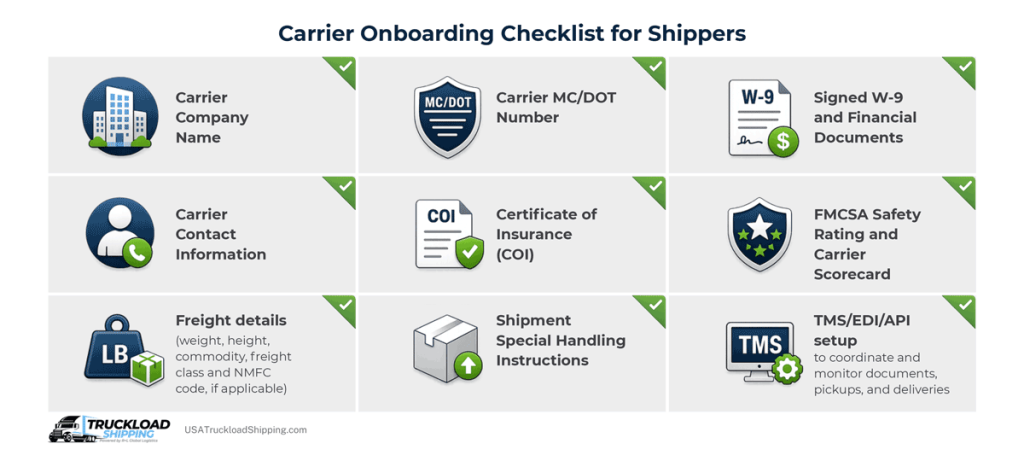
Now that you have carrier vetting process tools, you can select and train the best-fit freight professional to join your team.
If you have systems in place to automate the onboarding process, you’ll be able to finish the process in between a few minutes and a few hours. Standard onboarding processes are typically completed between 24 and 48 hours. However, manual onboarding processes can extend the process for as long as one and two weeks.
We’ll discuss some of the mistakes that can extend the onboarding process in the following section.
Carrier onboarding slows down when documentation is incomplete, workflows are manual, requirements are unclear, or systems are disconnected. Standardized checklists, digital document collection, and early validation checks help reduce delays and improve approval speed.
We’ve provided a list of the most common mistakes that cause these issues:
Shippers can speed up slow carrier onboarding by replacing manual, reactive processes with clear, streamlined workflows supported by technology. This starts by bringing everything into one system (or connected tools) where carriers can submit documents, fill out profiles, and track their status in one place.
Providing clear requirements, upfront checklists, and automatic checks helps catch missing or incorrect information early. When documents, compliance steps, and contracts are handled digitally and in the right order, onboarding becomes faster and more consistent.
Once your onboarding checklist, compliance checks, and scorecard criteria are in place, you can approve carriers faster and reduce avoidable freight risk. Teams that need help with carrier qualification or shipment execution can also work with a freight partner for added support.
Take a look at our services to find the right one for your shipping needs. Get in touch with our team and call (866)-353-7178 or get expert freight consultation to plan your shipment today.
Sources:
Safety and Fitness Electronic Record (SAFER) System, U.S. Department Transportation
Newsroom, U.S. Department of Transportation
What Is Operating Authority (MC number) and Who Needs It?, Federal Motor Carrier Safety Administration, 2023
About Form W-9, Request for Taxpayer Identification Number and Certification, International Revenue Service
A freight carrier moves freight with its own equipment, a freight broker arranges transportation through carrier partners, and a 3PL manages broader logistics functions like shipping, warehousing, and fulfillment. The best choice depends on whether you need direct hauling, flexible capacity, or end-to-end logistics support.
A carrier is a company that physically moves freight from one location to another using its own trucks, trailers, drivers, or other transportation assets.
A 3PL is a logistics company that manages part of a shipper’s supply chain, including transportation, warehousing, fulfillment, and freight coordination.
A freight broker is a licensed transportation intermediary that connects shippers with carriers and arranges freight movement without usually transporting the freight itself.
The table below compares ownership, pricing, capacity, and service scope across carriers, freight brokers, and 3PLs.
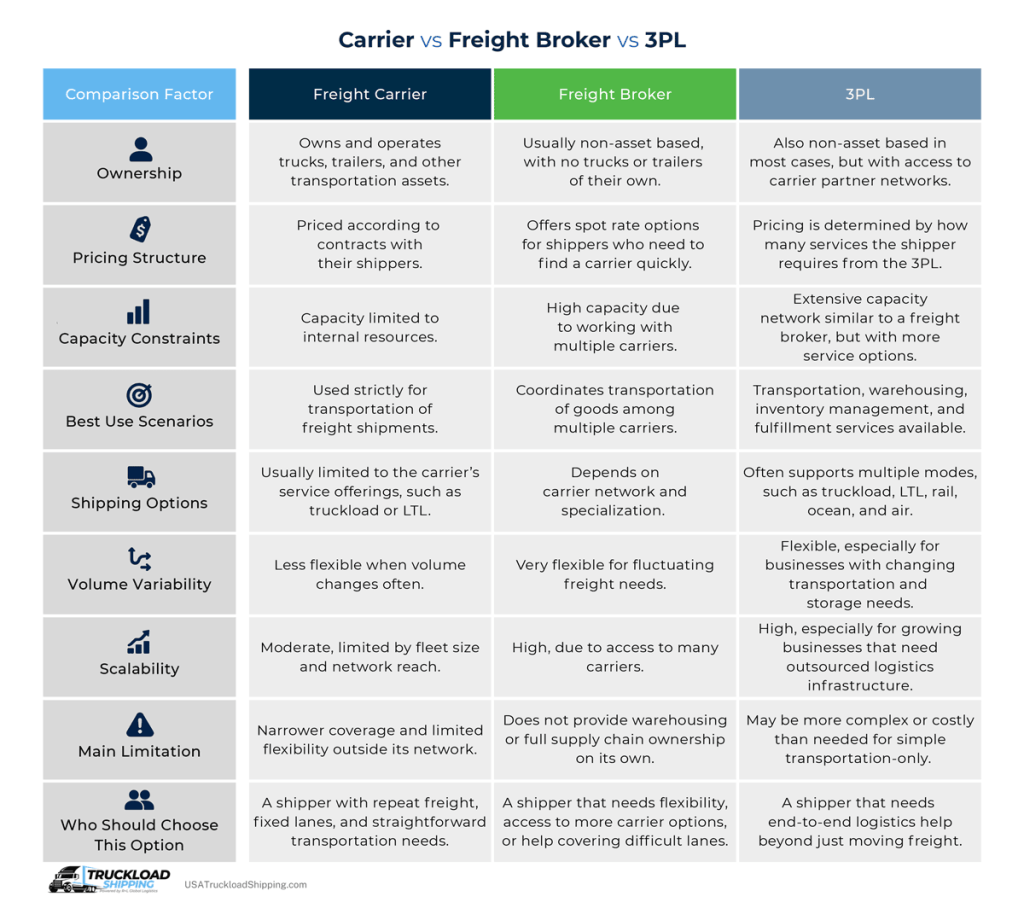
Choosing between these three logistics services is easy once you understand the strengths of each option.
A carrier is often the best fit for shippers with consistent lanes, scheduled freight, and predictable service requirements.
A shipper should evaluate two factors before working directly with a carrier:
I’ll examine these factors in the following section.
A truckload shipping lane is a recurring freight route between where a shipment is picked up and where it is delivered. Stable shipping lanes maintain consistent freight volume and pricing.
If a shipper moves freight on the same lanes each week or month, contracting with a carrier is a proven way to maintain consistent service.
Predictable freight moves on a regular schedule with limited variation in commodity type, dimensions, handling requirements, and delivery expectations.
A basic example would be a manufacturer or supplier who strictly sells engine replacement parts. This type of inventory creates similar shipping requirements from one order to the next when it moves on a set schedule.
When a single carrier cannot cover a shipper’s lanes, timing requirements, or volume needs, a freight broker becomes the better option.
Freight capacity is the amount of freight shipping resources available to a carrier, broker, or 3PL. A carrier is limited to its own fleet, while a freight broker can source capacity from multiple carrier partners.
When a shipper works with a freight broker, the broker compares carrier options to find a service match for the lane, timing, and freight requirements.
Another advantage of working with a freight broker is the shipping coverage they offer compared to standalone carriers. Let’s say you run the auto parts business I mentioned earlier and you secure a contract with a new customer in an area to which your carrier doesn’t ship
The freight broker can secure coverage by sourcing a carrier that already operates in the destination area.
When your logistics service needs go beyond simple freight transportation, it’s time to talk to a 3PL. A broker mainly arranges freight, while a 3PL can own the broader logistics process, including warehousing, fulfillment workflows, returns, and multi-mode coordination.
Since 3PLs offer a comprehensive suite of services, they can provide shipping mode options other than just full truckload (FTL) and less than truckload (LTL) shipping. They can also offer alternate shipping modes, including:
Building on our engine parts example again, consider a scenario in which you need to ship an order to a customer in a country without a physical border with the United States. Such a shipment would likely need to go out via ocean freight for international shipping.
When you reach out to a 3PL for this kind of shipment, they can make arrangements with ocean carriers and freight forwarders to get your goods where they need to go.
A 3PL can manage warehousing, order fulfillment, and pick & pack services on behalf of a shipper. Some 3PLs also offer reverse logistics services, so they can process returns from their clients’ customers.
Use a freight broker when seasonal demand exceeds your regular carrier capacity. A freight broker is often the best fit when your business ships predictable freight most of the year but needs extra trucks during peak periods like holiday demand, promotions, harvest season, or year-end inventory pushes.
For example, a distributor may rely on one core carrier for normal weekly shipments, then need additional coverage when order volume spikes for six to eight weeks. In that case, a freight broker can source extra carrier capacity without requiring the shipper to replace its main carrier relationship.
Use a 3PL when you need storage, order fulfillment, and returns handling in addition to transportation. A 3PL is usually the right fit for ecommerce brands that do not just need freight moved, but also need inventory received, stored, picked, packed, shipped, and sometimes returned.
For example, an online auto parts seller may store inventory in a 3PL warehouse, send daily customer orders to the 3PL for fulfillment, and rely on the same provider to process returns and restock eligible items. That setup reduces the shipper’s internal operational burden and keeps fulfillment, warehousing, and outbound shipping under one logistics partner.
Use a freight broker when you need to move an urgent load outside your normal shipping pattern. A freight broker is often the better option when a shipper has a last-minute load, an unusual destination, or a time-sensitive order that its regular carrier cannot cover quickly.
For example, a manufacturer may need to send one emergency palletized shipment to a new customer two states away after a production recovery. If the regular carrier does not have available equipment or does not service that lane on short notice, a freight broker can find available capacity faster than the shipper could by contacting individual carriers one by one.
To choose between a 3PL, freight broker, or carrier, a shipper should evaluate required services, shipment frequency, lane consistency, customer locations, and storage or fulfillment needs.
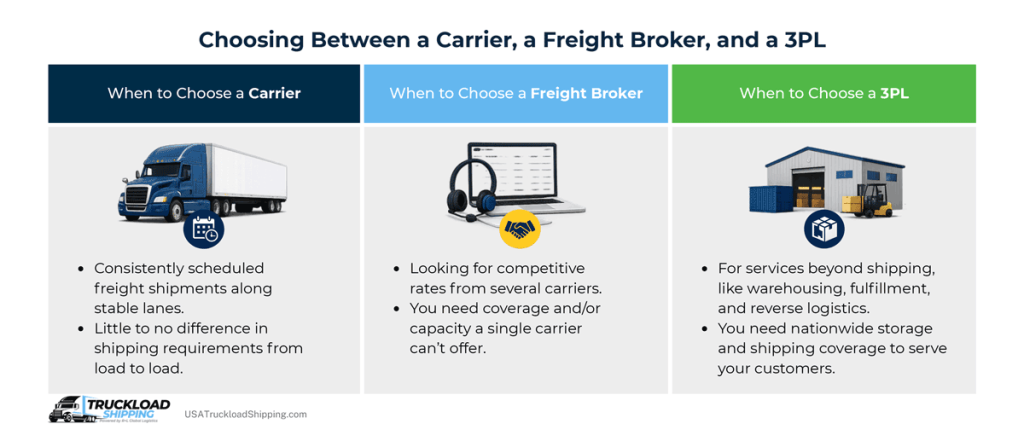
A shipper should also prepare a short qualification checklist before selecting a carrier, freight broker, or 3PL.
Ask the following questions of a 3PL, carrier, or freight broker before committing to any service agreements.
Shippers should also ask these prospective logistic service providers to show, in writing, what responsibility they take for loss, damage, delay, or misdelivery.
If you need a 3PL to move or store your freight, then USA Truckload Shipping is here to help. We have a variety of services that can help you transport your freight anywhere in the country. Call the team of freight shipping experts at USA Truckload Shipping for a risk free quote. You can reach us (866) 353-7178 or visit our contact us page.
Sources:
Do I Need a USDOT Number? Federal Motor Carrier Safety Administration, 2025
What Is Operating Authority (MC number) and Who Needs It?, Federal Motor Carrier Safety Administration, 2023
What Is A Third-Party Logistics Partner? U.S. Chamber of Commerce, 2021
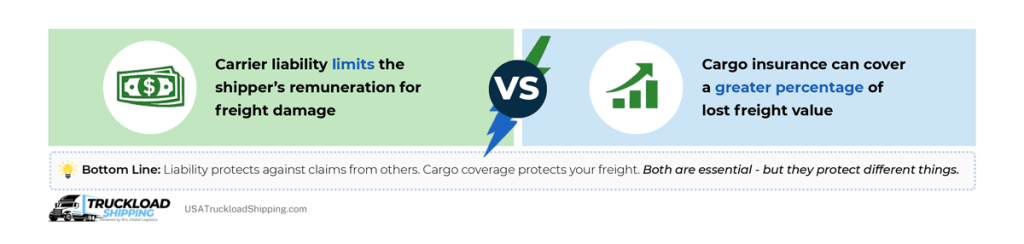
Cargo insurance is shipment coverage that helps shippers recover losses when freight is damaged, stolen, or lost in transit. Unlike carrier liability, which may be limited by law or contract, a cargo policy can provide broader protection based on the purchased limits, exclusions, and claim terms. Insuring your cargo protects your business’s bottom line, and shippers who rely strictly on carrier liability as defined in The Carmack Amendment (49 U.S.C. § 14706) when shipping across state lines could be compensated for just pennies on the dollar of the value of their shipment.
Carrier liability is the carrier’s legal responsibility for freight loss or damage while the shipment is in its care. Cargo insurance is separate protection purchased to cover the shipper’s financial loss, often with broader reimbursement options and clearer claim pathways.
In the following table, I’ve laid out some of the most notable differences between cargo insurance and carrier liability.
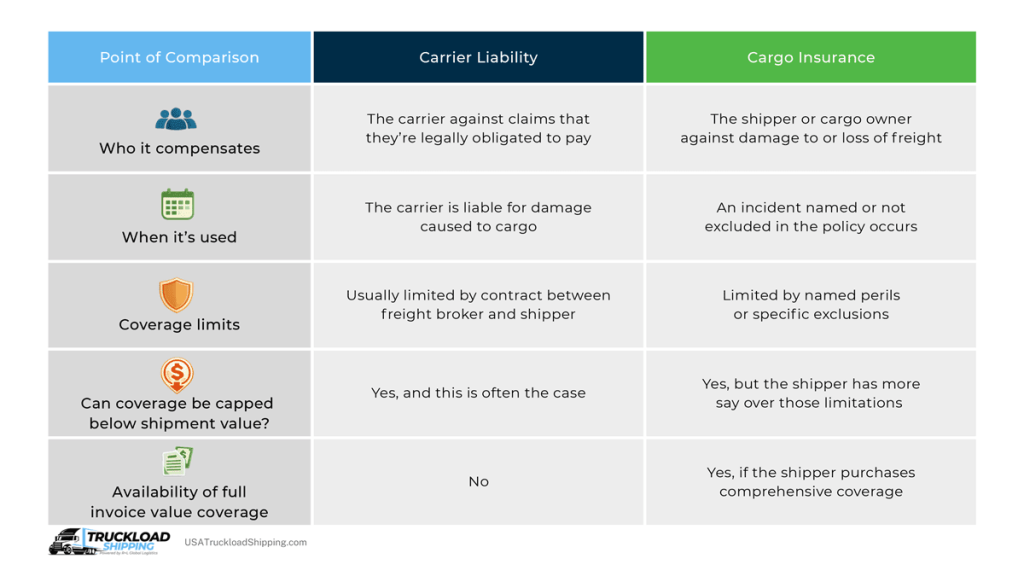
Carriers and freight brokers usually limit the amount of money they pay out for liability claims in contracts and arrangements with their clients (shippers).
Example: A shipper moves $85,000 of branded consumer electronics via LTL in winter. Carrier liability may not reimburse full invoice value if the contract caps exposure. A separate policy can cover theft or damage based on purchased limits and exclusions.
Carrier liability covers freight damages and loss resulting from the following scenarios:
This list is not comprehensive, but includes some of the most common scenarios that trigger carrier liability.
Coverage gaps under The Carmack Amendment can be expressed by the following five legal defenses:
Cargo insurance policies can be tailored to account for these defenses, which carrier liability doesn’t cover.
When you purchase cargo insurance for your shipment, you should confirm the following details on the policy and make adjustments if required:
I’ll examine these in greater detail in the sections below.
Cargo insurance limits are provisions in the policy that establish scenarios under which the policyholder will not receive compensation for lost or damaged cargo. Insurance policies for cargo can be largely grouped into two different types:
Cargo insurance limits define the maximum amount the policy can pay for a covered loss. Those limits may be based on invoice value, declared value, replacement cost, or other policy terms.
Exclusions to cargo insurance are, as previously implied, enumerated in all-risk policies to limit circumstances under which compensation would be provided to the policyholder. An otherwise all-risk policy could be tailored to exclude situations such as:
When purchasing a cargo insurance policy, you should consider factors that increase chances of cargo damage. For instance, if you’re shipping freight during the winter months, make sure your policy doesn’t exclude freeze damage, weather-related delays, or temperature-related spoilage where relevant.
Cargo insurance claims must be made within time windows specified in the insurance policy. The shipper will also need to have the following documents pertaining to the affected shipment available when submitting a cargo insurance claim:
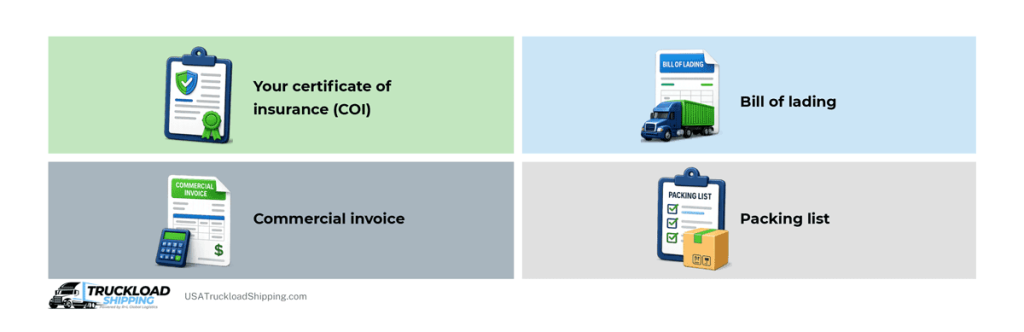
You may require additional documents depending on factors like the type of commodity you were shipping, but any cargo insurance policy will specify what those requirements are should you need to make a claim.
Choose a cargo insurance policy based on the value of the shipment, the type of goods, the route risk, and the policy exclusions. The right policy should cover your likely loss scenarios, not just offer the lowest premium.
Before buying, confirm:
A good policy is one that matches your shipment’s actual risk and gives you a realistic path to full reimbursement if something goes wrong.
Shippers should consider added coverage when shipment value, theft exposure, handling complexity, weather risk, or claims urgency exceeds what standard carrier liability is likely to reimburse. This is especially true for electronics, food, branded goods, and multi-stop or LTL freight.
Some common scenarios in which shippers should strongly consider purchasing additional coverage include:
The cost of cargo insurance coverage pales in comparison to the cost of replacing uninsured goods should a worst-case scenario occur.
When you ship your goods with USA Truckload Shipping, you have the option of insuring the cargo. The peace of mind that comes with knowing your shipment is covered is often worth the investment. Call our team of freight shipping experts at (866) 353-7178 or get a quote online in just minutes.
Does carrier liability automatically cover the full value of my shipment?
Usually not. Liability is often limited by the carrier’s contract with the shipper.
What does cargo insurance typically cover?
Cargo insurance is generally used to protect against freight that is lost, damaged, or stolen in transit.
Can I buy cargo insurance through a freight broker or shipping provider?
Yes, we offer cargo insurance options for shippers who choose to let us handle their freight shipping needs.
Works Cited:
49 U.S. Code 14706 - Liability of Carriers Under Receipts and Bills of Lading, Legal Information Institute, Cornell Law School
You Are Presumed Liable, eTrucker, Seaton, Henry E., 2005
Inherent Vice, North Standard, 2017
Acts of the Public Enemy Clause Samples, Law Insider
Insurance Exclusions Explained, Thimble
The carrier vetting process is the step-by-step review a shipper uses to verify a carrier’s operating authority, insurance, safety record, identity, and compliance with regulations from the Federal Motor Carrier Safety Administration (FMCSA) and U.S. Department of Transportation (USDOT). Shippers who vet carriers with a predetermined checklist of safety and compliance-related questions will find a reliable logistics service provider.
Carrier vetting is the process of evaluating a carrier’s compliance with USDOT and FMCSA regulations, their insurance coverage for carrier liability, and the carrier’s reputation for safety and on-time deliveries.
For instance, a shipper vetting a carrier should ask questions like:
Carriers should provide their USDOT number to shippers during the vetting process. The USDOT number can be referenced on the department’s website to check a carrier’s safety rating.
Inquiring about a carrier’s FMCSA status first will save time in the vetting process, since failure to comply with FMCSA regulations should be an immediate red flag that indicates the carrier is not to be trusted with a shipper’s cargo.
The carrier vetting process is the step-by-step review a shipper uses to confirm that a motor carrier meets legal, insurance, safety, and operational standards before freight is awarded.
A typical carrier vetting process includes the following steps:
This process requires attention to detail, which means you’ll need to complete each step as carefully as possible.
The FMCSA is the government entity responsible for regulating interstate freight movement by commercial motor vehicles (CMV). Carriers must comply with the rules and regulations the FMCSA sets in order to gain and maintain operating authority.
FMCSA outlines three common situations in which operating authority may not be required:
Otherwise, if a carrier does not meet these FMCSA compliance basics, it cannot transport interstate freight.
You can compare freight brokers and asset-based carriers to determine if your freight shipping requirements require more options than a single carrier can offer.
Carrier authority status is an indicator of whether FMCSA has authorized the carrier to transport freight owned by other individuals or businesses across state lines. When carriers apply for operating authority, FMCSA issues an MC Number to the applicant, but this is not sufficient to begin moving freight between states.
The FMCSA requires the following forms to be submitted after they issue the MC number:
The carrier must then wait to receive certification of operating authority before conducting interstate freight transportation.
FMCSA requires carriers to have a qualified inspector examine their commercial motor vehicles every twelve months under 49 CFR subsection 396.17. This requirement applies to the power unit itself and any trailers used in tandem with the unit for freight delivery purposes.
Common violations that preclude a (CMV) from passing inspection include the following:
The carrier must include proof of a successful inspection with all inspected vehicles. A carrier who can’t or won’t provide proof of inspection for their CMV(s) is likely to operate in violation of FMCSA regulations.
As mentioned before, carriers must provide proof of insurance to FMCSA when applying for operating authority. Carriers who can’t prove they have the insurance required for operating authority are not legally permitted to haul interstate freight.
Specifically, FMCSA requires proof of liability insurance. This is not the same as cargo insurance.
Liability insurance is a type of coverage FMCSA requires carriers to prove they have to gain an operating authority license. Requirements for liability insurance are found in 49 CFR 387.303.
A CMV with a gross vehicle weight of over 10,000 lbs must carry $750,000 worth of liability insurance to cover property damage, personal injury, and damage to or loss of freight.
Liability insurance contrasts with cargo coverage because carrier liability covers the three previously mentioned occurrences, while cargo coverage applies to the freight itself.
A shipper vetting a carrier can request a copy of the carrier’s certificate of insurance (COI) for inspection during the vetting process.
Red flags on insurance certificates indicate that the carrier’s coverage is insufficient or non-existent. A shipper can look for the following potential red flags when reviewing a prospective carrier’s COI:
While vetting a carrier’s liability insurance, request a freshly printed certificate with you or your company’s name as the requestor. Don’t accept an older copy of the certificate as it may contain out-of-date information.
Shippers can use a carrier’s USDOT number to find out how the carrier ranks compared to others in terms of safety and performance on FMCSA’s website. FMCSA uses the Behavior Analysis and Safety Improvement Categories (BASICs), part of its Safety Measurement System (SMS), to determine a carrier’s compliance with FMCSA regulations.
FMCSA does this by evaluating data from the following:
Shippers can look for high-priority green flags in a carrier’s BASIC history during the vetting process:
In practical terms, a shipper reviewing a carrier’s USDOT/FMCSA profile should feel more confident when the carrier’s record shows low BASIC exposure, no unresolved serious violations, and no recent signs of enforcement attention.
Use this score card during the vetting process to make a decision about whether you should approve a carrier, request more information, or avoid doing business with them.
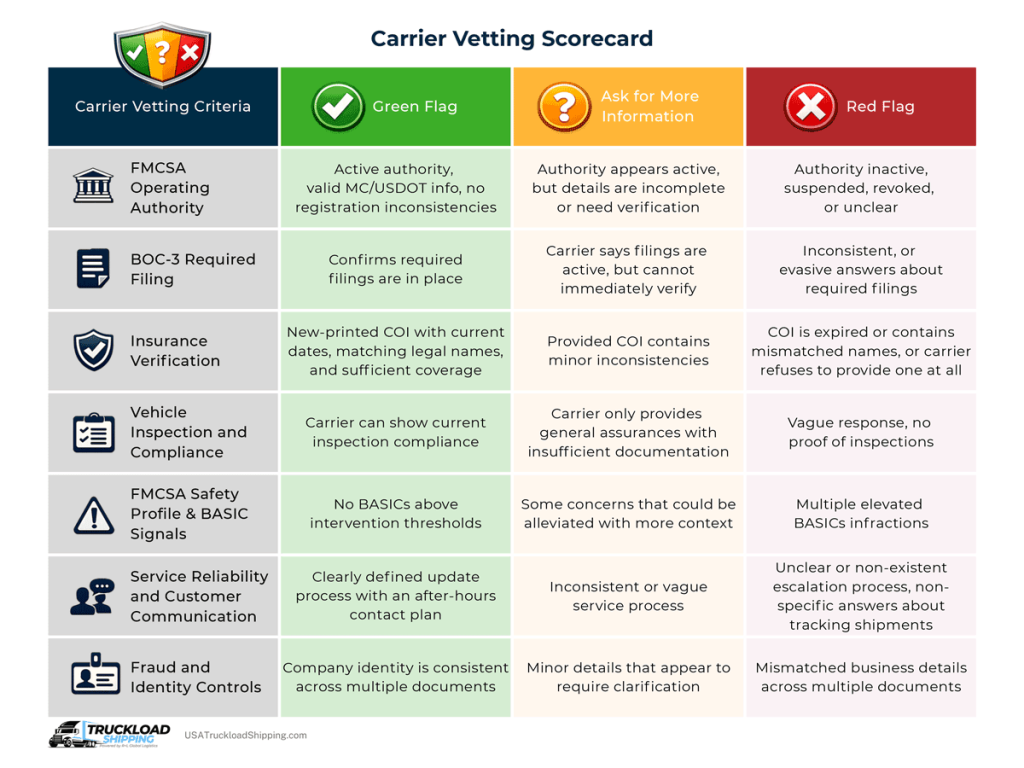
Now that you have a scorecard to evaluate your carriers, here’s when you should approve, seek more information, or reject a carrier based on your findings:
A shipper should never rely strictly on price while vetting a carrier. It’s not uncommon for dubious carriers to advertise lower prices than their fully-compliant competitors.
Our rigorous vetting process is in place to ensure that your freight shipments are only hauled by FMCSA and USDOT-compliant carriers. Give us a call at (866) 353-7178 or fill out a contact form online to find out more about our freight brokerage and third-party logistics services.
Sources:
Regulations, Federal Motor Carrier Safety Administration, 2024
Unlocking Success: The Key Elements of Carrier Vetting and Managing Liability, Transportation Intermediaries Association, Johnson, Andrew, 2024
Get Operating Authority (Docket Number), Federal Motor Carrier Safety Administration, 2026
Newsroom, U.S. Department of Transportation,
Instructions for Form OP-1, Federal Motor Carrier Safety Administration, 2024
Title 49, Subtitle B, Chapter III, Subchapter B, Part 396, Code of Federal Regulations, 2026
Common Violations, Federal Motor Carrier Safety Administration
Title 49, Subtitle B, Chapter III, Subchapter B, Part 387, Subpart C, Code of Federal Regulations, 2026
Certificates of Insurance - What They Don’t Tell You!, Ford Insurance Agency, 2023
Compliance Manual for eFOTM Redevelopment, Federal Motor Carrier Safety Administration, 2021
A tender acceptance rate is the percentage of load tenders that carriers or brokers accept out of the total tenders a shipper offers. A low tender acceptance rate can delay shipments, raise transportation costs, and force shippers into the spot market. Shippers improve tender acceptance by giving carriers more lead time, sending accurate shipment data, and aligning pricing and appointment windows with market conditions.
Tender acceptance is the share of tenders accepted by the carrier or broker out of all tenders offered by the shipper. To determine your acceptance rate, simply divide your accepted tenders by total tenders offered and multiply the result by 100.
For example, let’s say you specialize in manufacturing and/or providing office furniture and equipment to businesses across the U.S. When you receive an order from your customer, you palletize the requested goods to fulfill that order. However, most businesses don’t have their own dedicated logistics resources, such as trucks and drivers.
Instead, you would make your shipment available for freight transport via an online resource, like a load board, including the shipping information and what you’re willing to pay for a carrier to transport the merchandise on your behalf. This is an example of tendering a shipment.
You may instead choose to work with a select handful of carriers, or a freight brokerage with access to thousands of carriers. In the latter case, your freight broker would find the best carrier for your shipment based on factors such as point of origin, destination, time frames, and required accessorial charges.
Whichever method you use, tender acceptance can vary based on timing, capacity, and pricing . The other side of this coin is tender rejection.
Tender acceptance often declines in times of limited freight capacity, when demand for services outweighs the resources available to meet that demand. Timing also has an impact on acceptance rates: the narrower your shipping window, the harder the load may be to cover.
Let’s look more closely at notable factors that contribute to decreased acceptance rates.
Last-minute shipments are often harder and more expensive to book than shipments with more lead time. As a shipper, you’ll also be at the mercy of high spot rates if you request a shipment to be picked up with only a few hours of notice.
An appointment constraint within the context of tender acceptance is a limit or limits to how and when a shipment must be picked up and delivered.
Think of it as if you were a truck driver deciding between two equally priced loads, but one of them can be delivered any time between 8 AM and 5 PM while the other can only be delivered within a narrow time frame of 2:00 PM to 4:00 PM.
That narrow window may reduce flexibility for the driver and increase the risk of scheduling conflicts, whereas the first shipment is more forgiving and allows the driver greater flexibility to pick up a shipment or shipments on their return trip, avoiding deadhead miles.
Accessorial charges include using a truck with a liftgate to make a local dropoff, white glove delivery, hazardous material transportation, and other fees that arise from the particular requirements of your shipment.
If you leave out likely accessorials, you could underprice the shipment.
Low freight capacity has fueled low percentages of tender acceptance in 2026 that haven’t been seen since the COVID pandemic. In March 2026, tender rejection rates were up by over 8 percent year-over-year, signaling some recovery from the 2025 freight recession.
Unfortunately, shippers can’t reliably plan for reduced freight capacity, which leads to reduced tender acceptance. Volatile shipping lanes compound this frustration, as capacity is not spread out evenly across the United States and hazardous weather reduces carrier availability.
Regional freight data from February 2026 showed weaker acceptance in parts of the Midwest, where winter storms reduced carrier availability.
As a shipper, you can’t exactly control the weather or reduce freight capacity. You can, however, use some best practices for shippers who wish to increase their tender rates.
These four practices can help improve a shipper’s chances of tender acceptance:
Let’s look at these practices in greater detail.
More lead time generally improves the odds of tender acceptance. Timing is key to the logistics business, and shippers who provide lengthy lead times on their requests for carrier support experience higher acceptance rates than those who wait until the last minute to find a carrier.
Detailed RFP data helps carriers and brokers price the load, verify requirements, and evaluate the tender more efficiently. In the following table, I’ve laid out some common mistakes shippers make when filling out a proposal request, and how you can avoid them to improve your acceptance rate.
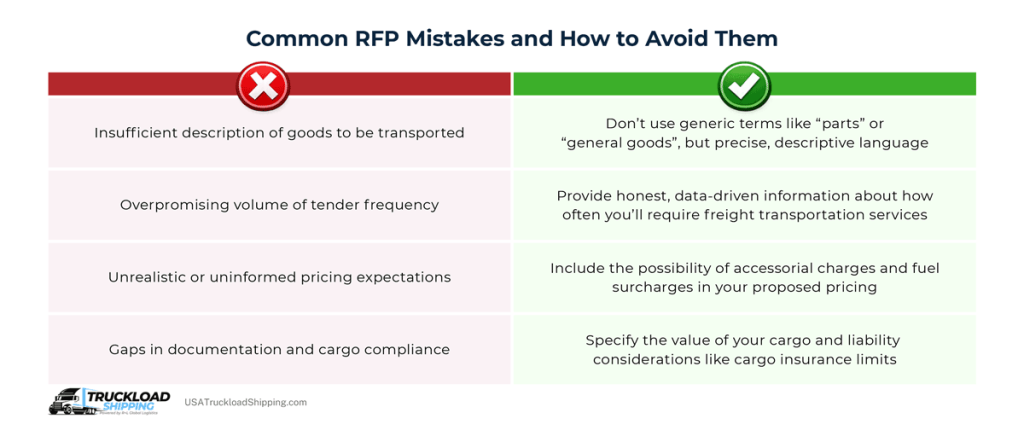
Detailed, accurate RFPs are an important factor in maintaining stronger acceptance rates.
Avoid wavering from the pick-up and delivery time windows you establish with your carrier. Consistent appointment windows can make your freight easier for carriers to plan around.
Therefore, failing to provide accurate timing windows to your freight broker doesn’t just affect the trucker: it can affect their other clients, which in time could lead to your shipments being deprioritized for tender acceptance.
Shippers who need consistent carrier support can contract with a 3PL or freight brokerage to take advantage of better pricing than the spot market offers. Consistency is often an important factor in making this arrangement beneficial.
Many shippers view a tender acceptance rate above 90% as a strong benchmark, but the right target depends on your mode, lane mix, seasonality, and routing guide performance. A lower rate may be manageable in volatile lanes, while a higher rate is often expected in more stable contract freight.
When your rate falls below 90%, you’ll have to rely on the spot market. Using the spot market is more expensive, but comes with lower service reliability.
When you’re gathering information for your shipment, setting up pickup windows, and working to get your freight accepted for shipment by a carrier, follow these instructions to keep your tender rates in acceptable parameters.
Use these six practices to improve your acceptance rate with carriers:
These best practices can improve your chances of tender acceptance.
Shipping lanes in the U.S. are subject to changes in their overall efficiency and costs due to factors like sustained traffic congestion or increased availability of freight along the lanes. This impacts tender acceptance if there are more shippers competing for carrier business than you’ve contended with in the past, or if delivery times suffer due to backed-up traffic.
If you establish repeat business with a broker or carrier, work with them to review the status of your most-used shipping lanes once per quarter. You may find that an alternate lane has become more advantageous for your shipments.
If you want a second opinion on lanes with low tender acceptance, our team can review your freight profile and identify opportunities to improve lead times, pricing alignment, and carrier coverage. We also have a variety of services that you can use to transport your freight. Reach us at (866) 353-7178 or request a quote online if you require more information.
Sources Cited:
Strickland, Zach, Midwest and West Coast Rejection Rates, FreightWaves, 2026
Strickland, Zach, Why is the Midwest the Most Volatile Region In the U.S., FreightWaves, 2026
A freight claim is a written demand for compensation when a shipment is lost, damaged, short, or delivered with another transportation discrepancy. This guide explains the main claim types, when shippers can file, what documents they need, and how the claims process usually works.
*Legal disclaimer: All information provided is not to be taken as legal advice.
A freight claim is a formal written request for payment when freight is lost, damaged, short, or otherwise delivered outside the terms of the Bill of Lading (BoL). A shipper doesn’t have to purchase freight insurance to file a freight claim. Claim outcomes depend on carrier liability, shipping terms, and the available documentation.
Freight doesn’t move without a BoL, which provides carriers with their shipper’s freight delivery specifications.
A BOL form is a shipping document that outlines the freight transportation agreement between a shipper and carrier.
When filling out a BoL form, shippers should include the following information to avoid disputes:
If freight arrives in any condition not agreed upon in the BoL, the shipper may be able to file a freight claim. There are six types of freight claims that we’ve listed in the following table.
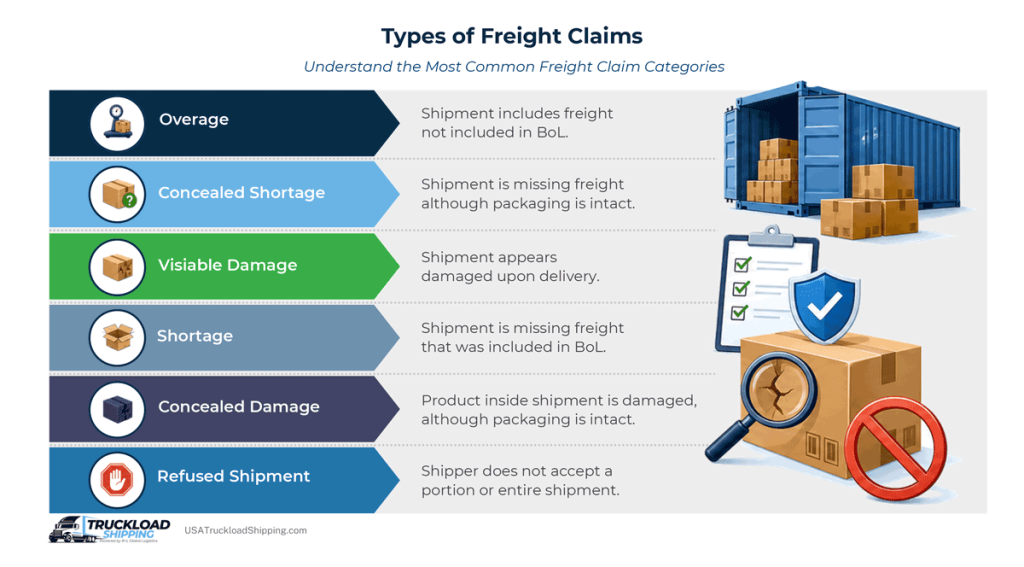
According to 49 U.S.C. §14706 (Carmack Amendment), shippers must file a freight claim no later than nine months after the date of delivery.
An over, short, and damaged (OS&D) claim covers freight that arrives over, short, or damaged when compared to what’s listed in the Bill of Lading. Shippers should document the discrepancy at delivery and keep photos, notes, and delivery records to support the claim.
Shippers can refuse a shipment and file a claim when a carrier delivers freight that doesn’t match the information in the BoL, or when freight is visibly damaged.
In the next section, we’ll look at scenarios to illustrate when it’s best to file a freight claim.
The timeline for a freight claim to process varies based on the type of claim and documentation. Freight claims need to be filed within nine months of delivery, but to save time and money, the sooner a shipper files, the better.
Shippers should take note of delivery discrepancies as soon as possible, ideally within 24 to 48 hours. This includes taking pictures of missing or damaged freight.
Once a claim is filed, carriers must respond to it within 120 days to pay, decline, or settle, according to the claim disposition rules in 49 CFR (Code of Federal Regulations) Part 370.
Filling out a freight claim correctly is essential if you want it to be accepted. This includes incomplete or missing documentation, damage not noted at delivery, late filing, improper packaging, lack of evidence of carrier damage, and failure to mitigate damage.
Let’s break down each one:
Avoiding these mistakes is essential if you want to ensure your claim is accepted.
A freight claim usually requires the Bill of Lading, Proof of Delivery, freight bill, invoice, written notice of loss or damage, and photo evidence when available. Missing or incomplete documentation is one of the most common reasons carriers deny claims.
A Proof of Delivery (POD) is a document that confirms a delivery was completed. Shippers can use this document along with photo evidence and notes documenting shipping errors as they discover them to build strong evidence and reduce claim denial.
Common freight claim denials include:
Freight claims may also be denied due to elements of the Carmack Amendment. This rule includes five exclusions that prevent shippers from filing a claim under these circumstances:
In the next section, we’ll review how to file a freight claim step by step.
To file a freight claim, inspect the shipment, document the damage or shortage, gather shipping records, submit a written claim to the carrier, and wait for the carrier’s decision or settlement response.
We’ve provided a chart with each step to file a claim with your carrier, including the timeline for payment, settlement, or denial.
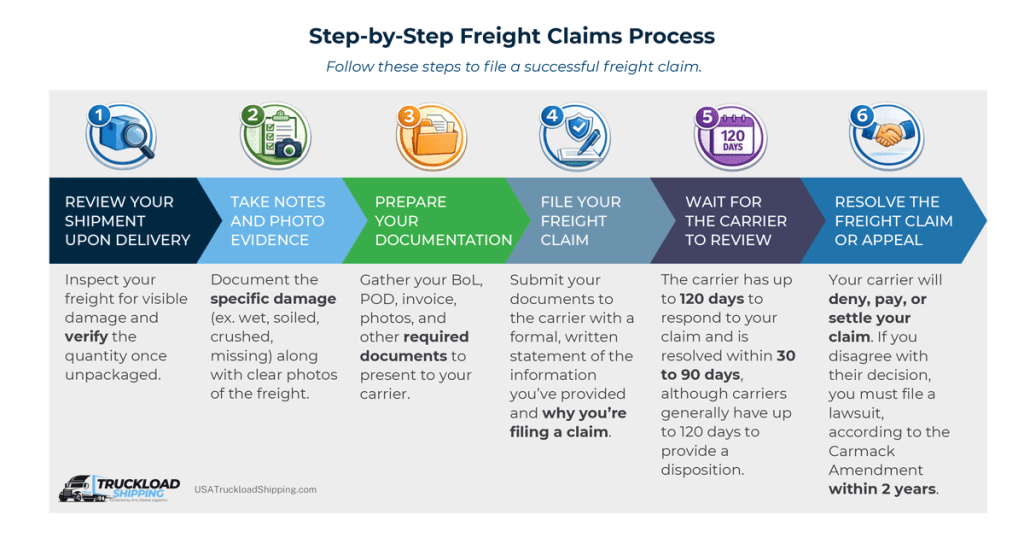
Shippers are not required to submit a copy of their freight claim to the U.S. General Services Administration (GSA). While the GSA is a federal agency that manages government property and technology services, only the carrier can process a freight claim.
Freight claims are used to recoup financial losses from shipping mistakes, but shippers can avoid the hassle by working with freight professionals who handle cargo from pickup to delivery with care.
A strong carrier and clear shipping documents reduce the risk of damage, shortage, and documentation errors. If you need help preparing freight correctly, working with an experienced logistics partner can reduce preventable claim issues.
Get in touch with our Freight Experts on a risk-free call at (866)-353-7178 or get an instant quote today. You can also send your questions through our freight shipping contact form.
What are freight claims?
A freight claim is a formal request for compensation when a shipment is lost, damaged, short, or otherwise delivered incorrectly. The carrier reviews the documentation and then pays, settles, or denies the claim.
What is OS&D?
OS&D stands for over, short, and damaged. It refers to a shipment discrepancy in which freight arrives with extra items, missing items, or visible or concealed damage.
How do I file a freight claim?
To file a freight claim, document the problem, gather the Bill of Lading, invoice, Proof of Delivery, and photo evidence, then send a written claim to the carrier. The carrier generally has up to 120 days to respond.
Sources:
49 U.S. Code 14706 - Liability of Carriers Under Receipts and Bills of Lading, Legal Information Institute
Title 49, Subtitle B, Chapter III, Subchapter B, Part 370, Code of Federal Regulations, 2026
Freight Damage Claims FAQs, U.S. General Services Administration, 2025
Key Takeaways:
Carrier vetting is an essential logistics strategy, and this guide is for shippers who need to select the right carriers to protect capacity, control costs, and reduce service failures across the supply chain.
Strategic carrier selection is the process of choosing freight carriers based on FMCSA compliance, lane fit, service reliability, equipment availability, and transportation risk. We’ll go over how to strategically select the right carrier for your company to keep your supply chain flowing.
Strategic carrier selection is the process of evaluating freight carriers for service fit, compliance, safety, capacity, and cost. This helps shippers build reliable transportation networks that support long-term supply chain performance.
A freight carrier is a company or person who ships goods with their own vehicles, drivers, and equipment. Shippers rely on carriers to transport goods to and from destinations like:
Carriers must register with the Federal Motor Carrier Safety Administration (FMCSA), an agency of the U.S. Department of Transportation (DOT) to obtain a Motor Carrier (MC) or USDOT Number. FMCSA oversees over 2 million carriers in the U.S. to audit carrier safety and compliance. FMCSA performs these audits to ensure a carrier meets the satisfactory conditions to handle and ship freight.
Carriers can ship goods domestically or internationally. Cross-border hauls are shipped between the U.S., Mexico, and Canada. For domestic transits, carriers deliver goods in two ways:
A logistics network is a transportation system that moves freight between suppliers, ports, warehouses, distribution centers, and end customers. Logistics networks coordinate how goods get to and from ports, warehouses, and other destinations. This includes the vehicles and equipment needed, and carriers provide the following:
The chart below details how carriers operate in a logistics network:
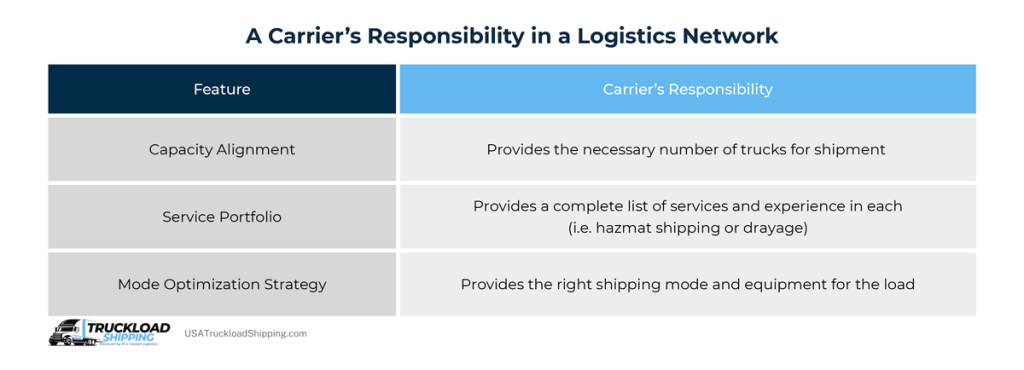
Carriers provide truckload shipping modes like:
Keep in mind that carriers who offer hazmat shipping must meet FMCSA’s Hazardous Materials Safety Permit Program requirements.
Carriers can operate alone or as part of a carrier network within a third-party logistics (3PL) company. When carriers are in a network, shippers can refer to a 3PL’s freight consultant to help with the carrier selection process.
Strategic carrier selection is a process of vetting a carrier’s services, safety rating, and compliance record to match a shipper’s supply chain needs.
A lack of carrier vetting can make or break a supply chain. Choose the wrong carrier and shippers may deal with transportation delays or inconsistent capacity. Choose the right carrier and shippers can benefit from cost-effective shipping and risk mitigation strategies to boost their supply chain’s productivity.
We’ll go over the carrier selection factors that shippers should be aware of in the following sections.
Carriers can offer spot rates and contract rates depending on your transportation needs. If you need a one-time or time-critical shipment, spot rates can be costly and time-consuming as you search for a new carrier each time you need transportation.
However, if you routinely ship large loads, a contracted rate with a carrier you’ve vetted and trust allows you to save money and time with reliable shipping services.
Early carrier planning helps shippers identify the right service model before pickup deadlines tighten.
While the best time to book a load is usually two to three days out from your desired pickup date and time. Carrier selection involves finding a carrier who aligns with your shipping needs.
Booking qualified carriers in advance keeps freight moving through each stage of the supply chain. Whether that’s from the port to the warehouse or from the warehouse to the retail store or customer’s doorstep, vetting and booking a carrier in advance keeps your supply chain resilient.
Shippers who bypass carrier vetting risk freight damage, common FMCSA violations, and delayed deliveries. We’ve made a chart of the most common mistakes in carrier selection.
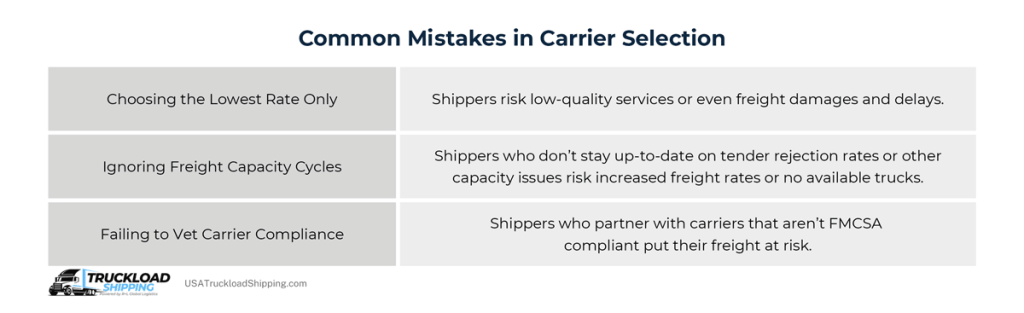
Thorough carrier vetting stabilizes service by reducing compliance risk and capacity surprises.
The FMCSA recommends checking their Safety and Fitness Electronic Records (SAFER) website to verify a carrier’s compliance with safety regulations. You can look carriers up with their DOT or MC number. Once locating them, you can access their safety rating and other compliance-related details.
To utilize carrier selection to find the right match for your next load, use the checklist we’ve provided.
This checklist will help you include the right key performance indicators (KPIs) to find the right carrier for you:
Shippers can use automated tools like DAT’s Carrier Select, a carrier performance analytics platform, or speak with a freight broker to start building a scorecard and compare carriers’ costs and capacity.
You should investigate potential carriers vigorously to ensure you can trust them with transporting your freight.
Any of the following red flags should be disqualifiers:
Even if a carrier offers you a low rate, you should never overlook compliance risks.
Your carrier strategy should reflect the demands of each lane. A high-volume recurring lane may justify contract pricing and long-term carrier relationships. Inconsistent or season lanes may require more flexible sourcing.
If you’re shipping freight over the border and need to transport specialized cargo like hazmat freight, you’ll need a carrier with specific operational experience.
You should use a 3PL for carrier selection when you need reliable freight coverage, but don’t have the time, internal resources, or carrier network to manage and vet transportation providers.
Here are some common situations where using a 3PL can be useful:
Choosing a 3PL will give you access to qualified capacity and reduce the internal burden of carrier vetting.
USA Truckload Shipping is a 3PL with a network of over 22,000 vetted and FMCSA compliant carriers ready to ship your goods anywhere in the United States. Reach out to our freight experts by calling (866)-353-7178 or book a consultation today.
Sources:
FMCSA, Improving the Safety of Motor Vehicles, 2026
FMCSA, Analysis & Information, 2026
FMCSA, Hazardous Materials Safety Permit Program, 2023
FMCSA, Common Violations, 2026
FMCSA, SAFER, 2026
DAT, Carrier Select, 2026
FMCSA, Safety Measurement Search, 2026

R+L Global Logistics
315 NE 14th St., Ocala, FL 34470
