

See more of our coverage on Google.
Add usatruckloadshipping.com as a preferred source!

A 3PL is a company that manages broad logistics operations like warehousing, inventory management, fulfillment, and transportation. A freight broker is a logistics professional that primarily arranges freight transportation between shippers and carriers. If your business needs ongoing logistics support, a 3PL is usually the better fit; if you only need help booking freight, a broker is typically the safer option.
A 3PL is a logistics company that provides logistics services for other businesses. A freight broker is a person or company who acts as an intermediary between carriers and companies that need transportation services.
We’ve created a comparison chart to list the differences between each role’s services:
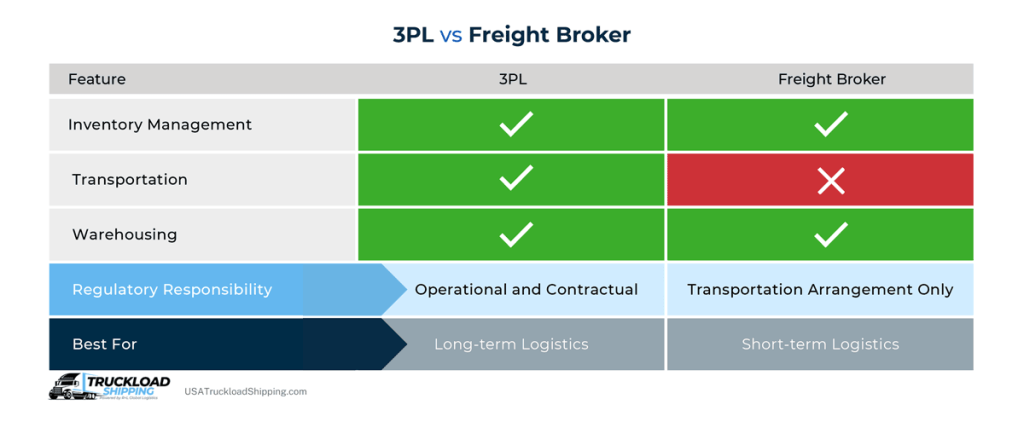
Essentially, 3PLs provide a broader range of logistics services based on the contractual needs of the shipper. Freight brokers only focus on coordinating shippers with carriers to move or store shipments.
However, both 3PLs and freight brokers must register with the Federal Motor Carrier Safety Administration (FMCSA) to obtain an authority number.
This includes:
In the next section, we’ll break down the differences in services between 3PLs and freight brokers.
Understanding the service differences between 3PLs and freight brokers can help businesses determine the best solution for their needs.
The following comparisons serve to illustrate three of the major differences between these roles.
3PLs provide the following services:
On the other hand, freight brokers are responsible for:
A 3PL may employ or work with freight brokers as part of its operations, but those operations encompass a number of logistics-related tasks, not just brokerage.
3PLs are full service logistics providers but are either asset or non-asset based. An asset-based provider gives shippers usage of their trucks and equipment to transport their freight. A non-asset based provider doesn’t own any trucks or equipment to transport shipments.
This means:
Unlike 3PLs, freight brokers don’t handle physical inventory. Instead, they make freight arrangements between shippers and carriers, negotiating rates and connecting the two parties to facilitate efficient shipping.
Shippers moving high quantities of freight on a routine schedule could benefit from contracted transportation with a 3PL. For one-time or occasional shipments, shippers may want to opt to work with a freight broker, instead.
Use a 3PL for:
Use a freight broker for:
Let’s examine some scenarios where a 3PL would be your best choice and others where a freight broker alone may be sufficient.
One major difference between a 3PL and a freight broker is how much of your logistics workflow each one helps manage.
A 3PL typically takes on a broader operational role. Depending on the relationship, it may manage inventory flow, warehouse processes, fulfillment steps, and transportation coordination. That makes a 3PL more suitable for businesses that want one partner to support several parts of the supply chain.
A freight broker usually plays a narrower coordination role. The broker helps connect a shipper with a carrier and arrange the movement of freight, but it does not usually function as the company managing inventory, warehouse operations, or full order fulfillment.
Choose a 3PL if your business needs ongoing logistics support beyond booking freight. A 3PL is usually the better fit when you need warehousing, inventory visibility, order fulfillment, returns handling, or multi-step transportation coordination.
Choose a freight broker if you mainly need transportation arranged. A broker is often the better option when you already manage storage and fulfillment internally and only need help finding capacity, negotiating rates, or moving occasional shipments.
The type of business you’re running can determine which option is best for you. We’ve listed some common business types that frequently use logistics services and matched them with the best provider.
A 3PL is typically the best choice for an e-commerce brand that needs storage, order fulfillment, returns handling, and shipping coordination across multiple orders.
A manufacturer may use either option depending on complexity. A 3PL works best for ongoing distribution support, while a freight broker may work well for occasional outbound shipments.
A seasonal business may benefit from a freight broker if shipping volume is inconsistent and warehousing is already handled elsewhere. If seasonal inventory and fulfillment are also problems, a 3PL may provide better support.
A distributor with repeat shipments, multiple SKUs, or warehouse demands often benefits more from a 3PL than a freight broker alone.
For businesses with recurring shipping, inventory, or fulfillment needs, a 3PL often provides more operational support and scalability. For businesses that only need transportation arranged, a freight broker can be a simpler option.
Call us today at (866) 353-7178 or submit a request for proposal online. We have the knowledge and resources you need for efficient, reliable storage and shipping.
Sources:
What is Operating Authority (MC Number) and Who Needs It?, Federal Motor Carrier Safety Administration, 2023
Broker Registration, Federal Motor Carrier Safety Administration, 2023
 Copy URL to Clipboard
Did you find this article helpful?
See more of our coverage on Google.
Add usatruckloadshipping.com as a preferred source!

R+L Global Logistics
315 NE 14th St., Ocala, FL 34470
