Consolidated freight is a shipping method that combines multiple small shipments into one load. Businesses often use consolidated freight for less-than-truckload (LTL), intermodal, and rail shipments. In this guide, you’ll learn what consolidated freight is, when to use it, how each shipping mode works, and how to lower costs without losing visibility or delivery control.
Consolidated freight is a shipping method that groups smaller shipments into one. Shippers transporting smaller quantities of freight opt to consolidate so they can reduce shipping costs by only using the needed space for their cargo.
Consolidated freight can move through several shipping modes:
We’ve provided a table that compares the different methods of transport used for consolidated freight shipments.
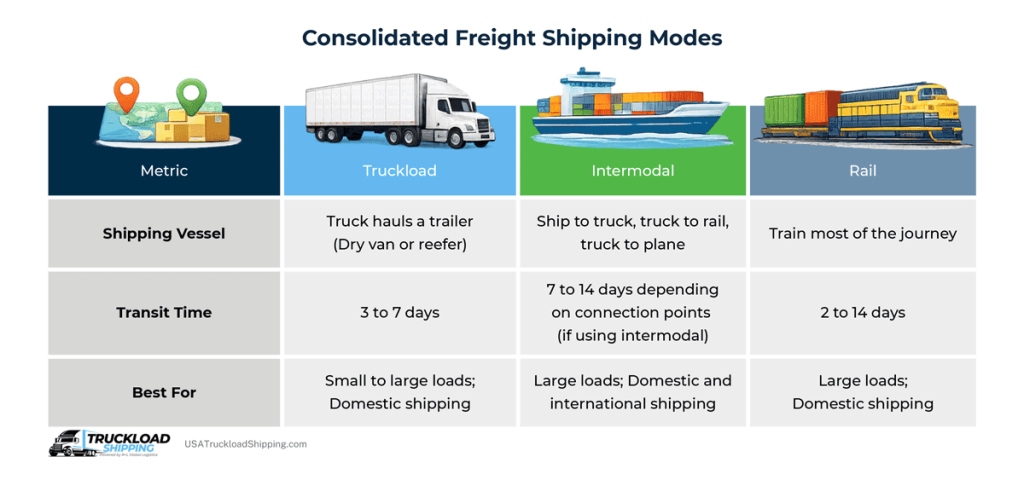
Consolidated freight shipments consist of items that are too large for parcel service, but too small to justify full truckload, full container load, or other dedicated capacity.
Consolidated freight is especially suitable for intermodal shipping when freight requires multiple connection stops on its way to its final destination.
Use consolidated freight when freight is:
In the next section, we’ll go over the various shipping modes you can use to deliver consolidated freight.
You can ship consolidated freight on various shipping vessels for faster local transit or coast-to-coast shipping. The best option ultimately comes down to the needs of your freight.
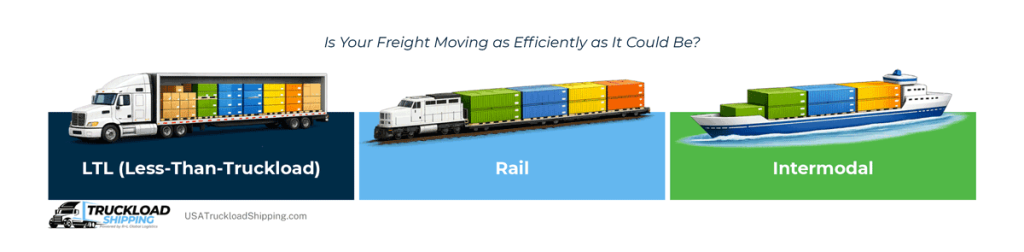
Less-than-truckload (LTL) is a shipping mode that consolidates freight from multiple shippers into one semi-trailer. LTL works best for palletized freight that is too large for parcel shipping, but too small to fill an entire trailer.
Semi-trailers used for LTL shipments are:
Consolidated freight can ride on either a dry van or reefer, as both have the capacity for large amounts of cargo.
For many LTL shipments, the shipper must provide accurate dimensions, weight, commodity details, and the correct NMFC code and freight class.
The National Motor Freight Traffic Association (NMFTA) states that the NMFC system standardizes how LTL freight is classified for rating and handling. Accurate classification helps reduce billing disputes, reweighs, and reclassification charges.
Intermodal is a shipping mode that delivers freight on multiple vehicles with multiple connection points. These connection points can be from a port to a warehouse to a distribution center using a ship, truck, and rail.
Intermodal shipping is used to move full-container loads (FCL) less-than-container-loads (LCL). LCL is a shipping mode where cargo is consolidated in one container on a ship in two to three pallets.
Intermodal shipping is best for long hauls. The shipping method also requires a chassis. A chassis is a skeletal steel frame with wheels, axles, and twist locks that’s designed to move containers. Using chassis trailers will result in an accessorial charge to your overall freight rate.
Rail is a shipping mode used to transport consolidated freight on a train for long-distance hauls. Shipping by rail can be a cost-effective transit mode for long haul shipments. Unless you’re shipping bulk materials, most rail freight will need to travel by truck to the final destination. This means LTL shipping is still necessary when using this mode of transport for consolidated freight.
Rail shipping can also be paired with rail drayage, which is a shipping mode that connects truck and rail to deliver freight. A truck picks up freight from a port or rail terminal to load onto a train before being shipped to its final destination.
We’ll discuss how to use each shipping mode to reduce shipping fees and streamline your company’s logistics in the next section.
Whether you’re shipping domestically via truck or internationally via intermodal, you can reduce your shipping costs by following our checklist.
Use this checklist to prepare your next consolidated haul for transportation:
No matter how you ship your consolidated freight, you’ll need a reliable logistics partner for each step of the way. We work with over 22,000 vetted carriers trained in various shipping modes to transport consolidated freight anywhere in the United States.
Whether your freight requires drayage services or expedited shipping, USA Truckload has the resources to streamline your freight transit of any size.
What we do:
Typical timeline: We start building your consolidated freight plan the same business day and coordinate pickup and transit based on your shipment’s ready date, lane, and service requirements. Transit times vary by mode, route, and appointment availability.
What you’ll need: Commercial invoice or BOL details, pallet count, dimensions, total weight, commodity description, pickup and delivery addresses, requested ship date, delivery requirements, and freight class/NMFC item for LTL shipments when applicable.
Why choose us: We help retailers, grocery companies, and ecommerce businesses book consolidated freight with experienced carrier coordination, mode-specific planning, and practical support that helps reduce delays, billing issues, and unnecessary shipping costs.
Outcome: Your freight moves through the right consolidated shipping network, arrives on schedule, and avoids preventable delays and added charges caused by incomplete shipment details or poor mode selection.
Get in touch with our consultants and call (866) 353-7178 or get a quote in just minutes.
A spot rate is a one-time freight rate for a single shipment. A contract rate is a long-term negotiated freight rate for shipments moved over a defined period. Both spot and contract rates are beneficial to shippers moving goods via truckload depending on carrier capacity, lane stability, and other factors. We’ll use our knowledge to explain how they work to secure the right truckload price for your business.
A spot rate is a one-time, “on the fly” truckload rate for a specific shipment in the current market. A contract rate is a negotiated, dedicated, and long-term truckload rate for continuous transportation over a specified period.
Spot rates are determined by the spot market. The spot market is used for one-off freight transactions priced against current supply and demand. Shippers, carriers, and brokers can monitor spot-market trends with freight data platforms like DAT.
The spot market reflects rates based on the following factors:
Shippers can assess the current rates to book a particular truck for immediate, one-time freight transportation, such as expedited shipments.
Contract rates are negotiated rates between carriers and shippers, or shipper and a 3PL. Shippers use contract rates to haul multiple freight shipments during a dedicated amount of time.
Contract rates help you stay on schedule and streamline your shipping. Most are negotiated for six months or longer, with a focus on your budget goals and consumer demand. This gives you peace of mind that your business is in good hands today and in the future.In simple terms, spot rates prioritize flexibility, while contract rates prioritize predictability. We’ve created a comparison chart below to outline the main differences between the rates.
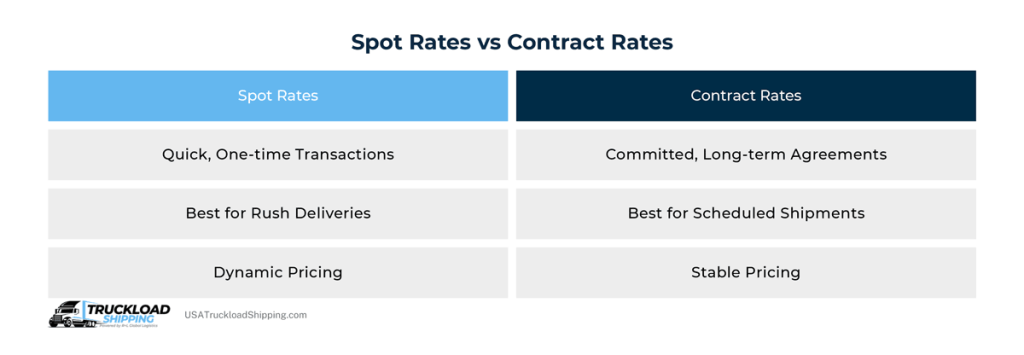
Let’s take a look at a hypothetical situation where a spot rate would be appropriate:
Picture one of your retailers requesting a rush delivery of mascara containers because they forgot to include the item in their last order. They need them as soon as possible for a beauty event in a few days. This is where spot rates are handy.
Now, here’s a hypothetical example where a contract rate would work best:
Let’s say you own a warehouse that ships beauty supply goods monthly to various retailers nationwide. You require reliable shipping to deliver freight to consumers who expect their cosmetic goods at the same time each month. In this scenario, a contract rate would be essential.
Spot and contract pricing respond to freight-market conditions, but they do so in different ways. Spot rates react faster to short-term changes in freight capacity and demand, while contract rates usually reflect long-term negotiations based on expected volume, service requirements, and lane history.
You can use trend tools to learn the current National Van Rates, as well as flatbed and reefer rates.
Spot rates are determined by the spot market, which is based on national pricing for loads at any given moment. The spot market, in turn, is dynamic and poses risks to shippers that affect their freight costs and overall supply chain.
We’ll review when to use this type of rate and how to avoid risks in the following sections.
Freight market volatility is common in the freight industry due to variables like fuel rates, carrier capacity, and seasonal demand that impact truckload rates.
A volatile lane is a lane that changes frequently in price and freight capacity.
For one-off moves, freight brokers or carriers review a lane’s history that best fits a shipper’s single load. Spot rates often rise on lanes with inconsistent volume, limited truck availability, or expedited pickup requirements..
Spot truckload rates run the risk of tender rejection and gaps in service due to lane volatility or the freight itself.
Tender rejection is a freight shipment that a carrier refuses to haul. Carriers might reject spot loads to secure contracted loads that pay more. Tender rejection also includes service variability as carriers may not have the available truck for a spot shipment.
Contract rates offer a predictable freight rate for both shippers and carriers to use when shipping goods. They work best when a shipper can offer repeat volume, forecast accuracy, and require lane consistency
Contract rates negotiate a set amount of freight a shipper needs a carrier to move each month or year.
For large shippers needing to ship high-volumes of freight every month, contracts help them secure dedicated lanes at their desired rate. This includes the required shipping mode, usually full truckload (FTL), and loading equipment, like liftgates.
Freight data is a wide-ranging analysis of freight industry trends in spot and contract rates, tender rejection information, fuel prices, and more.
Freight database tools like DAT or SONAR help shippers and carriers organize and clean up data to improve tender acceptance and offer shippers preferred contract rates.
Whether you’re relying on spot or contract rates for your shipments, use our checklist to ensure you’re asking your freight provider the right questions to get your load on the road.
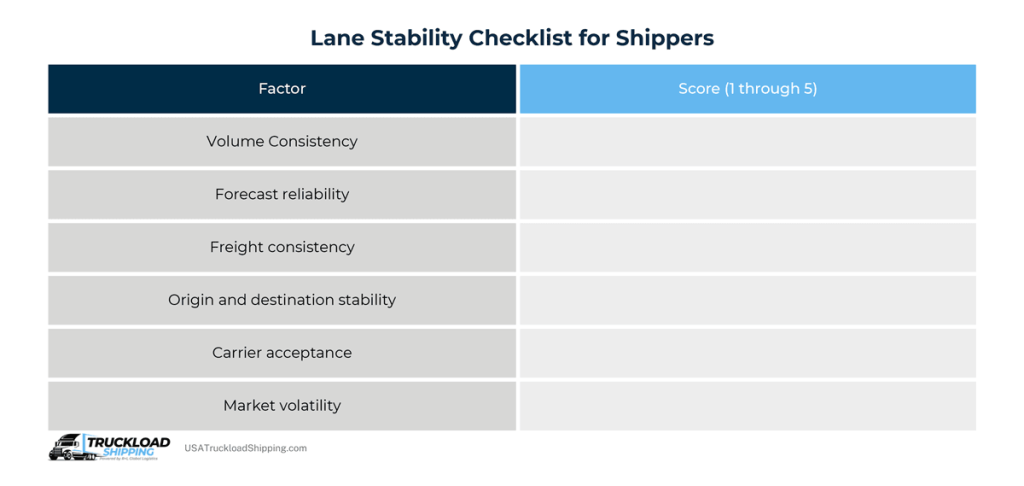
The total score determines the following factors:
In the next section, we’ll review how to navigate market shifts to secure lanes for your loads.
The freight market is ever-changing and spot and contract rates fluctuate when capacity is loose or tight.
Loose capacity means truck availability exceeds current shipper demand. In these markets, spot rates often soften, contract negotiations may become more favorable for shippers, and carrier options usually expand..
Tight capacity means truck availability is limited relative to shipper demand This increases spot and contract rates and reduces carriers’ resources, like trucks or drivers, to haul freight.
What we do:
Typical timeline: Our freight consultants review your freight details on a 1-on-1 phone call or quote request to deliver an estimated spot or contract rate for your load in minutes.
What you’ll need: Freight information (including size, temperature-control, hazmat, or fragile details), origin, destination, and timeline.
Why choose us: USA Truckload Shipping is a 3PL with a carrier network over 22,000, offering capacity and pricing matched to your shipping needs.
Outcome: Your load is secured with our experts who will provide a spot or contract rate to support your supply chain in any freight market.
Get in touch with our shipping experts at (866) 353-7178 or fill out a request for proposal to get started today.
What is a spot rate and a contract rate?
A spot rate is an “on the fly” truckload rate to book a lane for a one-time shipment. Spot rates are commonly used by small shippers who do not need dedicated lanes or contract rates to occasionally ship small quantities freight. A contract rate is a long-term shipping agreement between a carrier and a shipper to move high-volume freight each month or year.
Can high-volume shippers use spot loads?
High-volume shippers may benefit from using spot loads for freight that needs to be shipped urgently, or if they want to “test drive” a carrier’s services before committing to a contract rate.
Are contract rates worth the commitment?
Contract rates are beneficial to high-volume shippers who need predictable, stable rates and secured capacity. Spot rates offer quick solutions for urgent loads, but contract rates help shippers stay ahead on capacity forecasts and market shifts to keep their supply chain fluid.
There are a few ways to ship your products by truck, and sometimes it’s not so clear which transportation method is best when you know your freight won’t fill up an entire trailer. At USA Truckload Shipping, we’ve helped numerous businesses find the solution that’s right for them. In this article, we’ll cover how to determine whether a partial truckload is best for your next shipment, along with the benefits it offers.
In our opinion, PTL is the perfect middle ground between FTL and LTL. Where FTL uses an entire trailer for its cargo and LTL shares trailer space between multiple shippers, partially filled truck shipments also use a shared trailer—but other businesses’ shipments are only included if they are headed in the same direction.
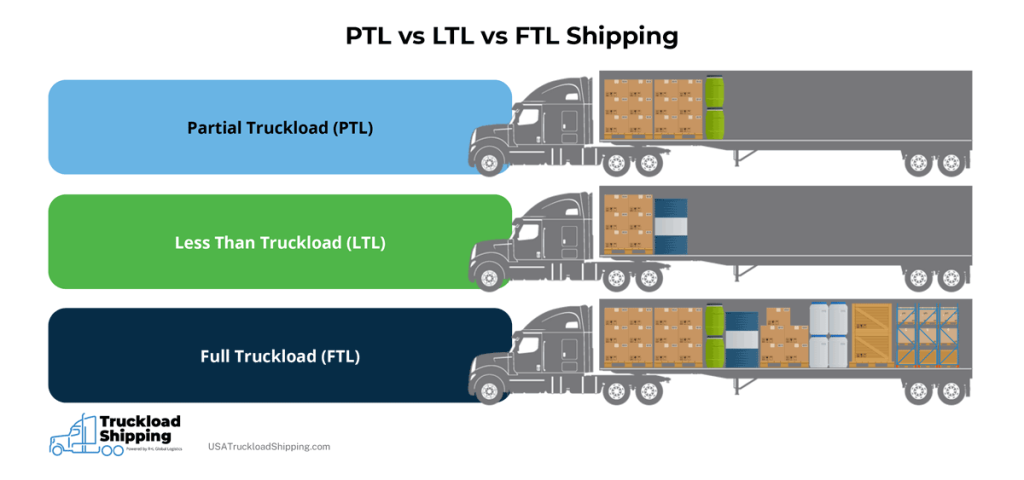
Looking at the image above, it’s easy to see how PTLs maximize truck space. We’ll break down the best cargo to use for partially filled truck shipments a bit later, but for now, keep in mind that PTL shipping is ideal for freight that is:
With that in mind, freight that is not ideal for PTL shipments is:
If your cargo is large but won’t require a full 53’ trailer's worth of space, we believe a PTL is the way to go. Now, let’s dive into how this shipping method can complement your logistics needs.
If your cargo is large but won’t require a lot of space in a truck, we believe a PTL is the way to go.
Now, let’s dive into how PTL shipping can complement your logistics needs.
Related Article: PTL vs FTL Shipping: Key Differences for Shippers to Consider
PTL shipping offers a great deal of benefits when you compare it to LTL or FTL shipping. Here are the top three partial truckload benefits we believe are ideal to take advantage of for your shipping needs.
When it comes to shared truckloads, you won’t have as much truck space as a FTL, but you’ll have more than a LTL. Plus, the price of that space and the weight of your freight is what you pay, versus paying according to freight class. That’s why we recommend going with PTL shipping if you know your freight will not take up a full trailer, or if it’s too large for a less-than-truckload.
Because PTL shipments are around 4 to 20 pallets of freight, often preferred for uneven-sized cargo, you can make the most of the space you occupy in a truck. You only pay for the space that you’re using, so there are no extra fees for transportation.
Since partial truckload shipments include a variety of businesses’ loads headed towards the same destination, this can bring down fees like the cost per mile and freight class if your cargo is large but not heavy. With the freight combined on one truck, this can mean fewer stops and handling, which reduces the chance of your freight being damaged.
If your load needs to arrive at its destination within a particular timeframe, PTL vs LTL shipping offers time-sensitive and swift transfers.
As we mentioned previously, PTL shipments are only grouped together when they’re going to the same destination or general area, minimizing cross-docking and reducing stops at freight terminals. Your freight gets from point A to point B faster and easier.
We mentioned earlier how the shape and weight of your freight can impact the cost of your shipment, so let’s jump into what types of cargo work best for a partial truckload.
While there is an assortment of requirements for freight transportation, such as correctly palletizing your freight or filling out a bill of lading, when you opt for PTL shipping, it’s important to keep an eye on the weight of your freight.
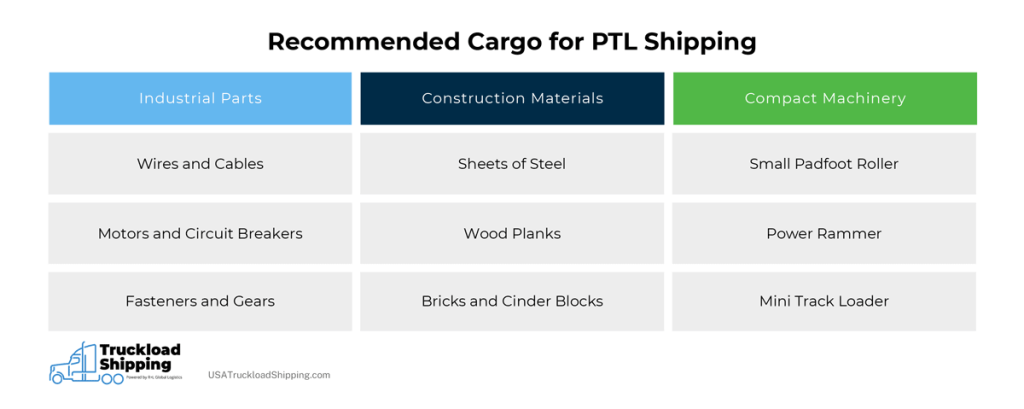
Since there’s no freight class to worry about as you would with LTL shipping, you’ll just need to consider how heavy and large your load will be. Partial truckload shipments are between 5,000 to 40,000 pounds, so let’s take a look at some ideal cargo for partial truckload shipping:
You can save on space and costs by choosing the right packaging for your freight.
This list can include many more types of cargo, however, the goal is low density freight. Think “large and light.”
If you’ve decided that a partial truckload will best suit your shipping needs, you’re already in the right place to get your cargo where it needs to go.
At USA Truckload Shipping, we provide simple logistics solutions that make the most sense for your partial truckload shipment and other shipping needs. This includes expedited, hazmat, and white glove transportation.
We’re ready to help you with your freight transportation—no matter the size of your cargo or business. Give us a call at (866) 353-7178 or get in touch with our team by visiting our contact page to learn about our other services.
Shipping an engine? We can help. We’re a team of freight experts who transport cargo like car engines throughout the US. Whether you’re shipping to an auto repair shop or to your home garage, here’s how we move to simplify your logistics for success.
Car engine shipping costs rely on a handful of factors, like your region’s dry van rates, distance, fuel costs, and other trucking industry market trends.
While LTL loads can be more cost-effective than FTL loads, the easiest way to calculate your engine shipping costs is to fill out a quote with your exact transport needs.
Our five step quote form gets you a simple truckload quote for one-time shipments in just minutes. If you’re looking for long-term engine shipment solutions, complete our Request for Proposal form to get started.
Car engines require heavy duty crates or pallets to secure the cargo without shifting during transport. Our freight drivers are trained to handle your engine shipment with care while loading and unloading.
We have a variety of equipment to expertly manage your haul, including:
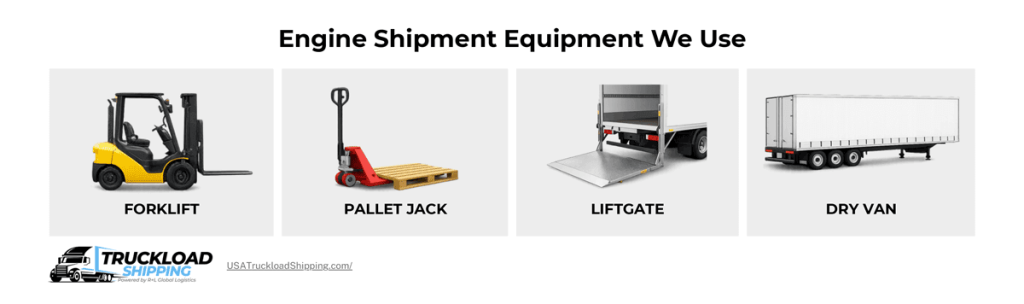
Whether you’re shipping just up the road or cross-country, our network of over 22,000 carriers can accommodate your haul of palletized freight or crated for easy engine shipping.
Related: Pallet Transportation: When To Use It and How
We can provide less-than-truckload (LTL) or full truckload (FTL) for your engine shipments. Our carriers have the capacity to move small engine shipments or high-volume engine shipments anywhere in the US.
The infographic we’ve provided shows the pros of LTL and FTL.
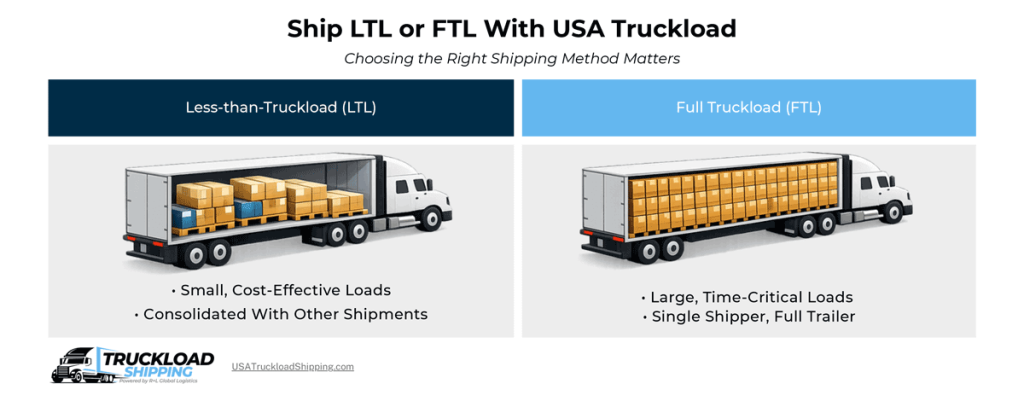
Ultimately, FTL is better for high-volume shipments and LTL is best for smaller shipments. If your engine shipment better fits a LTL, you’ll need to know your NMFC code prior to transport. Our freight consultants will classify your freight and its code to speed up the paperwork and shipping process.
Ohio and Michigan are major centers for automotive manufacturing, creating consistent freight demand for engines, transmissions and other vehicle components. We coordinate freight shipping to and from Ohio for assembly plants, parts manufacturers, machine shops and repair facilities throughout the state.
Our network also supports freight shipping to and from Michigan, including automotive hubs such as Detroit and Lansing. Whether you’re moving a single replacement engine or multiple palletized engines for production, we can match your shipment with an LTL or FTL carrier equipped to transport it safely.
Based on our internal TMS data, we ship throughout the US to any destination with a 99.5% on-time delivery rate. Our freight carriers are available in a town near you to ship your engine to:
Need your engine shipped fast? We also provide expedited shipping to get your engine on the road and delivered in under three business days.
Whether you’re moving engines intrastate or coast-to-coast, we ship it. Talk with our freight experts to book your quote by calling (866)-353-7178 today.
A sweet potato is a starchy vegetable that can be shipped fresh, canned, or frozen. Sweet potatoes must be transported according to the Food Safety Modernization Act (FSMA), a law enforced by the Food and Drug Administration (FDA). FSMA regulates the vehicle conditions sweet potatoes and all foods are delivered in to prevent contamination and foodborne illnesses. This guide will explain how to ship sweet potatoes by truckload to comply with FSMA.
The U.S. Food and Drug Administration enforces the Food Safety Modernization Act (FSMA), which sets sanitary transportation requirements for food moved in commerce. For sweet potato shippers, that means using clean equipment, documenting handling expectations, and matching trailer conditions to the product being shipped.
Under sanitary transportation rules, carriers and shippers should coordinate on equipment cleanliness, prior-load risk, and temperature needs when a shipment requires temperature control.
FSMA requires carriers to:
While it’s a carrier’s responsibility to ensure their trucks are sanitized and drivers practice food-safe operations during loading and transit, shippers must ensure the product is pest and disease free and packaged for safe shipping.
Sweet potatoes are shipped in high-quantities as fresh, frozen, or canned. In any form, here are the best practices to ship sweet potatoes to maintain quality and remain FSMA compliant.
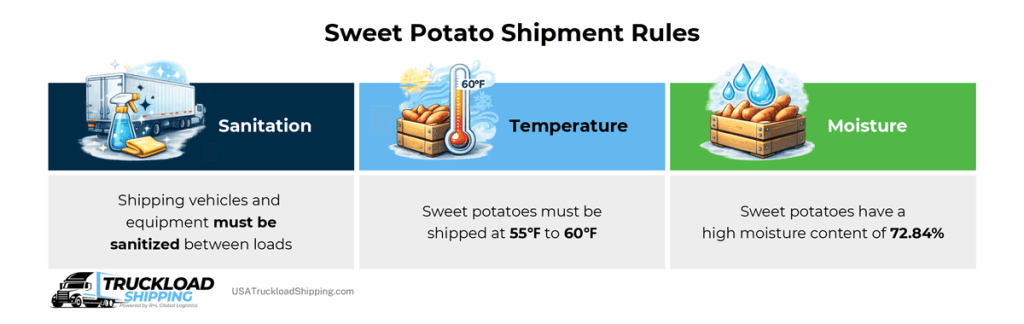
Sweet potatoes have a high moisture content percentage of 72.84%. This makes them prone to bruising and rotting if humidity and temperature levels aren’t stable during transit.
Curing sweet potatoes is a process to extend their shelf life and gives them a sweeter and more full-bodied taste. It also allows the sweet potatoes to heal from any damages incurred from the harvest process.
To cure, sweet potatoes are left in an environment of about 85℉ and 90% relative humidity for several days. After almost a week, the sweet potatoes are then cooled and processed for shipping.
While some sweet potato products, like frozen diced sweet potatoes, require a reefer trailer control temperature, a dry van is typically acceptable for large sweet potato shipments.
The Tar Heel State is a major producer of sweet potatoes. The state's temperate climate means you'll need an experienced partner when shipping freight from North Carolina.
We’ll review the best shipping modes for sweet potatoes in the following next section.
FTL shipping is usually the best fit for high-volume sweet potato freight moving from farms, packing facilities, or food suppliers to distribution centers, wholesalers, or grocery chains.
FSMA requires trucks to be cleaned before and after each shipment to eliminate contamination risks. In some cases, your customers may need a rush delivery to ensure the sweet potato freight arrives in quality condition.
We’ll break down how to use FTL and expedited services to ship sweet potatoes for logistics success.
FTL is a shipping mode that fills an entire semi-trailer (dry van or reefer) with one shipper’s freight. Sweet potato shippers use FTL when they need lower handling, faster transit, and more control over trailer conditions.
FTL shipments are best used for:
Whether you’re shipping bulk sweet potato freight locally or across the U.S. like from Mississippi to Texas, FTLs can haul both a dry van or reefer trailer to deliver your goods safely and remain in FSMA compliance.
Expedited is a shipping mode for FTL and less-than-truckload (LTL) freight. Sweet potato shippers may use expedited service when a retailer has a tight delivery appointment, a replenishment order is urgent, or product quality could decline if transit is delayed.
We offer both shipping modes through our network of over 22,000 carriers who are FSMA compliant and ready to ship your sweet potato freight.
Since some sweet potatoes may require temperature control, we recommend using this checklist to get ready for your next haul:
Now that you know how to protect your sweet potatoes on the road, let’s look at how to process and package them.
A sweet potato grading standard is a food grade shield regulated by the U.S. Department of Agriculture (USDA). This grade shield helps shippers to prepare sweet potato shipments to preserve the quality and avoid foodborne illnesses during transit.
There are five sweet potato grading standards:
For truckload shipping, grading matters because lower-grade products may need tighter inspection and packaging controls to prevent claims related to bruising, decay, or rejected deliveries.
You should ensure a thorough inspection process is conducted to detect signs of mold, decay, and pests before packaging. Once you have determined the grade of your sweet potato freight, you can prepare them for shipping.
Sweet potatoes are commonly packed in cartons, bins, bags, or retail-ready containers before palletization. The right packaging format depends on whether the shipment is bulk produce, retail distribution freight, or a processed sweet potato product.
Palletized freight is a packaging method to transport bulk freight on a sturdy, flat surface. You can stack boxes of sweet potatoes on pallets to optimize the space. Stable pallets reduce handling damage to sweet potatoes, improve loading speed, and make it easier for receivers to unload the shipment with forklifts or pallet jacks.
A 53-foot dry van or reefer trailer often carries around 26 standard pallets in a single layer, but actual capacity depends on pallet footprint, carton dimensions, product weight, and whether double-stacking is allowed.
We’ve created a chart of the packaging materials needed to ship sweet potatoes in high-quantities.
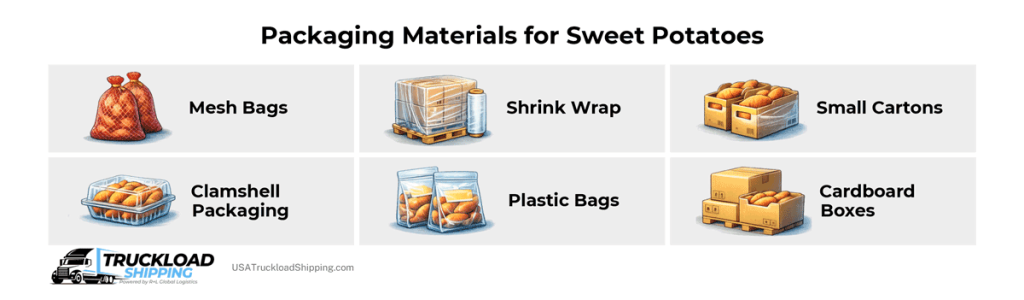
To reduce damage during transit, sweet potatoes shouldn’t have a lot of space to shift around in the box or container. Make sure your containers are going to hold up in high-humidity environments, since things like certain wood and cardboard lose their strength as they get damp.
Your carrier will be able to easier load and unload your palletized freight with pallet jacks or forklifts to speed up the overall transportation.
If you need help shipping sweet potatoes, you can count on us. If you’re ready to start shipping sweet potatoes, or anything else, give us a call at (866)-353-7178 or reach out to us on our contact page.

R+L Global Logistics
315 NE 14th St., Ocala, FL 34470
