

See more of our coverage on Google.
Add usatruckloadshipping.com as a preferred source!

Freight capacity is the supply of available trucks and drivers at a given time. When capacity tightens, tender rejections rise, lead times increase, and spot rates climb. We’ll dive into these market issues and how both small and large shippers can keep their supply chain flowing successfully in any market.
Freight capacity is the availability of carriers, drivers, and equipment to cover shipper loads on specific lanes. A capacity issue is a market condition where shippers cannot secure a truck at the service level they need.
Freight capacity determines which cargo carriers can ship on time. If there are trucks available but you can’t find a carrier or driver with a rate in your budget to get your goods into the back of an 18-wheeler, then you’re basically stuck at a standstill.
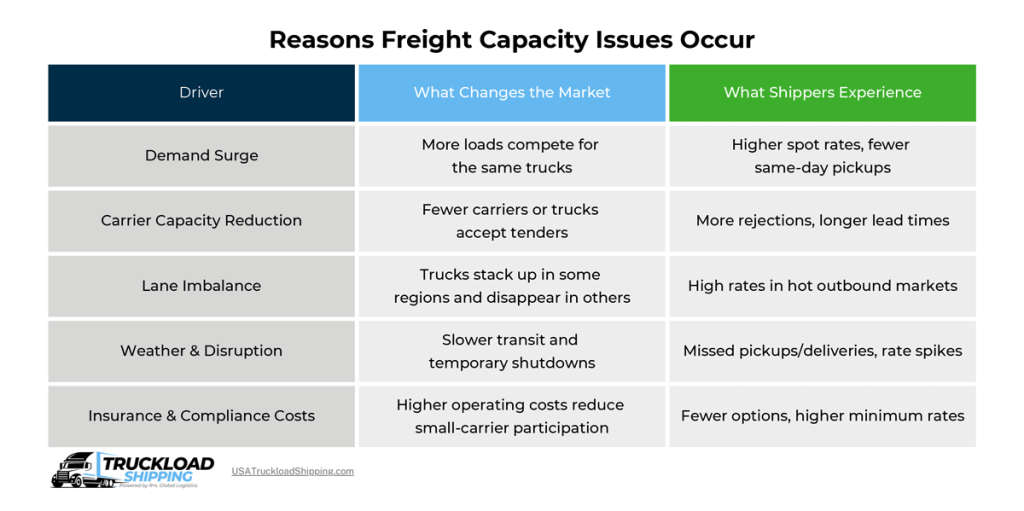
Freight capacity issues arise when one or more of the following events impact the freight market.
Other factors like weather, tariffs, and global pandemics can also tighten or put a strain on the freight industry. In this article, we’ll focus on common freight capacity issues in the U.S. and how shippers small and large can secure their freight.
First, let’s dive in with a closer look at each reason from the chart we’ve provided so you have a better look at what affects the freight market at any given time.
The freight market is a dynamic supply-and-demand-driven ecosystem where shippers pay carriers to transport goods. It tracks trends like the prices of dry vans, spot rates, and fuel.
Shippers feel a tight market when carriers decline tenders, pickup windows slip, or rates rise faster than budgets. These outcomes usually trace back to spot market shifts, carrier availability changes, or equipment imbalances.
These factors mainly include:
Each factor individually would tighten the supply, but all of them together can cause some real problems for shippers needing to move freight.
Let’s look at the individual issues for clarity on what causes them and how to navigate them under any market condition.
A spot rate is a freight rate available for one-time or urgent shipments. Spot rates spike primarily during holiday seasons where demand increases to ship goods across the country.
Spot rate signals to watch:
We’ve provided a data table showing how spot rates are affected by seasonality.
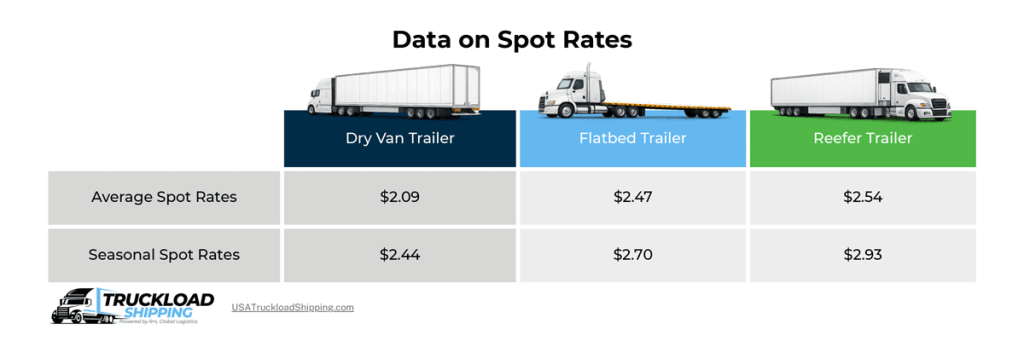
Disclaimer: This data is based on general spot rate prices according to current DAT Freight and Analytics Trendlines. Spot rate prices are per mile and fluctuate according to region and trailer type.
While they usually dip after a holiday rush, adverse events like severe weather can keep spot rates high, affecting shippers who buy truckload capacity on the spot market, especially on short notice or in tight outbound regions.. However, spot rates are also available for full truckloads (FTLs) and intermodal.
Large shippers moving high-volume freight don’t normally rely on spot rates, but instead contract rates which lock in favorable, long-term rates with a carrier or third-party logistics (3PL) provider they’ve built a relationship with.
Truck overcapacity is a market condition where available trucks exceed shipper demand on a lane or region. Overcapacity usually pushes spot rates down and increases carrier competition.
This leads to freight downtime. This is when commercial vehicles are halted, non-operational, or prevented from moving cargo. This can occur when trucks undergo scheduled maintenance, carriers are booked to capacity, or when loads are stuck on the road.
Freight downtime can also happen for the following reasons:
Trucks not able to get on the road isn’t only a result of lane accidents and weather.
If shippers aren’t able to secure their load on a truck due to high prices, or if their shipment gets trapped on the road due to unsafe weather conditions or road closures, capacity tightens for drivers trying to pick up their next load.
Carrier availability is the amount of motor carriers available to move your load at a given time, price, and service requirement.
The freight market tightens when there’s a shortage of carriers or carriers are booked to capacity and can’t take another load.
Carrier shortages happen when:
Whether a carrier company is small or large, every carrier must work within market prices and comply with FMCSA’s regulations. Unfortunately, this can put a crunch on particular carriers who aren’t booking enough lanes to cover business costs.
Fortunately for you, we work with over 22,000 carriers across the U.S. who are FMCSA-compliant and have reliable availability to haul your goods, no matter the freight market conditions.
How we evaluate capacity:
“We are leaning into our core carriers, those who have gone through our rigorous compliance checks, established lane history, and a great carrier score. Our aim is to continue to beat the tight market by utilizing our relationships and leveraging our data.” — Logan Randolph, Ops Manager
Shippers can keep their supply chain running smoothly during any freight market by doing the following:
Shippers have the option to study freight market trends on their own, or save time and spare the headache by working with a 3PL to do the heavy lifting for them.
Here’s how to simplify freight capacity issues to get your goods on the road without delay.
Freight rates for dry van, reefer, and flatbed trailers vary regionally and seasonally. They also vary based on the size of your haul, such as LTL or FTL.
You can use tools like our National Dry Van Rates tracker for the latest rate.
Spot rates are best for quick or one-time shipments, or shippers wanting to try a carrier’s freight services before committing to a contract rate.
Because spot rates are heavily influenced by weather and fuel rates, contract rates are the better choice for consistent rates and lanes to keep your freight moving.
A 3PL is a logistics company that sources capacity, manages carriers, and coordinates shipping operations for shippers. Some 3PLs also offer warehousing or asset-based capacity, depending on the provider.
Working with a 3PL will improve your odds of securing reliable freight rates and lanes for your goods no matter the freight market, or if you’re shipping LTL or FTL. USA Truckload is a 3PL capable of transporting goods for you and finding the right carrier for your freight.
Whether you need expedited or hazmat shipping services, our team is able to avoid freight capacity issues and manage your loads with our freight capacity experts at your service.
“By aligning carriers, sales, and leadership with real-time market intelligence, we stay proactive, protect profitability, and keep freight moving efficiently, even in tight markets.” — Cameron Burton, Capacity Operations Manager
Freight capacity issues aren’t a concern when your logistics are handled by our trained freight team. We prioritize your shipments and communicate our strategy for your supply chain success every step of the way.
Call our freight consultants at (866)-353-7178 to get started. Ready to ship your haul? Submit your Request for Proposal (RFP) here.
 Copy URL to Clipboard
Did you find this article helpful?
See more of our coverage on Google.
Add usatruckloadshipping.com as a preferred source!

R+L Global Logistics
315 NE 14th St., Ocala, FL 34470
