An accessorial charge is a truckload service fee carriers add on to a shipper’s final freight bill. This guide is for freight shippers to learn the most common accessorial charges and avoid supplemental truckload fees.
Accessorial charges are extra freight fees added when a truckload shipment requires services beyond standard pickup and delivery. Carriers usually apply them for delays, special equipment, failed delivery attempts, limited site access, appointment issues, or fuel-surcharges.
Accessorial charges vary from company to company, with fees ranging from as low as $25 per charge to as high as $1,000 per charge. Accessorial charges vary by carrier, shipment type, lane, and service requirement.
Some are flat fees, while others are billed hourly, daily, or as a percentage of total freight cost. Shippers should confirm likely fees before booking to avoid invoice surprises.
Most accessorial charges fall into six groups. The fee depends on what changed during the shipment, how long the disruption lasted, and whether the carrier had to provide extra labor, equipment, or capacity. We’ve provided a graphic showing the different categories of accessorial charges.
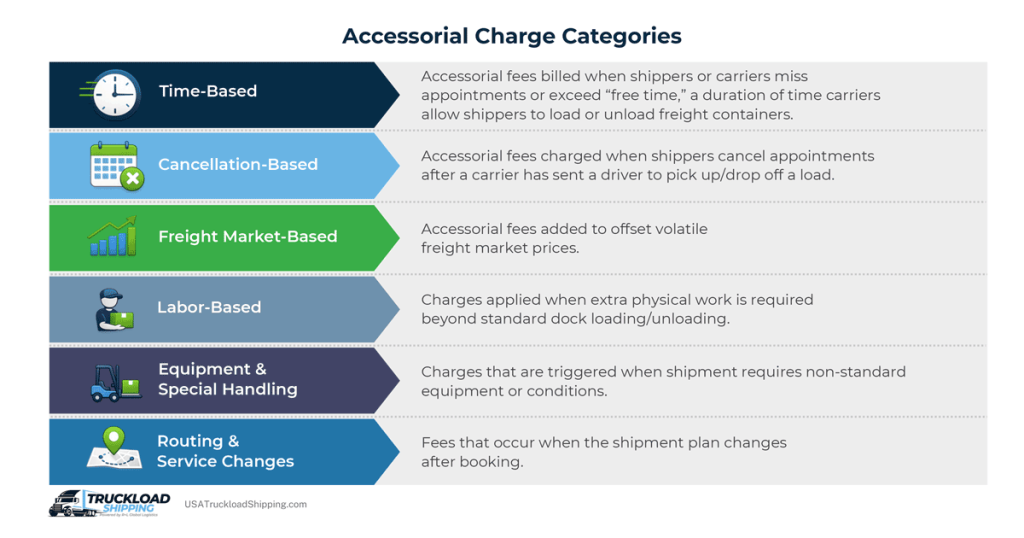
Shippers should ask about a carrier’s freight add-on charges prior to booking a load to verify the cost range and include them in their freight budget.
In the next section, we’ll review the various types of accessorial fees you may encounter.
There are numerous accessorial charges that can occur during truckload transportation. We’ll cover each one in the following sections.
Detention, also known as per diem, is a truckload accessorial charge billed when a shipper or receiver holds shipping containers longer than the allotted free time outside a port of entry. This applies mainly to port-related container moves. Demurrage is a similar fee for holding containers inside the port.
Most shipping contracts allow for a standard amount of “free time” to load or unload freight from shipping containers. However, if a driver is held up beyond the free time (usually one to two hours) specified in the contract, a detention or demurrage fee is applied to a shipper’s freight bill.
If you know that a shipment may be held for longer than allowed, you may be able to negotiate an increase in free time or pay a lower cost upfront. Note that a truck that is not actively in transit can still incur detention or demurrage charges if a shipper holds containers, or other equipment, beyond free time.
A limited access fee is charged when a truck cannot reach a pickup or delivery site through a normal commercial route. This usually happens when entry is restricted, dock instructions are unclear, or the location requires extra time, routing, or coordination.
Scenarios that result in a limited access accessorial fee include:
Shippers should inform carriers of a limited access area prior to pickup or delivery so they can add this charge to their freight bill ahead of time and reduce delivery delays.
A liftgate service fee covers the use of a hydraulic platform to load or unload freight when no loading dock is available. This charge usually applies when shipments are heavy, the site lacks dock equipment, or the liftgate requirement was not included in the original quote.
Most semi-trailers don’t include liftgates unless they’re required for a specific delivery, like oversized freight shipments or deliveries made to receiving locations without loading docks. Your carrier will need to stop the pickup or delivery and reschedule if your freight requires a liftgate that wasn’t specified in the freight quote. This delay will incur additional charges.
If your shipment exceeds 150 pounds or your location does not have a loading dock, ask your carrier to include a liftgate service in your freight quote to avoid delayed transportation.
An inside delivery fee applies when the carrier must move freight beyond the loading dock, front door, or receiving area. The charge increases when the shipment requires extra labor, manual handling, stairs, or movement into a specific room or floor. Inside deliveries may also require additional time or drivers to hand-carry inside.
Inside delivery fees range from $50 to over $300 depending on where the freight needs to be moved to or from. To avoid surprise charges, request inside delivery in your freight quote if your shipment requires special handling.
Storage is an accessorial fee to store freight for a limited time. In truckload contexts, this usually appears when a delivery is delayed, freight is held at a terminal, or a shipment cannot be received as scheduled.
A storage fee is a separate charge from a warehouse fee. Storage charges are for short-term holds for small quantities of freight, and warehousing is long-term storage for high-quanties of freight.
Scenarios where storage accessorial fees may apply are:
Shippers can use a transportation management system (TMS) to digitally monitor shipment status and avoid surprise storage fees.
TONU is a cancellation fee charged when a carrier has already assigned equipment or a driver to a shipment and the load is canceled outside the allowed cancellation window.
Load cancellations can happen when a shipper accidentally books two carriers for one shipment, or orders the wrong truckload shipping mode for their haul.
TONU charges range from $150 to $500 for load cancellations made outside of the cancellation window. Load cancellation windows are typically 24 hours before the scheduled pickup, but they vary from carrier to carrier.
A redelivery is an accessorial charge to deliver freight after the initial delivery attempt failed. In truckload contexts, this usually appears when the receiver is unavailable, rejects the shipment, or lacks the equipment needed to unload the trailer.
A carrier might need to redeliver your freight for the following reasons:
To avoid a redelivery fee, shippers should confirm pickup/delivery appointment times and prepare necessary unloading/loading equipment, like forklifts or pallet jacks.
A layover fee compensates a carrier when a driver loses productive time waiting too long for the next shipment step. It usually applies when pickup or delivery is delayed long enough to disrupt the driver’s schedule, hours, or next assigned load.
Situations that trigger layover fees include:
Keep in mind that layovers may result in a redelivery accessorial charge if a driver isn’t able to complete a shipment on the first attempt.
An additional stop fee applies when one shipment requires multiple pickup or delivery locations. This charge is more common in LTL than full truckload, but it can also apply in truckload shipping when the route includes planned or unplanned extra stops.
Additional stop charges can apply to less-than-truckload (LTL) shipments. LTL shipments are consolidated loads sharing one truck. If your shipment requires unplanned stops that delay the other freight’s delivery schedules, carriers will charge to recoup the loss of production.
An additional stop is a freight add-on charge for shipments that have two or more destinations. This charge is more common in LTL than full truckload, although it can apply in either mode depending on the shipment plan. If a driver is required to make multiple stops to complete a single shipment, the carrier may apply an additional stop fee.
A driver assist (or driver load/unload) is a fee when a driver works outside of their general labor to load/unload freight. Truck drivers typically deliver no-touch freight, but the driver is paid if they are tasked by the carrier or distributor to use a pallet jack or hand-load or unload freight. A driver assist fee is around $100 to $150 per assist.
While a distributor may require occasional assistance from a driver, lumper services and lumper fees are generally used to handle cargo at a distribution center. A lumper fee is an accessorial charge to pay third-party laborers hired by a distributor or shipper to load and unload freight with loading equipment like forklifts and pallet jacks.
Driver assist fees apply to freight deliveries the driver was not assigned to help load or unload. If you’re unsure as to whether or not the driver is responsible for loading and unloading freight, ask your carrier before finalizing your shipment.
A freight class is a National Motor Freight Traffic Association (NMFTA) standard to classify LTL shipments. Freight classifications are paired with National Motor Freight Classification (NMFC) codes, which are also determined by NMFTA.
LTL shipments require freight class and NMFC codes. Shippers obtain this information from their freight’s weight, density, and handling requirements. Freight classes range from 50 to 500 levels: The lower the freight class number, the easier freight is handled and cost-effective to ship.
If shippers fill out a Bill of Lading (BoL) form with the incorrect freight class, NMFC code, or weight, the carrier will bill a freight reclass/reweigh accessorial charge, costing the shipper up to $50 per reclass/reweigh.
An after-hours delivery is a fee to pick up or deliver freight outside of a receiving location’s operating hours. Carriers might struggle to drop off or pick up freight before or after business hours due to unavailable staff or obstructed freight routes from weekend traffic.
Sending a truck to a facility outside of its normal operating hours will usually cost a shipper between $75 to $150 per delivery.
A fuel surcharge is an extra fee carriers use to offset changes in diesel prices. The amount usually rises or falls with market fuel costs and may be calculated using a carrier schedule, base rate formula, or published fuel index.
A carrier’s surcharge pricing structure is based on the average price of fuel in the United States. The U.S. Energy Information Administration (EIA) publishes national fuel rates each week. This information allows carriers to calculate a fuel surcharge to cover a shipment’s mileage from its origin location to final destination.
For example, if the average cost of fuel is $2.75 per gallon, a carrier may charge a surcharge range of $2.76 to $3.25 depending on the load’s distance.
Does your freight bill include an unexpected accessorial charge? We’ve provided a graphic to show you how to avoid the accessorial charges and protect your freight budget.
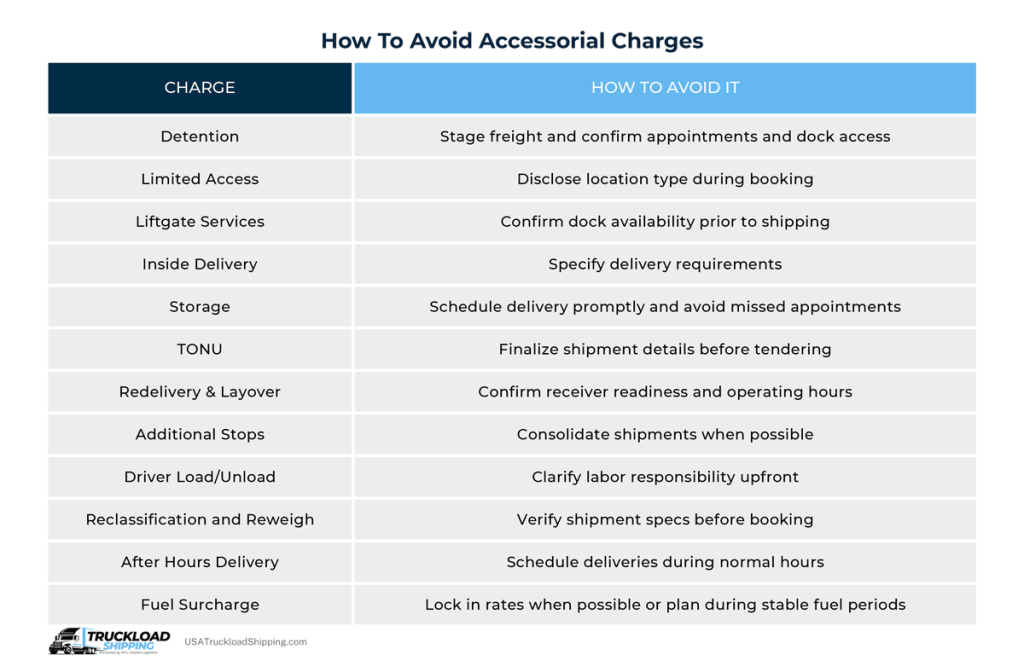
When a shipper follows these practices, they become a shipper-of-choice and can negotiate budget-friendly freight quotes with their carrier. Navigating accessorial charges with your carrier starts and ends with clear communication about your shipment, service expectations, and a reliable freight professional on your side.
At USA Truckload Shipping, we plan out your shipments carefully to ensure you don’t encounter any unwanted charges. Explore the services we offer and select the one that’s right for you. Call our team today at (866) 353-7178 to speak with a freight shipping expert. You can also contact our freight team with your questions.
Sources:
Petroleum & Other Liquids, U.S. Energy Information Administration, 2026

R+L Global Logistics
315 NE 14th St., Ocala, FL 34470
