

See more of our coverage on Google.
Add usatruckloadshipping.com as a preferred source!

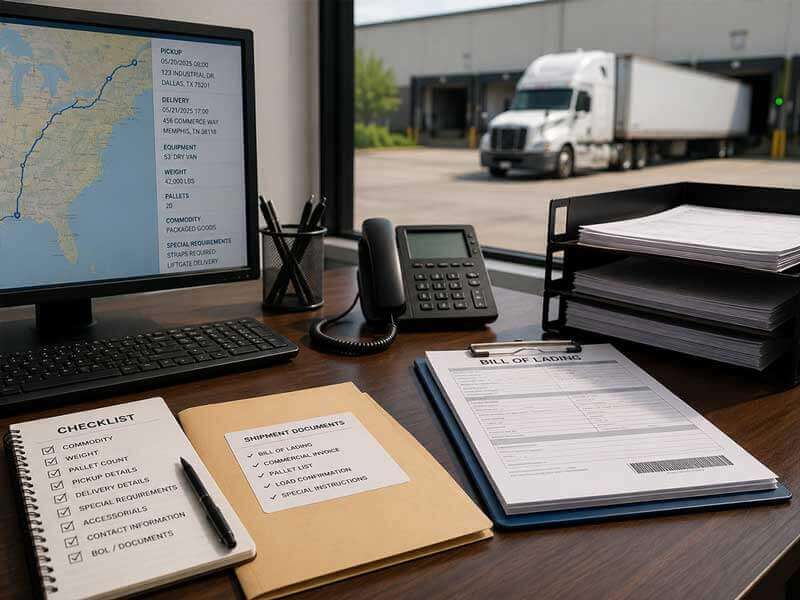
FTL shipment requirements are the shipment details, documents, and pickup conditions a carrier needs before dispatch. To book a full truckload move, shippers need to provide the commodity, total weight, pallet count, pickup and delivery details, and any special handling requirements.
A full truckload (FTL) shipment is a single-shipper load that occupies an entire trailer. To book an FTL shipment, shippers must provide the commodity, weight, and pallet count so the carrier can price the load accurately and plan for handling requirements.
Carriers require total shipment weight, dimensions, and pallet count before pickup because these inputs determine trailer selection, legal payload limits, pricing, and loading plans.
FTL shipments may travel in trailers such as a:
According to federal gross vehicle weight rating (GVWR), dry vans can typically haul up to 45,000 pounds of freight, while reefers can typically haul up to 44,000 pounds due to the added weight of their insulation and refrigeration units.
While GVWR is determined by the commercial vehicle’s manufacturer, the U.S. Department of Transportation (DOT) is an agency that regulates commercial vehicle weight requirements for freight transportation safety. DOT ensures carriers comply with each state’s specific truck size and weight limit laws for commercial vehicles and full truckload hauls.
An FTL load may use most of a trailer’s space or weight capacity, depending on the number of pallets and the freight’s dimensions.
Pallets can be stacked to use more space in a truck if palletized freight won’t be damaged in the process. Both dry vans and reefers can fit up to 52 stacked pallets.
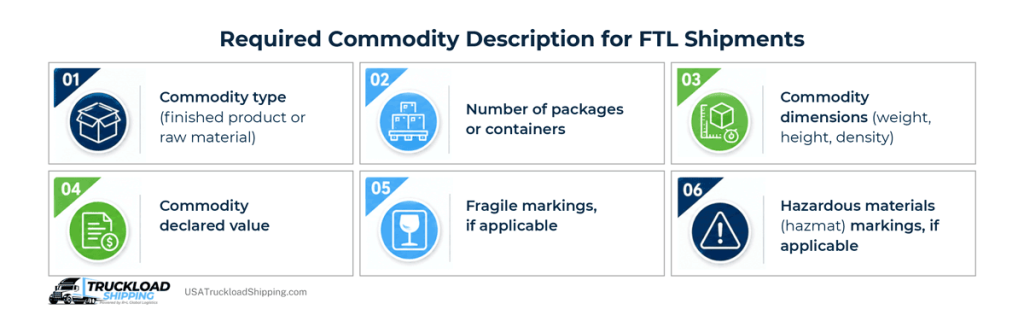
Carriers need a detailed commodity description so they can price the load correctly and confirm handling, securement, temperature-control, or hazmat requirements.
Whether you’re shipping non-perishable freight on a dry van or temperature-controlled freight on a reefer, you’ll need to provide your carrier with the following commodity descriptions:
A shipper’s freight weight, dimensions, pallet count, and commodity description are initially outlined in a freight quote. A freight quote is a request for truckload shipping rates. Shippers must request a quote from a carrier or third-party logistics (3PL) provider so the freight professional can recommend a shipping plan and provide pricing.
Once the shipper and carrier or 3PL agree on the strategy and price, the two parties outline the FTL shipment details in a Bill of Lading (BoL).
Shipping documents like the Bill of Lading outline record keeping, hazmat compliance, and freight insurance details.
The most common FTL shipping documents are:
While several documents may support an FTL shipment, the Bill of Lading is the primary document carriers use to confirm the freight details, pickup terms, and handling requirements.
A Bill of Lading (BoL) is a freight shipping contract between a shipper and carrier or 3PL. The BoL outlines both the shipper and freight provider’s information, freight details, and transportation requirements to complete shipment.
A BoL must contain the following freight information:
Shippers must fill out and sign the BoL to confirm shipping details for pickup and delivery. Any mistakes discovered on a BoL after signing and upon delivery, like over, short, or damaged (OS&D) freight, may be disputed with your carrier in a freight claim.
A freight bill is the carrier’s invoice for the shipment. It outlines transportation charges and may be used to confirm the agreed billing terms for the load.
A POD is a receipt signed at delivery to confirm the freight arrived at its destination. Carriers and shippers use the POD to verify successful delivery and resolve shipment disputes.
Hazmat documentation is required when an FTL shipment contains regulated hazardous materials. These documents identify the hazardous substance, its classification, and the handling information needed for safe and compliant transport.
A packing list summarizes the shipment contents, such as the number of pallets, cartons, or units included in the load. Shippers and receivers use it to check freight accuracy during pickup and delivery.
Before pickup, shippers must confirm the appointment details, prepare the loading area, and make sure the facility has the equipment needed to load the freight.
Shippers and carriers coordinate to schedule a freight pickup appointment at the shipper or consignee’s receiving location. Appointments are typically scheduled ten days in advance from pickup.
Appointment windows are usually within two to four hours during the receiving location’s operating hours. While many carriers operate 24/7, their pickup and delivery windows are typically between 8:00 AM and 5:00PM.
For streamlined freight pickups, shippers should provide the following information:
Shippers should verify appointment times with their freight professional and include loading dock notes, such as the dock location and dock height, to ensure the truck aligns with the dock for safe loading.
Whether your freight pickup is scheduled at a warehouse, distribution center, or retail store, shippers may need the following equipment for FTL freight.
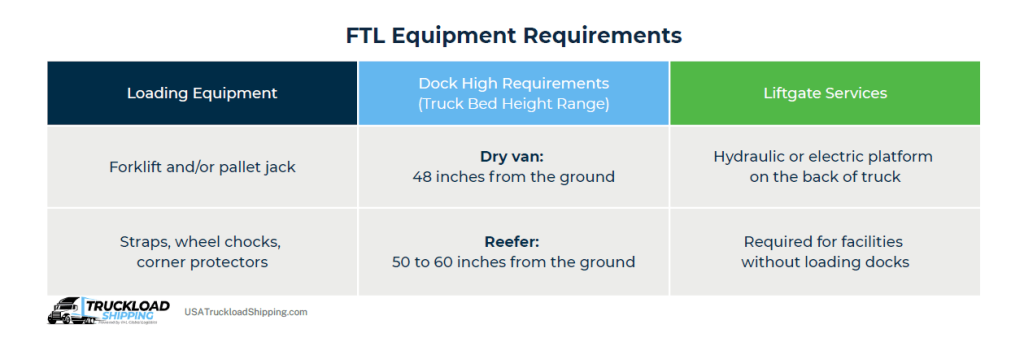
Once shippers have organized their receiving location with these resources, it’s time to load up the truck for the road.
The consignee or receiver of the shipment is responsible for unloading freight. The carrier’s responsibility is typically limited to delivery, but this may change if accessorial services are requested.
Since FTL shipments include high-quantities of palletized freight, consignees should prepare for safe loading/unloading with the following strategies:
The Occupational Safety and Health Administration (OSHA) is an agency that regulates worker training and safety across industries in the United States. Carriers and shippers must comply with OSHA’s trucking regulations to load/unload semi-trailers safely for every shipment.
Need help preparing an FTL shipment for pickup? Share your freight details and pickup location with our team so a freight specialist can confirm the right equipment and documentation before dispatch.
Speak with a freight expert today at (866)-353-7178 or strategize your shipment with a freight consultant.
Sources:
Compilation of Existing State Truck Size and Weight Limit Laws, Fr
Loading and Unloading, Occupational Safety and Health Administration
 Copy URL to Clipboard
Did you find this article helpful?
See more of our coverage on Google.
Add usatruckloadshipping.com as a preferred source!

R+L Global Logistics
315 NE 14th St., Ocala, FL 34470
