


See more of our coverage on Google.
Add usatruckloadshipping.com as a preferred source!

A truckload accessorial charge is a supplementary fee on a shipper's freight bill when delays occur, schedules are changed, or additional services are needed. The most frequent accessorial charges are detention, “Truck Order Not Used” (TONU), and layover fees. This guide will explain each surcharge and how to prevent them to reduce your freight rates.
A trucking accessorial charge is an additional service fee carriers apply to shipments when operational delays or service changes increase the time, equipment use, or labor required to complete a shipment.
Detention, TONU, and layover are common fees shippers face due to scheduling issues or load readiness. We’ve created a chart that outlines the differences between each surcharge.
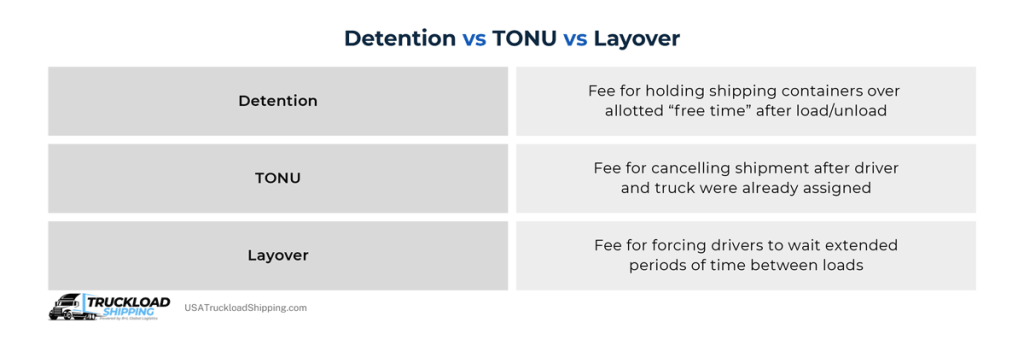
Now let’s take a closer look at each accessorial charge and what causes them.
Detention is a time-based accessorial charge. Carriers bill detention charges to shippers who exceed the allotted “free time” loading or unloading freight from containers. In truckload shipping, detention usually starts after the driver checks in and the free-time window expires.
Free time is a grace period allowed by carriers for using their equipment without incurring extra fees. Free time can range from hours to days, but if shippers go over that time, carriers can charge up to $100 an hour for every hour containers are held.
TONU is a surcharge shippers pay when they cancel a shipment after the carrier accepts the tender and prepares transportation.
Shippers can cancel transportation for any reason, such as accidentally double-booking or their customer cancels the order. The TONU fee helps the carrier recover the time and capacity reserved for the original move.
Layover is a time-based surcharge when drivers are delayed from picking up or delivering their next load. A shipper or carrier can cause this delay. Layover typically starts when a driver has been waiting at least 24 hours.
The typical amount of a layover fee is between $20 and $80. However, you could pay up to $500 depending on the carrier.
Shippers seeking to control freight cost can reduce accessorial charges by understanding their causes and using strategic planning practices across pickup, loading, and delivery.
We’ll go over common surcharge causes to help you navigate each.
Accessorial charges are headaches that can break trust between carriers and shippers. This can lead to problems like tender rejection. Let’s take a look at the usual triggers to avoid delays in your supply chain.
Scheduling conflicts happen when shippers and carriers miscommunicate about the freight pickup time. This leads to detention from dock delays where a driver has arrived at the receiving location, but there isn’t a dock door available as it’s already in use.
Load not read: Shippers who do not prepare or package loads correctly and on time for shipment trigger detention charges. Carriers can refuse to load freight that isn’t properly palletized or crated, causing shipping delays.
Late cancellation: TONU charges arise when shippers cancel the order after a driver and truck were matched with their shipment. Shippers can expect to pay up to $300 for a cancelled dry van shipment and $500 for oversized/over-length loads.
Shippers or carriers can be responsible for triggering accessorial charges. We’ll look at two common scenarios for each one and discuss how the fees can be avoided.
Here’s an example of a TONU fee:
A shipper has ordered a dry van truck for a full truckload (FTL) shipment of cosmetics to be picked up from Florida and driven to Texas.
The carrier has accepted this tender, assigned a driver to pick up the load, but the shipper calls to cancel the shipment because they accidentally selected the wrong truck. For cosmetics, they would need a reefer trailer to maintain temperature control to preserve the product.
The carrier would bill the shipper a TONU fee to recover expenses from the unused truck or even pay their driver if they were already en route to pickup.
Here’s an example of a layover fee:
A carrier has assigned a driver to haul a less-than-truckload (LTL) shipment of onions to a local grocery store. The carrier completes the shipment late Friday afternoon and the driver now waits for the carrier to assign them their next load.
However, the carrier says the next load won’t be until the next business day, which is Monday. Since the driver has to wait over 24 hours for their next load, the carrier will pay them their layover rate.
In the next session, we’ll discuss how to prevent accessorial charges with a few simple steps.
Use our checklist to avoid accessorial charges and reduce your freight bill.
Before you book your next shipment, follow these steps to ensure you don’t get stuck with a surcharge and maintain cost control.
Now let’s break down what to do if you’ve already been charged an accessorial fee.
Did your carrier bill you for an inaccurate accessorial charge? Our checklist will help you dispute the charge with valid proof to provide to your carrier.
Prepare yourself with proof to dispute billing errors in three steps:
Result: By using this checklist, you’re able to successfully dispute accessorial charges with documented proof and improve carrier accountability.
What we do:
Typical timeline: We prepare your truckload rate strategy and shipping papers the same day you book to confirm your lane.
What you’ll need: Freight information (including size, temperature-control, hazmat, or fragile details), origin, destination, and timeline.
Why choose us: USA Truckload Shipping is a 3PL with a vast carrier network that will match the best-fit carrier to your load for safe and on-time deliveries.
Outcome: We guarantee 99.5% on-time delivery to avoid disruptions in your supply chain. We communicate with you every step of the way. We can even calculate accessorial charges and reduce your freight bill.
At USA Truckload Shipping, we understand surcharges can throw a wrench in your supply chain with surprise fees. We partner with our freight experts in our 22,000+ carrier network to fit your business needs and complete your shipments without the extra steps or charges. Call us at (866) 353-7178 or reach out on our contact page.
What are truckload accessorial charges?
A truckload accessorial charge is a supplemental fee based on additional services or time-based penalties to complete a shipment.
Are shippers responsible for layover fees?
Shippers are responsible for layover fees if the shipper delays the driver from loading/unloading for over 24 hours. If the shipper’s receiving location was closed, loading docks were unavailable, or if staff wasn’t present, this can result in a shipper being at fault and paying a layover surcharge.
How can I dispute a truckload accessorial charge?
Shippers can dispute accessorial fees by presenting documentation that proves they were not at fault to receive a fee. Excessive or inaccurate surcharges should be disputed to maintain carrier accountability and trust between a shipper and carrier.
 Copy URL to Clipboard
Did you find this article helpful?
See more of our coverage on Google.
Add usatruckloadshipping.com as a preferred source!

R+L Global Logistics
315 NE 14th St., Ocala, FL 34470
