


See more of our coverage on Google.
Add usatruckloadshipping.com as a preferred source!

Key Takeaway:
A fuel surcharge is an additional freight charge carriers use to offset changes in diesel prices. In trucking, it is usually calculated as a per-mile fee built into a carrier’s surcharge table.
A fuel surcharge is a per-mile or percentage-based fee added to freight shipments when the cost of fuel exceeds the current average.
In trucking, carriers often use diesel price data from the U.S. Energy Information Administration (EIA) as a benchmark when updating fuel surcharge tables. However, each transportation company can choose its own surcharge method.
The EIA is a government agency within the U.S. Department of Energy (DOE) that provides electricity, petroleum, and natural gas data. The EIA publishes a weekly Gasoline and Diesel Fuel Update that many carriers use as a benchmark when updating surcharge tables.
According to the EIA, fuel surcharge methods are set by individual transportation companies, and EIA does not prescribe one required formula. There’s not one method of calculation inherently superior to another, nor does the EIA mandate any particular surcharge calculation formula.
Shippers may pay a fuel surcharge to carriers, brokers, or freight forwarders depending on how the shipment is arranged. Keep in mind during carrier selection that these surcharges are subject to change based on increasing and decreasing fuel prices.
Fuel surcharges help carriers recover costs when diesel prices rise unexpectedly. Without fuel surcharges, flat rates would be higher for shippers and would not take into account distance or variations in fuel prices from region to region.
We’ll go over how carriers determine the fuel surcharge fee for any given shipment in the next section.
The most common formula carriers use to calculate fuel surcharges is (Current Price - Base Price) ÷ Miles-Per-Gallon (MPG) = Fuel Surcharge-Per-Mile.
The surcharge is determined by considering the difference between the current fuel price and the baseline rate, along with the fuel efficiency of the vehicle. This is called a rate-per-mile fuel surcharge program.
We’ve provided a table below with an example of the formula:
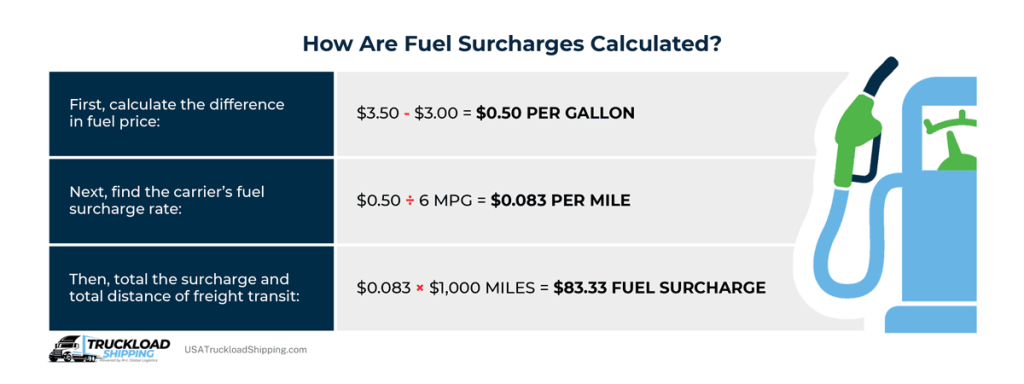
If a carrier has a surcharge baseline rate of $3.00 per gallon, the current nationwide fuel price average is $3.50 per gallon, and the truck gets six MPG, the surcharge is calculated as follows:
Some carriers use regional diesel averages instead of the national average. The regional benchmarks are often based on the Petroleum Administration for Defense District (PADD), which the EIA uses to report fuel prices by region. A PADD is a regional grouping of U.S. states to manage fuel allocation.
There are five PADDs:
Some carriers determine their fuel surcharge rates by making them a cent-per-mile addition to the overall line haul fee. The higher the cost of fuel, the higher the additional fee.
Let’s use the example carrier from earlier and say their general line haul fee is $4.00 per mile. You, the shipper, just booked a 500 mile haul for a total freight rate of $2,000. The formula would look like this:
$4.00 Line Haul Fee x 500 Mile Haul = $2,000
If the fuel rate provided by EIA or PADD is higher than the established rate, this carrier’s cent-per-mile surcharge is $0.36.
Now, let’s multiply the fuel surcharge with the mileage of your haul:
500 Mile Haul x $0.36 = $180
Your fuel surcharge would be $180 in addition to your overall $2,000 trip.

Now that you understand the definition of a fuel surcharge and how to calculate it, let’s discuss how to negotiate this accessorial fee in the next section.
Fuel surcharges usually cannot be adjusted on a shipment-by-shipment basis, as they are based on fluctuating fuel costs.
However, there may be “wiggle room” under the right circumstances, particularly for shippers looking for long-term contracts instead of spot rates.
Some of the steps shippers can take to ensure a fair fuel surcharge policy before committing to a carrier are:
By addressing fuel surcharge policies before signing an agreement, businesses can make their shipping expenses more predictable.
If you’re comparing carriers or reviewing freight costs, USA Truckload Shipping can help you evaluate your options and plan your next shipment with confidence. Call us at (866) 353-7178 or submit an RFP to connect with our team.
Sources:
Diesel Fuel Explained - Diesel Fuel Surcharges, U.S. Energy Information Administration
Petroleum & Other Liquids - Gasoline and Diesel Fuel Updated, U.S. Energy Information Administration, 2026
PADD Regions Enable Regional Analysis of Petroleum Product Supply and Movements, U.S. Energy Information Administration, 2012
 Copy URL to Clipboard
Did you find this article helpful?
See more of our coverage on Google.
Add usatruckloadshipping.com as a preferred source!

R+L Global Logistics
315 NE 14th St., Ocala, FL 34470

What if the company I’m leased to decided to start taking 10% of my FSC. Is this something they can do?
I was told that fuel surcharge is a federal law that a owner operator we'll get a fuel surcharge. But a company that I know of does not have a fuel.Surcharge they don't ask their customers for a fuel surcharge. I was wondering if I could get someone to show me.The federal law federal statute that states it is a federal law
Hello. If a person collects $30.00 fuel surcharge do they have to pay all of it to the trucking company?