


See more of our coverage on Google.
Add usatruckloadshipping.com as a preferred source!

A tender acceptance rate is the percentage of load tenders that carriers or brokers accept out of the total tenders a shipper offers. A low tender acceptance rate can delay shipments, raise transportation costs, and force shippers into the spot market. Shippers improve tender acceptance by giving carriers more lead time, sending accurate shipment data, and aligning pricing and appointment windows with market conditions.
Tender acceptance is the share of tenders accepted by the carrier or broker out of all tenders offered by the shipper. To determine your acceptance rate, simply divide your accepted tenders by total tenders offered and multiply the result by 100.
For example, let’s say you specialize in manufacturing and/or providing office furniture and equipment to businesses across the U.S. When you receive an order from your customer, you palletize the requested goods to fulfill that order. However, most businesses don’t have their own dedicated logistics resources, such as trucks and drivers.
Instead, you would make your shipment available for freight transport via an online resource, like a load board, including the shipping information and what you’re willing to pay for a carrier to transport the merchandise on your behalf. This is an example of tendering a shipment.
You may instead choose to work with a select handful of carriers, or a freight brokerage with access to thousands of carriers. In the latter case, your freight broker would find the best carrier for your shipment based on factors such as point of origin, destination, time frames, and required accessorial charges.
Whichever method you use, tender acceptance can vary based on timing, capacity, and pricing . The other side of this coin is tender rejection.
Tender acceptance often declines in times of limited freight capacity, when demand for services outweighs the resources available to meet that demand. Timing also has an impact on acceptance rates: the narrower your shipping window, the harder the load may be to cover.
Let’s look more closely at notable factors that contribute to decreased acceptance rates.
Last-minute shipments are often harder and more expensive to book than shipments with more lead time. As a shipper, you’ll also be at the mercy of high spot rates if you request a shipment to be picked up with only a few hours of notice.
An appointment constraint within the context of tender acceptance is a limit or limits to how and when a shipment must be picked up and delivered.
Think of it as if you were a truck driver deciding between two equally priced loads, but one of them can be delivered any time between 8 AM and 5 PM while the other can only be delivered within a narrow time frame of 2:00 PM to 4:00 PM.
That narrow window may reduce flexibility for the driver and increase the risk of scheduling conflicts, whereas the first shipment is more forgiving and allows the driver greater flexibility to pick up a shipment or shipments on their return trip, avoiding deadhead miles.
Accessorial charges include using a truck with a liftgate to make a local dropoff, white glove delivery, hazardous material transportation, and other fees that arise from the particular requirements of your shipment.
If you leave out likely accessorials, you could underprice the shipment.
Low freight capacity has fueled low percentages of tender acceptance in 2026 that haven’t been seen since the COVID pandemic. In March 2026, tender rejection rates were up by over 8 percent year-over-year, signaling some recovery from the 2025 freight recession.
Unfortunately, shippers can’t reliably plan for reduced freight capacity, which leads to reduced tender acceptance. Volatile shipping lanes compound this frustration, as capacity is not spread out evenly across the United States and hazardous weather reduces carrier availability.
Regional freight data from February 2026 showed weaker acceptance in parts of the Midwest, where winter storms reduced carrier availability.
As a shipper, you can’t exactly control the weather or reduce freight capacity. You can, however, use some best practices for shippers who wish to increase their tender rates.
These four practices can help improve a shipper’s chances of tender acceptance:
Let’s look at these practices in greater detail.
More lead time generally improves the odds of tender acceptance. Timing is key to the logistics business, and shippers who provide lengthy lead times on their requests for carrier support experience higher acceptance rates than those who wait until the last minute to find a carrier.
Detailed RFP data helps carriers and brokers price the load, verify requirements, and evaluate the tender more efficiently. In the following table, I’ve laid out some common mistakes shippers make when filling out a proposal request, and how you can avoid them to improve your acceptance rate.
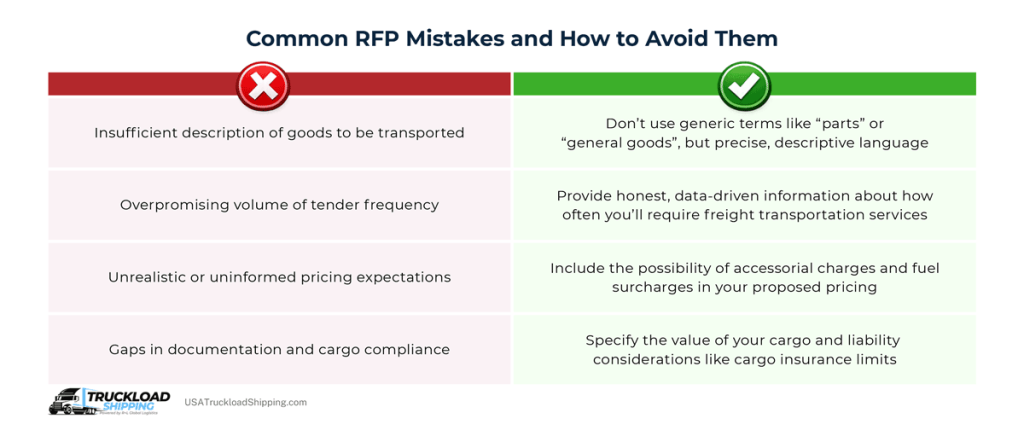
Detailed, accurate RFPs are an important factor in maintaining stronger acceptance rates.
Avoid wavering from the pick-up and delivery time windows you establish with your carrier. Consistent appointment windows can make your freight easier for carriers to plan around.
Therefore, failing to provide accurate timing windows to your freight broker doesn’t just affect the trucker: it can affect their other clients, which in time could lead to your shipments being deprioritized for tender acceptance.
Shippers who need consistent carrier support can contract with a 3PL or freight brokerage to take advantage of better pricing than the spot market offers. Consistency is often an important factor in making this arrangement beneficial.
Many shippers view a tender acceptance rate above 90% as a strong benchmark, but the right target depends on your mode, lane mix, seasonality, and routing guide performance. A lower rate may be manageable in volatile lanes, while a higher rate is often expected in more stable contract freight.
When your rate falls below 90%, you’ll have to rely on the spot market. Using the spot market is more expensive, but comes with lower service reliability.
When you’re gathering information for your shipment, setting up pickup windows, and working to get your freight accepted for shipment by a carrier, follow these instructions to keep your tender rates in acceptable parameters.
Use these six practices to improve your acceptance rate with carriers:
These best practices can improve your chances of tender acceptance.
Shipping lanes in the U.S. are subject to changes in their overall efficiency and costs due to factors like sustained traffic congestion or increased availability of freight along the lanes. This impacts tender acceptance if there are more shippers competing for carrier business than you’ve contended with in the past, or if delivery times suffer due to backed-up traffic.
If you establish repeat business with a broker or carrier, work with them to review the status of your most-used shipping lanes once per quarter. You may find that an alternate lane has become more advantageous for your shipments.
If you want a second opinion on lanes with low tender acceptance, our team can review your freight profile and identify opportunities to improve lead times, pricing alignment, and carrier coverage. We also have a variety of services that you can use to transport your freight. Reach us at (866) 353-7178 or request a quote online if you require more information.
Sources Cited:
Strickland, Zach, Midwest and West Coast Rejection Rates, FreightWaves, 2026
Strickland, Zach, Why is the Midwest the Most Volatile Region In the U.S., FreightWaves, 2026
 Copy URL to Clipboard
Did you find this article helpful?
See more of our coverage on Google.
Add usatruckloadshipping.com as a preferred source!

R+L Global Logistics
315 NE 14th St., Ocala, FL 34470
