

See more of our coverage on Google.
Add usatruckloadshipping.com as a preferred source!

Shipping fitness equipment is the process of transporting gym equipment like treadmills, bikes, and weight sets using full truckload (FTL) or less-than-truckload (LTL). Gym equipment that’s bulky, heavy, and awkward may require specialized shipping services, like expedited or white glove delivery. If you’re a manufacturer, distributor, or retailer of fitness equipment, this guide is for you.
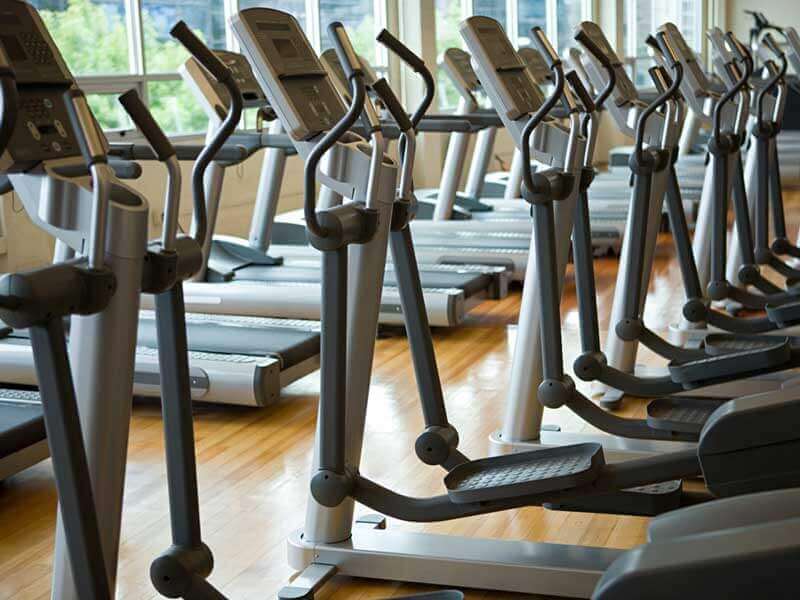
Fitness equipment can be large and bulky like treadmills and weight benches, or small and dense like kettlebells and dumbbells.
Whether you’re shipping fitness equipment to a warehouse, a gym, or your home, here are some of the most commonly transported exercise equipment.
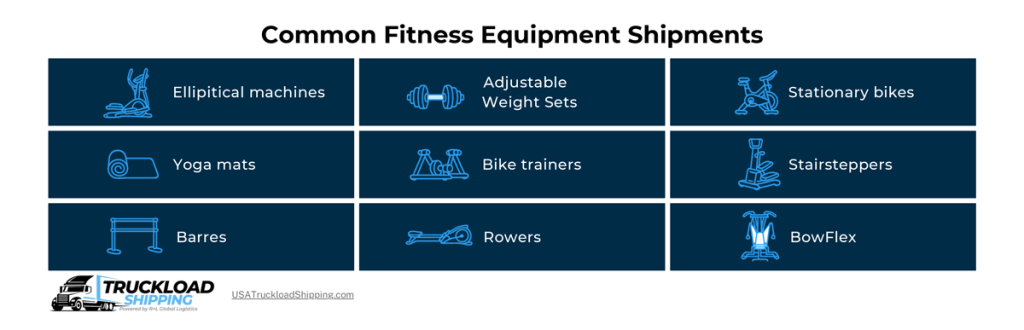
You can use FTL or LTL shipping to move any of these products. Just consider the size, shape, and weight of your load, as well as the distance and frequency of shipping.
We’ll break down each truckload shipping mode so you can choose the best method for your fitness equipment. Here are some best-use scenarios that will help you decide.
Use FTL when:
Use LTL when:
We’ll explain in more detail how FTL and LTL work in the following sections.
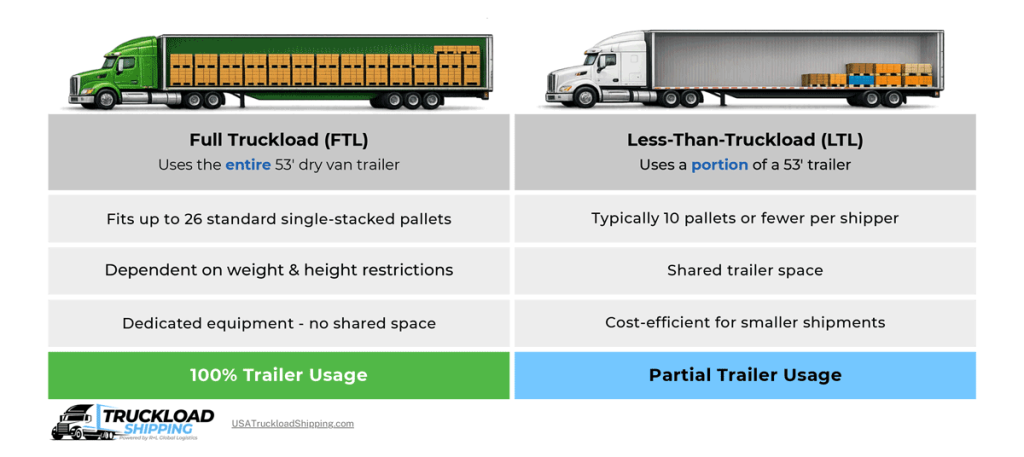
A full truckload is a shipping mode for freight that fills an entire semi-trailer.
Shippers moving large quantities of fitness equipment on a routine schedule to big box stores like Walmart or gyms like Planet Fitness would benefit from FTL shipping.
FTL is cost-effective compared to LTL in this case because shipping in small amounts with frequent stops for bulk items may increase your rate due to the extra freight handling, distance, and fuel being used.
FTL shipments travel from point-to-point with no unauthorized stops, which reduces handling and risk of damage to your fitness equipment.
A less-than-truckload is a shipment that fills only a portion of a semi-trailer. LTL freight is consolidated on a trailer with other shipments and shares the delivery route with multiple stops.
Fitness equipment will travel through multiple terminals, which means packaging carefully is even more important when using LTL.
If you’re shipping to big box stores, gyms, or your customers’ residential homes, LTL becomes the more budget-friendly option when your freight can’t fill an entire trailer.
There are a few things to keep in mind when freight shipping fitness equipment. Fitness equipment can be heavy and bulky and a truckload of goods might end up as an overweight load.
We’re ready to handle any shipment of fitness equipment and can get your freight from the factory to the warehouse to retailers to consumers. But before we do, here’s how to package your equipment so it’s ready to be shipped.
We’ll discuss the different materials you can use to package your fitness and equipment and discuss the difference between using a pallet or crate.
Most fitness equipment needs rigid outer packaging plus internal bracing to prevent shifting and impact damage. Here are the materials you’ll need to ship your equipment.
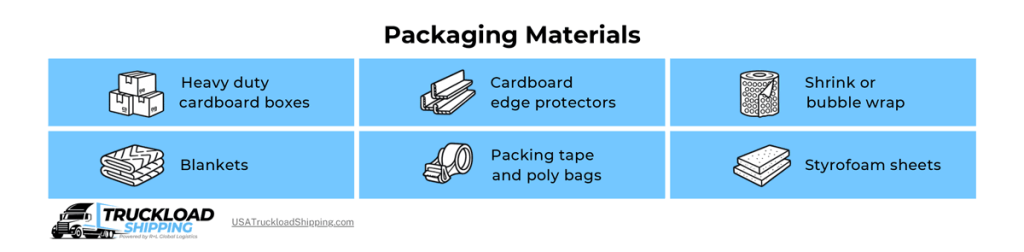
Since fitness equipment can be considered high-value items, shippers may want to transport them with extra protection. Blanket wrap shipping can help for inside or white glove delivery, but freight shipments still need rigid protection.
Once your items are packaged, you’ll need to decide whether to palletize or crate your load. Let’s look at the benefits of each method in the next section.
To ensure your freight doesn’t take any damage during load, transit, and unload, you’ll need to decide if your fitness equipment should be palletized or crated.
Both protect the equipment from shifting, scraping together, or breaking. Be sure to consider the quantity of cargo you’re moving and its shape, weight, and density as pallets and crates add to the handling and weight of your shipment.
We’ve made a table to break down the advantages of both for you to learn which is better for your shipment.
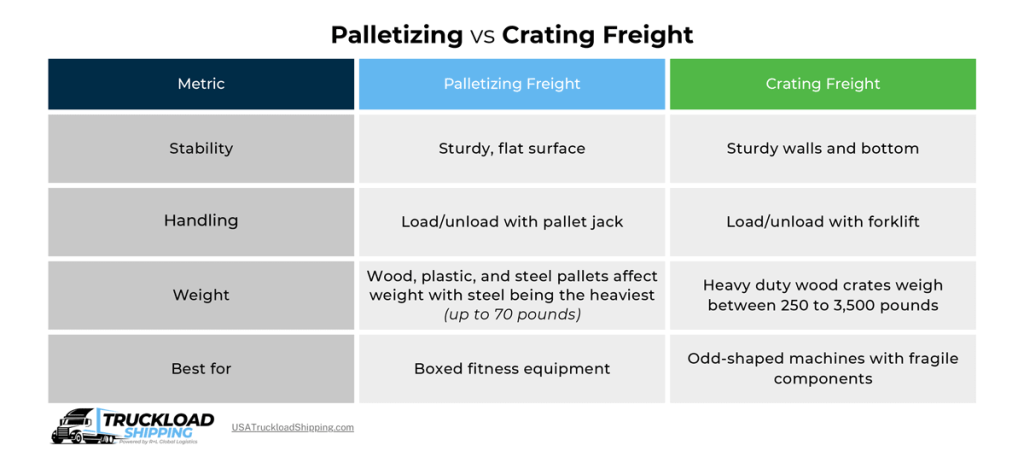
You can ship with pallets or crates with FTL or LTL, but keep in mind the space each method takes up in the trailer.
Crates and pallets come in a variety of sizes to fit different types of freight. Since fitness equipment can be as large like exercise bikes or as small as resistance bands, we made a chart with rules of thumb to follow:
Double-stacking is stacking two pallets together to create more space for cargo. FTL hauls can carry up to 52 double-stacked pallets.
Crates are stackable and can be palletized, too. For example, several crates of exercise bikes and treadmills can be palletized for easy movement and shipment.
Since crates vary in size based on the freight inside, we recommend speaking with a freight consultant about the dimensions of your freight for the best loading method.
The last thing you want is for your fitness equipment to be damaged during the delivery process. That’s why it’s essential you pick the correct method.
You can use the following delivery methods for your fitness equipment:
Each option is an accessorial charge that will be added to the cost of your shipment, but it’s well worth the price to keep your freight protected.
FTL and LTL shipping costs both include factors like freight weight, size, trailer type, and distance. However, LTL shipments also require freight classification and National Motor Freight Classification (NMFC) codes to accurately price your fitness equipment cargo.
FTLs don't require freight classification and NMFC codes because one shipper is using the entire trailer for their load, even if the load includes different types of fitness equipment.
However, LTLs are products from various shippers. Freight classification and NMFC codes are used to identify and price each shipper’s load.
LTL freight classification includes your fitness equipment’s weight, stowability, handling, and density. The denser your equipment, the lower the freight class. The less dense your equipment, the higher the freight class.
Fitness equipment can be assigned different NFMC codes depending on packaging and density. Dense items like dumbbells and kettlebells have a lower freight class. However, the total cost can still be high because the shipment is heavy and requires special handling.
We know LTL shipping costs can be complex. Accuracy is important to label and ship your fitness equipment and avoid reclassification and additional fees. You can learn how to calculate your freight density in our guide or speak with our freight consultants to easily find your gym equipment’s shipping costs.
Here are some extra tips you can use to prevent your fitness equipment from being damaged.
Pairing these procedures with the packaging guidelines we’ve discussed will ensure your gym equipment arrives at the final destination in one piece.
Let us make exercise equipment logistics easy. We can handle every step of your supply chain. Ready to start shipping fitness equipment? Start the process by reaching out to one of our knowledgeable freight experts. Give us a call at (866) 353-7178 or grab your free quote today.
 Copy URL to Clipboard
Did you find this article helpful?
See more of our coverage on Google.
Add usatruckloadshipping.com as a preferred source!

R+L Global Logistics
315 NE 14th St., Ocala, FL 34470
