


See more of our coverage on Google.
Add usatruckloadshipping.com as a preferred source!

A freight bill audit is the process of checking a carrier invoice against shipment records, agreed rates, and accessorial approvals to catch billing errors before payment. Shippers use it to verify charges, dispute overbilling, and recover avoidable freight costs.
A freight bill lists the transportation charges, surcharges, and accessorial fees billed for a shipment. Carriers calculate and send freight bills to shippers or consignees with truckload rates for the following services.
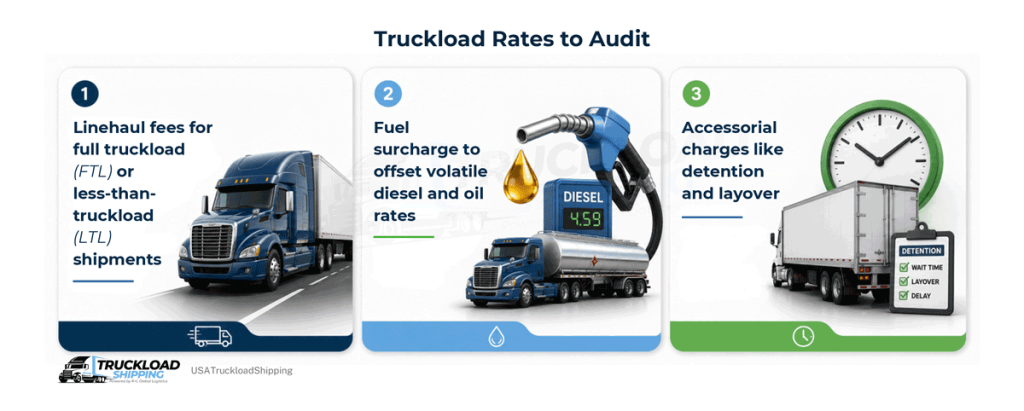
Freight bills include these service fees in an itemized list for shippers to review and ensure each charge is for a service they ordered and calculated correctly. However, mistakes can happen due to human or electronic errors, like mistyping a number in a quote or using outdated software to process billing.
Freight audit services verify invoice accuracy, identify billing errors, and help shippers recover overpayments. Freight bill audits also hold carriers accountable for mistakes or intentional discrepancies like double-brokering.
Double-brokering in the freight industry is an illegal practice where a carrier or freight broker tenders a load from a shipper before subcontracting the same load to a different carrier or freight broker. This can happen without the shipper’s knowledge or consent, which may lead to inflated transportation costs and disputes.
Freight bill audits also help freight brokers and freight forwarders remain compliant with the Federal Motor Carrier Safety Administration (FMCSA). FMCSA requires brokers and freight forwarders to maintain a minimum financial security for freight claims.
FMCSA rules addressing double-brokering and broker accountability help protect transportation transactions from hidden re-brokering and related disputes.
When shippers, carriers, or freight brokers catch billing errors before a dispute occurs, the two parties build trust and better communication to complete future shipments without hassle.
Freight billing errors can happen accidentally, but shippers and their brokers should watch for the following mistakes to avoid overpaying or being overbilled for freight services.
A duplicate charge is a fee that appears multiple times on a freight bill for the same service. Let’s look at two scenarios where a freight bill has duplicate charges.
Scenario 1:
A carrier tenders a FTL load of treadmills to pick up from a warehouse and haul to a gym. The shipper has requested liftgate services for loading and unloading the heavy freight. The carrier loads the freight onto the truck at the warehouse and presents the Bill of Lading (BoL) to the shipper to sign and confirm the load has been picked up and is ready for transport.
However, the shipper notices there are two liftgate service charges on the form. The carrier has mistakenly entered the charges twice and promptly corrects the BoL to match the shipper’s request.
Scenario 2:
A shipper sends a freight quote request to a carrier to haul a LTL load of makeup brushes to their boutique. The shipper provides the carrier the National Motor Freight Classification (NMFC) code for the load before booking. Yet the shipper receives a freight bill that lists three reclassification charges.
When the shipper questions this, the carrier explains that the provided freight class was incorrect and they had to reweigh the freight three separate times to identify the accurate freight class. This discrepancy could lead to a potential freight claim for dishonest billing.
A fuel surcharge is a fee carriers apply to freight bills to account for fluctuating gas and oil market prices. Carriers typically use the following formula to calculate fuel surcharges:
Fuel Surcharge = Carrier’s Fuel Surcharge Rate-Per-Mile x Freight Total Transportation Miles
Carriers may miscalculate by applying the wrong current gas rate or transportation mileage, which unnecessarily increases a shipper’s freight bill.
An accessorial charge is a supplemental fee to complete a shipment. Common accessorial charges include:
FMCSA’s moving glossary defines common transportation terms. When shippers spot unfamiliar accessorials on a freight bill, the carrier should be able to verify what the charge is and how it was calculated.
Freight bill audits ensure shippers only pay for the services ordered. Shippers can review invoices internally or outsource the audit to a 3PL or freight payment provider.
We’ve illustrated in a chart how to run a freight bill audit in three steps.
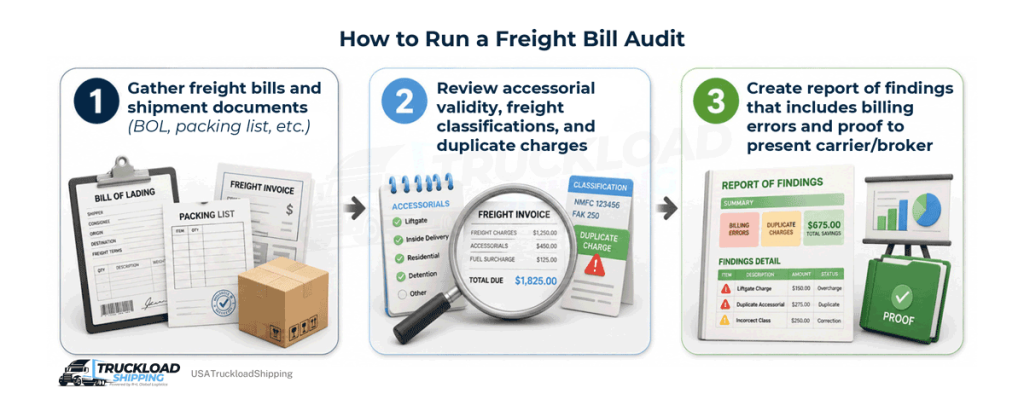
When discrepancies are found on the freight invoice, shippers should report these findings to their freight broker or carrier to correct. If the carrier or broker refuses to correct the invoice and maintains that the charges are valid, the shipper can file a freight claim.
In the next section, we’ll discuss how to dispute billing errors.
Need to file a dispute with your carrier after conducting a freight bill audit? Use our step-by-step checklist to present your evidence and make a freight claim to recover funds.
According to the 49 CFR (Code of Federal Regulations) Part 370, carriers have up to 120 days to accept, deny, or settle freight claims.
We know billing can be complex, but it’s a necessary step in protecting your supply chain. By working with a 3PL, shippers can trust freight bills are processed accurately and disputes are handled quickly and professionally with timely refunds.
As a 3PL, we’re a freight team with licensed freight brokers and carriers with the capacity to move any freight anywhere in the United States. We value honest and transparent quotes to fit your freight budget and support your supply chain with our 22,000+ FMCSA-compliant carriers nationwide.
If your team audits a high volume of invoices or disputes recurring accessorial charges, a 3PL can centralize review, documentation, and carrier follow-up. Call our freight experts today at (866)-353-7178 to plan your next load or get an accurate quote in under five minutes.
Sources:
Broker and Freight Forwarder Financial Responsibility Rule Overview and Compliance Requirements, Federal Motor Carrier Safety Administration, 2026
MAP-21 - Moving Ahead for Progress in the 21st Century Act, Federal Motor Carrier Safety Administration, 2024
Title 49, Subtitle B, Chapter III, Subchapter B, Part 370 - Principles and Practices for the Investigation and Voluntary Disposition of Loss and Damage Claims and Processing Salvage, Code of Federal Regulations, 2026
Glossary, Federal Motor Carrier Safety Administration, 2024
 Copy URL to Clipboard
Did you find this article helpful?
See more of our coverage on Google.
Add usatruckloadshipping.com as a preferred source!

R+L Global Logistics
315 NE 14th St., Ocala, FL 34470
