

See more of our coverage on Google.
Add usatruckloadshipping.com as a preferred source!

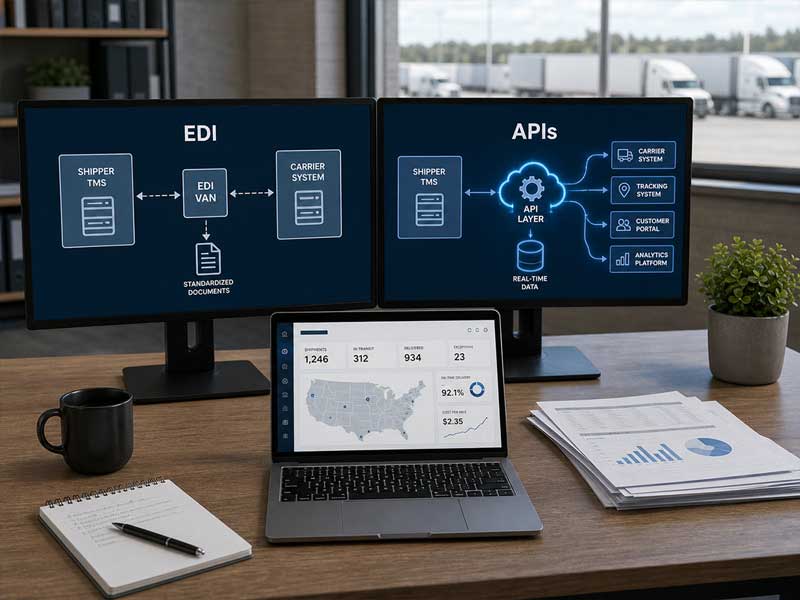
Electronic data interchange (EDI) and application programming interface (API) are two freight-data integration methods used in transportation management systems. EDI works best for standardized, high-volume document exchange with carriers, while APIs support faster, more flexible data sharing across TMS, customer portals, tracking tools, and other logistics systems.
A transportation management system (TMS) is a software used to integrate freight shipping data between a shipper and carrier or third-party logistics (3PL) provider.
TMSs help shippers and logistics companies optimize supply chain management by:
EDI and API are two types of software used to complete supply chain management tasks.
EDI is a standardized method for exchanging shipping documents and structured freight data between business partners, such as shippers, carriers, brokers, and 3PLs. EDI functions as a business-to-business data exchange method that lets trading partners share standardized freight information.
An API is a system-to-system connection that lets software applications exchange freight data in near real time across tools such as TMS platforms, customer portals, visibility systems, and billing platforms. APIs let shippers connect their TMS with carriers, 3PLs, customer portals, visibility tools, and other supply chain systems.
We’ve made a chart to compile the main differences between EDI and API systems.
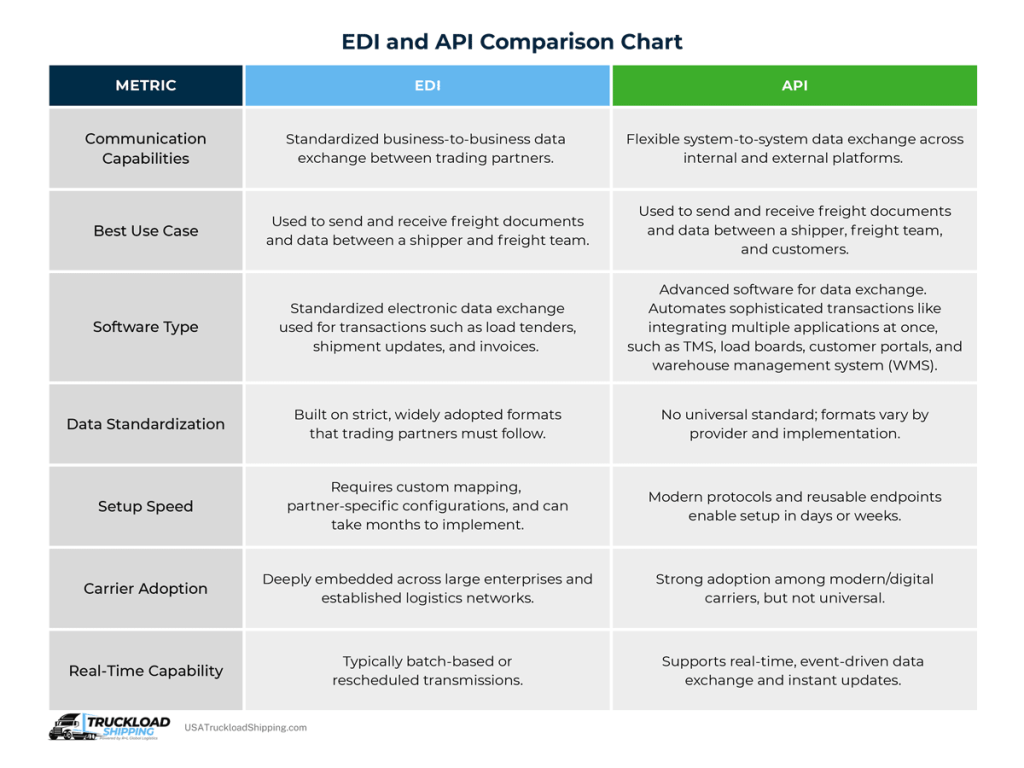
EDI remains the most widely used method for standardized freight document exchange, while APIs give shippers faster and more flexible integrations across modern logistics systems.
Now that you know what distinguishes these freight programs, let’s discuss how to use EDI and API to simplify your logistics strategy.
Shippers use EDI and API to communicate with their freight team to start, track, and complete a shipment.
EDI uses standardized transaction sets in freight workflows, so activities like load tendering, shipment updates, and invoicing can be sent in a consistent format across partners. An EDI transaction code identifies a standardized document type used to exchange a specific set of freight data.
Many freight APIs use REST-based connections to exchange shipment data between systems. Depending on the workflow, those integrations may pass identifiers such as PRO numbers for LTL shipments or reference numbers used inside a TMS.
Let’s take a look at the most common services featured in a TMS.
Load tendering is a process to request freight shipping rates and book loads from carriers. Shippers and freight brokers use load tendering to submit freight quotes from individual or multiple carriers or 3PLs to find the best-fit truckload rate.
EDI 204 is the transaction code for a motor carrier load tender and includes the following collective data:
EDI 990 is the transaction code used to approve or deny loads. Carriers use EDI 990 to send shippers a response to EDI 204, or load tendering.
A shipment status is an update on a freight shipment’s condition, location, and delivery time. Both EDI and API display real-time shipment status updates for both shippers and carriers to analyze a shipment’s progress to delivery.
Shippers and carriers use EDI 214, the Transportation Carrier Shipment Status message, to exchange shipment milestone updates and delivery status information. For API, shipment status updates are monitored using PRO numbers that are generally paired with a Standard Carrier Alpha Code (SCAC), a two to four digit letter code, to identify the freight company shipping the cargo.
Invoicing is a process to send and receive freight bills and payments. On an EDI system, shippers and carriers use the EDI 210 transaction code to create and send invoices, set up routing information, and view payment history in a TMS.
With APIs, invoicing data can move between a TMS, billing platform, customer portal, and payment system, giving shippers more flexible ways to manage invoice and payment workflows.
While both methods support freight operations, many shippers use EDI and API together. This hybrid approach combines standardized document exchange with faster, more flexible data sharing across the supply chain.
To implement a TMS, set up your business and carrier or 3PL’s information to effectively communicate your logistics needs and monitor how/when they are met.
Use our TMS implementation checklist to gather the required freight documents and data to build your logistics strategy.
Once this information is ready, you can work with a carrier or 3PL to configure your TMS and support your freight transportation strategy.
As a 3PL, we understand each component of a supply chain, from importing, warehousing, and truckload shipping. Our Freight Team of professional freight brokers and over 22,000 vetted carriers are trained to operate transportation management systems, simplify truckload rates, and deliver freight on time, every time.
Submit your freight details and receive an instant freight quote to price your shipment, or call our Freight Experts at (866)-353-7178 to get started.
Sources:
Standard Carrier Alpha Code: The Transportation Industry’s Carrier Identifier, SCAC
Get Operating Authority (Docket Number), Federal Motor Carrier Safety Administration, 2026
How To Comply with Federal Hazardous Materials Regulations, Federal Motor Carrier Safety Administration, 2024
 Copy URL to Clipboard
Did you find this article helpful?
See more of our coverage on Google.
Add usatruckloadshipping.com as a preferred source!

R+L Global Logistics
315 NE 14th St., Ocala, FL 34470
