


See more of our coverage on Google.
Add usatruckloadshipping.com as a preferred source!

Truckload rates are a set of prices carriers charge to move freight on a dedicated truckload shipment. Capacity planning is a strategic process to measure logistics resources and meet customer demand. In 2026, truckload rates will continue to change with fuel costs, seasonal demand, equipment availability, lane balance, and service requirements. We’ll help you learn how to build a logistics forecast process to simplify costs capacity planning.
A truckload rate is a total price to move a shipment on a dedicated truck. A carrier's truckload rate usually includes mileage, fuel, equipment type, service level, shipment timing, and lane conditions.
Truckload rates move up or down with market conditions. When demand rises faster than available trucks in a lane, rates usually increase. When truck capacity loosens, rates will soften.
Your freight profile also affects the rate. Trailer type, shipment weight, shipment dimensions, pickup and delivery windows, and special handling requirements all influence freight costs.
Truckload rates are also affected by shipping services that increase the cost of shipping. Use these shipping services to improve customer service, preserve freight quality, or when handling hazardous goods:
Costs capacity planning starts with a clear understanding of the freight itself, including shipment size, equipment needs, service requirements, and any applicable compliance standards. When these details are defined early, shippers can evaluate rates more accurately and reduce avoidable disruptions during booking and transit.
Reliable truckload pricing also depends on working from complete shipment information and realistic service expectations. Clear communication about freight characteristics, timing, and routing helps carriers and shippers align on capacity needs and build a reliable transportation plan.
An accessorial charge is an extra transportation fee added when a shipment requires services or time beyond the standard pickup and delivery plan.
Common truckload accessorial charges include detention, layover, and truck order not used (TONU). These charges can materially increase the total cost of a shipment, so shippers should define them clearly before booking.
We’ll review each accessorial charge in the following sections.
Detention is a type of accessorial charge when a carrier or shipper delays freight delivery. Delays can happen for any reason, like road construction, severe weather, or traffic congestion.
Carriers, shippers, or receivers determine the free time allotted to drivers in between loading, transit, and unloading to ensure deliveries arrive on time while allowing the driver a break.
However, if a driver for any reason goes over this free time, a detention charge is given to the carrier to reimburse the shipper.
On the other hand, shippers can also delay drivers, in the event they are not at the receiving location for the driver to unload freight. In this case, the shipper is charged with detention.
TONU is a cancellation fee that may apply when a truck is dispatched or reserved for a load that does not move. The amount depends on the lane, equipment type, and how far the carrier has already committed resources.
A TONU can happen when the carrier or shipper needs to reschedule or cancel the lane last minute or the wrong truck has been booked. In either event, carriers and shippers must work together to ensure the correct TONU charge is billed and paid to maintain a healthy relationship and continue booking in the future.
A layover is a type of accessorial charge paid to drivers who are forced to wait for their next load assignment. Carriers bill the shipper a layover charge when drivers arrive at the receiving location to load but experience an extended delay.
A layover is different from detention because detentions can be at the shipper or carrier’s fault. With layovers, the shipper is at fault for delaying the load and is required to pay the carrier between $250 to $300 for a layover.
Capacity signals are market indicators that help shippers and carriers estimate how easy or difficult it will be to secure trucks in a lane. Common signals include tender rejection trends, spot rate movement, seasonal shipping surges, severe weather, and regional equipment imbalances.
Capacity signals help shippers predict the amount of trucks available, spot rates, and dry van rates. This helps shippers understand how to plan their loads and streamline their supply chain for the long-term.
A few capacity signals are:
While shippers can study the freight market themselves to monitor these capacity signals, it’s recommended to partner with a trusted carrier, broker, or 3PL. These logistics providers study the freight market daily to strategize lane bookings and prioritize freight transit for shippers of all sizes.
When shippers work with carriers for repeated loads, this improves tender acceptance, allowing shippers to accurately plan capacity with a dedicated carrier on their supply chain team.
Tender acceptance is the carrier’s agreement to move a load at the offered terms. For shippers, stronger carrier relationships, realistic lead times, and consistent freight volume can improve tender acceptance and reduce last-minute coverage risk.
While tender rejection is a formal denial to transport a shipper’s freight, shippers can avoid this delay in their supply chain by partnering with a logistics company that understands their capacity needs and helps them to scale their transportation strategy.
In the next section, we’ll go over how shippers can build a relationship with carriers to nurture tender acceptance and sustain a capacity plan.
Spot rates are one-time market prices for individual loads. Spot pricing changes quickly because it reflects current supply, demand, and lane conditions. While shippers can use spot rates to “test drive” a carrier service before committing to a contract, most times spot rates are used for small, infrequent, or urgent shipments.
Use spot rates when:
Contract rates are negotiated prices for recurring freight over a defined period. Contract pricing usually gives shippers more predictable cost planning and steadier capacity access than spot buying. Shippers moving high-quantity or high-value freight on a routine schedule benefit from contract rates.
Use a contract rate when:
In the next section, we’ll discuss how to secure a spot or contract rate with your carrier to ship at rates that benefit your capacity plan.
When a shipper wants long-term pricing or structured carrier coverage, the shipper can issue a request for proposal (RFP). An RFP gives carriers or 3PLs the shipment data they need to price lanes, propose service levels, and bid for the business.
A Request for Proposal (RFP) is a document that formally requests a shipment quote for services for a carrier or 3PL to bid on. This quote can include a range of services the shipper would like from the carrier, such as:
An RFP includes the following elements for shippers to fill out to clearly communicate the services they’d like for their order.
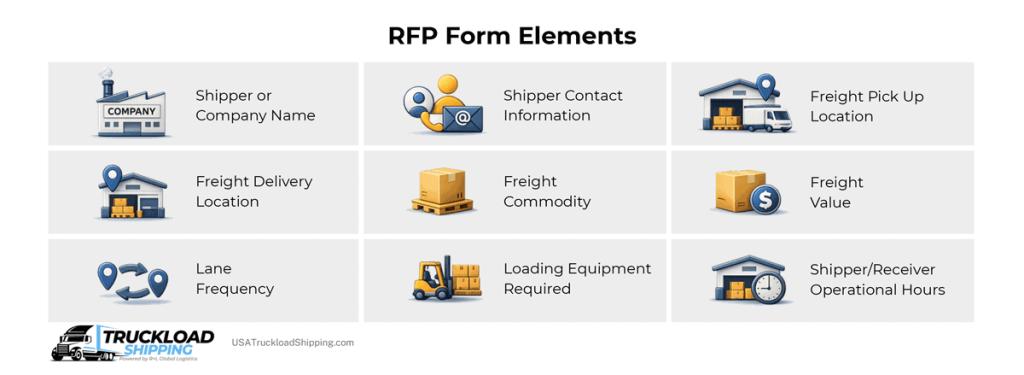
Shippers can submit RFPs to multiple carriers and 3PLs. Carriers and 3PLs can then bid on the RFP with a quote the shipper can accept to start shipping.
A mini-bid is a short-term revision to a contract rate between a shipper and logistics provider when market conditions change on selected lanes. Shippers often use mini-bids to adjust contract pricing on a subset of freight instead of reopening a full annual bid.
After a shipper has submitted an RFP and the logistics provider has provided a long-term rate that the shipper accepts to begin working together, changes can be made to that rate when capacity changes.
Network and lane design help shippers match freight demand with the right routing, facilities, and carrier coverage. In truckload planning, lane design affects service reliability, empty miles, and total transportation cost.
Strategic design for lane bookings can look like the following:
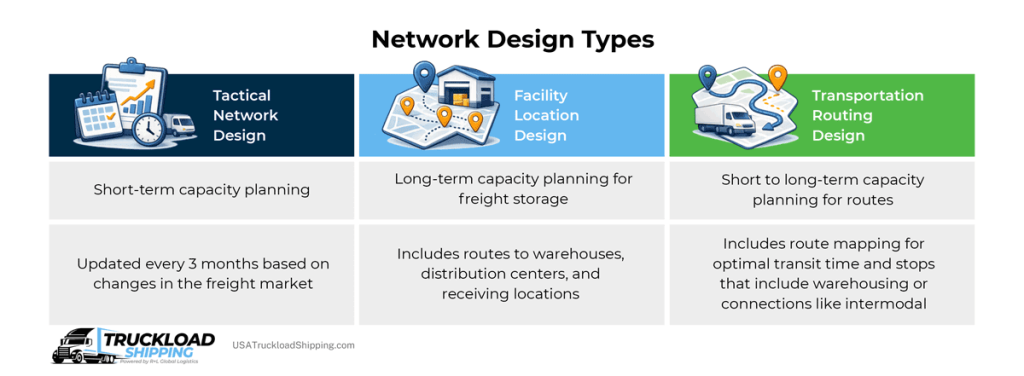
A well-designed freight network gives shippers a clearer framework for managing lanes, capacity, and service expectations over time.
You can forecast truckload rates and capacity more effectively when they track lane demand, internal shipment volume, budget, and operational constraints in one place.
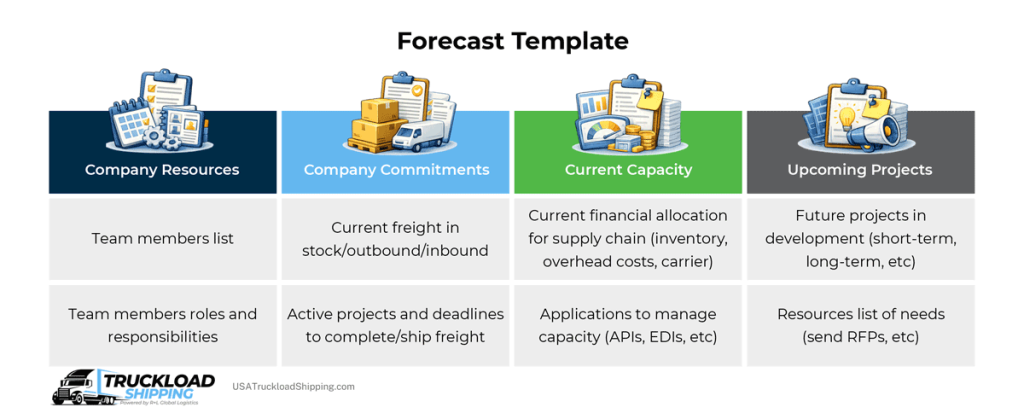
While this information is handy to use on your own, we recommend speaking with a freight consultant to map out the full picture of your freight needs and build your capacity plan.
Build your capacity plan with a freight consultant who can map your freight needs and compare spot and contract options for your lanes, or speak with a freight expert now at (866) 353-7178.
FAQ:
1. What factors affect truckload rates the most?
Truckload rates are usually driven by lane demand, truck availability, fuel prices, trailer type, shipment timing, and service requirements. Rates can also increase when a shipment needs expedited service, special equipment, or additional accessorial support such as detention or layover.
2. How can I find the best truckload rate for my shipment?
The best truckload rate is not always the lowest quote. The best rate is the one that balances price, service reliability, transit time, and accessorial risk for your lane. To compare rates accurately, use the same shipment details for every quote, including origin, destination, freight type, weight, dimensions, equipment needs, and delivery windows.
3. What is the difference between a spot rate and a contract rate?
A spot rate is a one-time market price for an individual shipment. A contract rate is a negotiated price for recurring freight over a set period. Spot rates are often used for urgent, infrequent, or overflow loads, while contract rates are usually better for shippers that need predictable pricing and more consistent capacity on core lanes.
4. How can shippers secure truckload capacity during tight market conditions?
Shippers can improve capacity by forecasting freight earlier, tendering loads with more lead time, keeping appointment windows realistic, and building relationships with trusted carriers or logistics providers. Many shippers also secure core lanes on contract and use spot coverage only when volumes spike or routing changes.
 Copy URL to Clipboard
Did you find this article helpful?
See more of our coverage on Google.
Add usatruckloadshipping.com as a preferred source!

R+L Global Logistics
315 NE 14th St., Ocala, FL 34470
