

See more of our coverage on Google.
Add usatruckloadshipping.com as a preferred source!

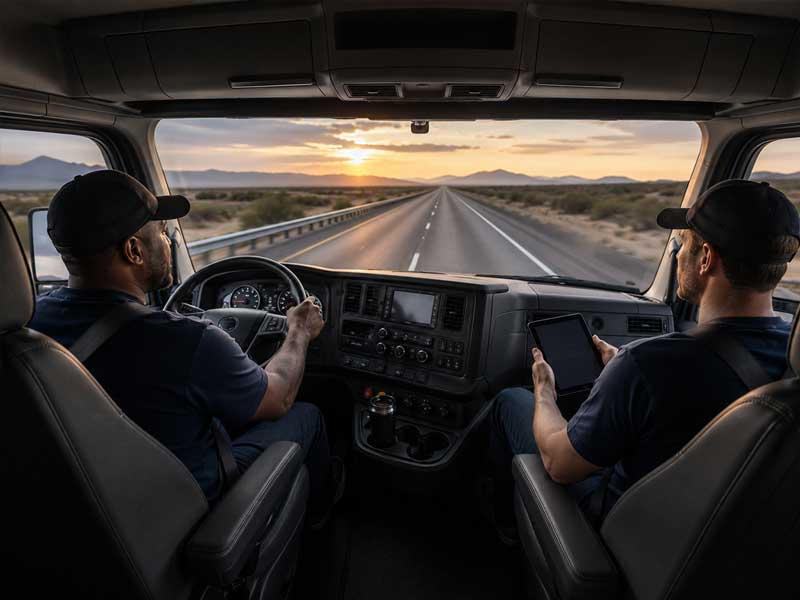
Trucking team drivers are two CDL-licensed drivers who share one truck so the shipment can keep moving with minimal downtime. Shippers typically use team drivers for expedited freight, tight delivery windows, and high-consequence loads where speed matters more than the lowest rate.
Team driving is a logistics strategy that assigns two drivers to one truck so freight can stay in transit longer with fewer extended stops. One driver operates the vehicle and the other driver rests before the two switch roles, keeping the vehicle in motion until the delivery is complete.
Solo drivers are a standard logistics practice to deliver small or large loads, like less-than-truckload (LTL) or full truckload (FTL), respectively. Solo drivers can also handle expedited freight, but team drivers usually move long-haul, time-sensitive shipments faster because the truck can stay in motion for more hours each day.
We’ve created a chart to define the main differences between truckload team drivers and solo truck drivers.
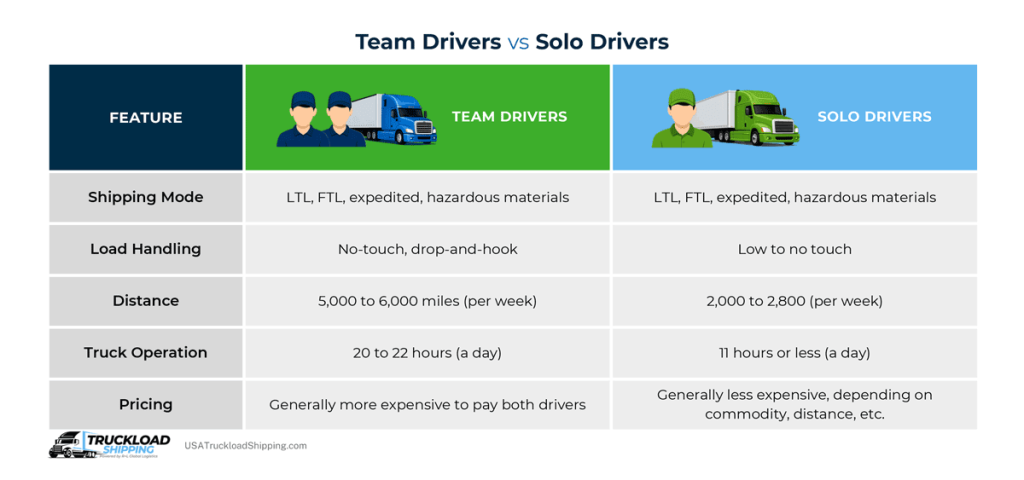
Team drivers cover more distance in less time than solo drivers due to the pair working in tandem shifts. The Federal Motor Carrier Safety Administration (FMCSA), an agency of the U.S. Department of Transportation (DOT), enforces driver welfare and freight transportation to ensure team drivers deliver freight both quickly and safely.
Carriers and their drivers must comply with the FMCSA Behavior Analysis Safety Improvement Categories (BASICs) for driver and road safety.
The FMCSA BASICs include:
Each category audits a motor carrier and their truck drivers’ federal compliance, Hours-of-Service (HOS). HOS is a FMCSA regulation that ensures no truck driver operates a vehicle longer than 11 hours. Team drivers comply with this rule through the Sleeper Berth Provision.
According to the FMCSA’s Sleeper Berth Provision, drivers must split driving duty by:
FMCSA specifies that team drivers must rest at least ten hours before going on duty. This helps drivers maintain driver fitness to deliver freight safely and on time.
In the next section, we’ll review if team driving is best for your freight and timeline requirements.
Trucking team drivers are best used to deliver urgent or time-sensitive freight. Perishable commodities like medicine or emergency supplies are best transported by team drivers.
Let’s look at the benefits of team drivers and when they are a worthy investment to secure your load.
A tight delivery window is a restricted timeframe to pickup, ship, and deliver freight. Tight delivery windows can range from within a couple hours in a single day or within a few days.
Expedited shipping is a shipping mode best used to quickly deliver goods in short delivery windows. Trucking team drivers excel at expedited freight services by taking turns operating a truck to avoid stops and deliver freight within a few days or less.
High-consequence deadlines happen when a late delivery would create a major business, safety, or service problem. These shipments often include medical freight, critical replacement parts, hazardous materials, or goods tied to strict delivery appointments.
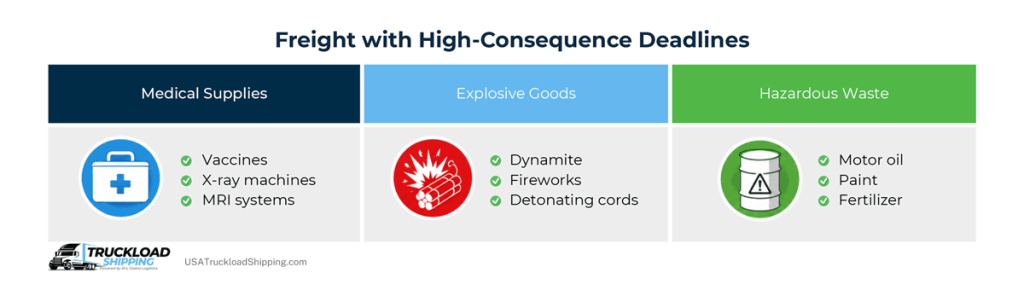
Team drivers normally deliver no-touch or drop-and-hook freight to streamline pickup or delivery. This shipping method allows urgent or sensitive freight to be handled, loaded, and unloaded efficiently and on time.
To make choosing between team drivers and a solo driver easier, we’ve provided a decision table showing the best scenarios to use each.
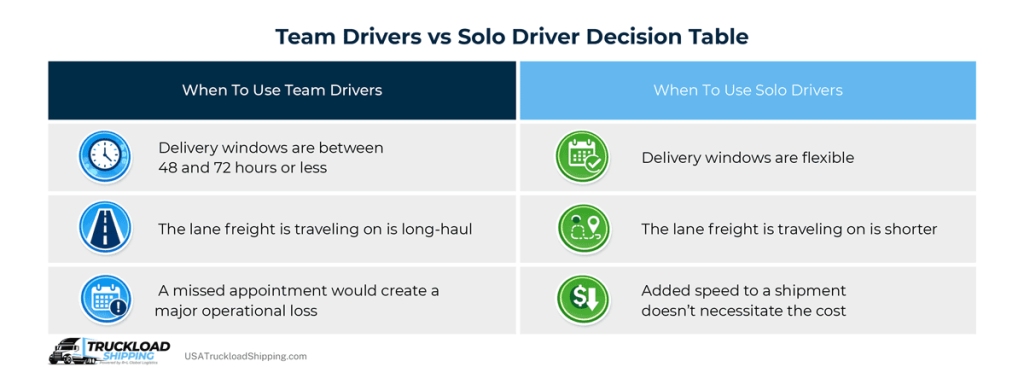
In most cases, team drivers make sense when delivery speed outweighs cost, while solo drivers are the better fit when the shipment can move on a more flexible timeline.
Team drivers usually cost more than solo drivers because the carrier is assigning two drivers to the same shipment. Although exact cost can vary, shippers are likely to spend between two and a half and three times more on team drivers than solo drivers.
Let’s look at a couple of factors that contribute to pricing team drivers and how to work them into your freight budget.
Team drivers drive trucks for any shipping mode, like dry van, reefer, flatbed, or intermodal. However, not every carrier offers team driving services, and market capacity can limit availability.
The freight market is a collection of freight industry data signalling loose or tight freight capacity to meet customer demand. When the market is loose, there are more available team drivers and trucks at any given moment with optimal rates for shippers to choose from. When the market is tight, team-driver availability shrinks and rates increase.
Team drivers cover thousands of miles more than solo drivers per week based on the load, lane, and distance of the shipment.
Like solo drivers, carriers bill shippers per mile for team drivers to expedite freight. The rate-per-mile is determined by factors like mode type, fuel prices, and spot and contract rates. These truckload rates fluctuate based on the lane and distance your team drivers travel.
Team driving often costs more because the carrier has to cover the cost of paying two drivers and facilitating the resources for faster transit.
Time-sensitive, high-value, or long-haul shipments benefit the most from team drivers. This kind of cargo requires near 24/7 movement, and team drivers can help shippers achieve this level of speed.
Goods that can benefit from team driving include:
If your freight is time-sensitive, high-value, or moving long-haul on a tight deadline, team driving may be the better option.
Team drivers are worth considering when transit time, appointment performance, or operational risk matters more than the lowest cost. If your shipment has a flexible timeline, solo service may be the better fit. Here at USA Truckload Shipping, we’re ready to ship to meet your transportation needs. We have a variety of transportation services you can choose from, including expedited shipping.
Call our freight team today at (866)-353-7178 or submit your request for proposal. You can also get in touch with our team by sending your questions through our contact form.
Sources:
Commercial Driver’s License Program, Federal Motor Carrier Safety Administration, 2025
FMCSA Homepage, U.S. Department of Transportation
Get Road Smart About the 7 Basics of Safety, Carrier, Safety, Accountability
Summary of Hours of Service Regulations, Federal Motor Carrier Safety Administration, 2022
 Copy URL to Clipboard
Did you find this article helpful?
See more of our coverage on Google.
Add usatruckloadshipping.com as a preferred source!

R+L Global Logistics
315 NE 14th St., Ocala, FL 34470
