

See more of our coverage on Google.
Add usatruckloadshipping.com as a preferred source!

Coffee is a shelf-stable food product that can still lose quality in transit due to moisture, odor contamination, and packaging damage. Businesses must follow good coffee shipping practices outlined by the Food and Drug Administration’s (FDA) Food Safety Modernization Act (FSMA). FSMA is a law that monitors food safety during transportation with regulations to prevent foodborne illnesses from unsanitary shipping conditions. This guide explains how to ship coffee by the truckload while maintaining FSMA requirements.
The FDA is a federal agency that regulates food safety and oversees FSMA requirements, which also apply to transportation practices. The FSMA sanitary transportation rule is the set of requirements designed to prevent food safety risks during transit.
This includes:
Shippers moving coffee must follow FSMA’s food safety regulations to prevent unsafe transit conditions that could damage or spoil coffee freight.
Coffee is shipped as packaged roasted beans, coffee concentrate, or in plastic or glass bottles of prepared coffee beverages. Each requires specific shipping conditions to maintain food-safe temperatures and sanitation.
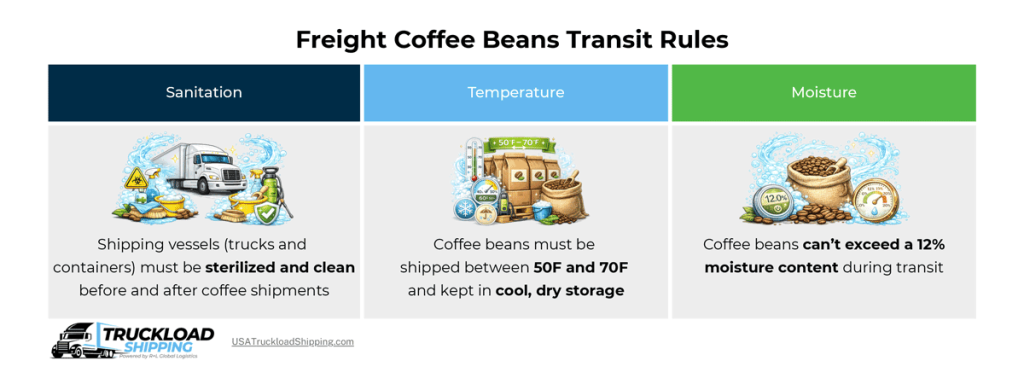
We’ve made a chart of truckload coffee shipping best practices that support FSMA sanitary transportation expectations.
Chilled coffee products like coffee concentrate or bottled iced coffee must be shipped at or under 40F according to the US Department of Agriculture (USDA).
If chilled coffee drinks heat up to over 40F, the USDA considers this the “danger zone.” Bacteria and mold can potentially develop in the drinks during transit if they’re above this temperature.
Shipping coffee safely requires the appropriate trailer, such as a reefer or refrigerated trailer for chilled coffee beverages. We’ll explore the best shipping modes for coffee in the next section.
You can ship coffee in a variety of ways, including full-truckloads (FTL) for large, commercial amounts of coffee freight.
Whether it’s coffee beans or bottled beverages, we’ll go over the best shipping mode for coffee logistic success.
FTL is a shipping mode where one shipper uses an entire trailer, which reduces handling and helps protect shipments. FTL is a strong fit for palletized cases of packaged coffee beans, coffee grinds, and bottled or cartoned beverages.
Here’s a truckload planning checklist:
Unlike less-than-truckload (LTL) freight, FTL shipments belong to one shipper instead of multiple shipments owned.
Use FTL for large quantities of coffee for cost-effective and quicker shipping.
Expedited is a shipping service designed to reduce transit and dwell time for shipments that have strict delivery windows or higher risk of spoilage.Transit times are typically between one and three days, or even same-day.
Use expedited shipping when:
Here at USA Truckload, we offer each shipping mode to deliver your coffee with our network of over 22,000 carriers who are qualified to transport your freight with care and speed.
After primary packaging, most truckload coffee freight is unitized as palletized cases. Crating is less common and is typically reserved for high-value or fragile freight that requires rigid protection.
We've made a chart to compare the best ways to ship coffee with pallets:
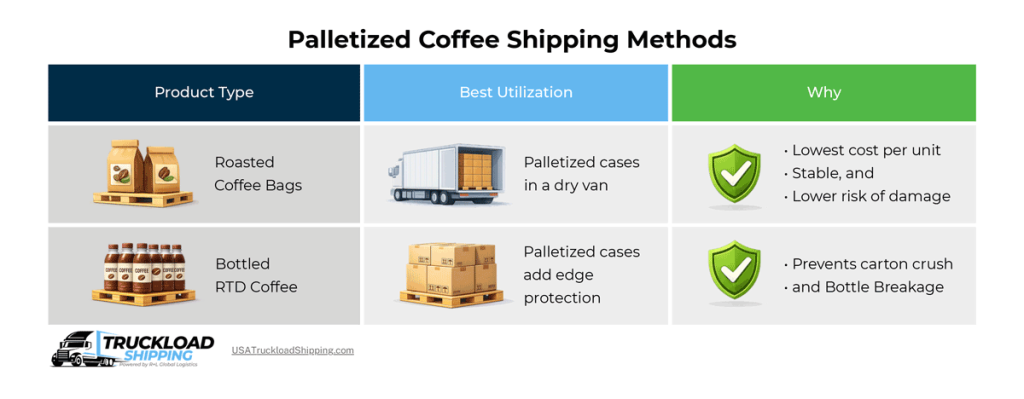
Palletized freight needs maximum stability on the base. You must secure boxes to endure strong turns or movements to prevent toppling over on the ship or in the freight truck. Shrink-wrapping your palletized freight secures it to resist movement.
Our drivers are trained to handle fragile freight with our equipment like forklifts and pallet jacks to load and unload your coffee with ease.
If you are looking for a company to help you with the coffee shipping process, we’re ready to help. We provide domestic and international service to a wide range of industries, so if you ship roasted coffee, we’ve got the expertise to get it done.
Give us a call at (866) 353-7178 to speak to one of our logistics experts or receive a freight shipping quote in under ten minutes here.
 Copy URL to Clipboard
Did you find this article helpful?
See more of our coverage on Google.
Add usatruckloadshipping.com as a preferred source!

R+L Global Logistics
315 NE 14th St., Ocala, FL 34470
