

See more of our coverage on Google.
Add usatruckloadshipping.com as a preferred source!

Freight pickup problems often begin before a truck reaches the dock. A poorly chosen appointment window can leave drivers waiting, disrupt warehouse workflows, and create avoidable charges that cut into shipment margins. This guide shows how shippers can build a more reliable pickup process before the scheduled arrival.
A freight pickup appointment window reduces missed pickups by aligning dock availability, carrier capacity, and driver Hours-of-Service limits. Better scheduling lowers delay risk, reduces accessorial charges, and improves on-time pickup performance.
A freight pickup is a scheduled appointment for a motor carrier to pick up a shipper’s freight for transportation. Booking appointments reduces miscommunication, service delays, and costly accessorial charges when carriers attempt a pickup.
Freight appointments generally take place during 8 A.M. and 5 P.M. or standard business operations. However, shippers can partner with carriers for morning, afternoon, or evening pickups depending on capacity, equipment and mode availability, and freight routing.
Shippers and carriers miss freight pickups when they fail to confirm appointment details or prepare loads on time.
The Federal Motor Carrier Safety Administration (FMCSA) is an agency of the U.S. Department of Transportation (DOT) that oversees freight transportation and safe carrier practices. The FMCSA Behavior Analysis and Safety Improvement Categories (BASICs) to monitor carrier safety and compliance, including Hours-of-Service (HOS) compliance.
According to the FMCSA Hours-of-Service rule (2020), truck drivers cannot exceed 11 driving hours per shift, or the FMCSA short-haul exception 14-hour work shift. This means shippers must account for their business operational hours and the carrier’s HOS in the freight appointment window to keep goods moving and maintain compliance.
While many truck drivers prefer early morning time slots to haul freight that fills their 11 driving hour limit, shippers must schedule appointments based on what works best for their business and logistics needs.
Consider your product, receiving location and surrounding traffic, and shipping mode to choose the best time slot for your pickup appointment.
Here are a couple of scenarios where morning, afternoon, or evening can work as appointment times.
LTL and FTL:
Less-than-truckload (LTL) is a shipping mode that consolidates small shipments from multiple shippers into one truck. Full truckload is a shipping mode to transport high-volume loads on a dedicated truck from point-to-point.
Morning appointments work best for shippers using LTL or FTL as each mode may take a driver between up to 500 miles, or around 10 hours, from pick up to delivery.
Urban vs Rural:
If your fulfillment center or business location restricts freight entry, your driver may encounter traffic congestion or limited access conditions at your building. However, dense urban areas often have better infrastructure (local roads, highways, and interstates) than rural areas to keep goods moving.
Early to late afternoon pickups are a great option for shippers in either location as carrier capacity opens up during this time as drivers are completing early morning appointments.
Spot loads and First-Come, First-Serve (FCFS) methods may benefit shippers with freight that can handle longer wait and transit times. A spot load is a one-time transaction for shipments using current market spot freight rates. FCFS is a logistics method that assigns loads to drivers without appointments and instead loads trucks based on each driver’s arrival time.
While shippers can utilize spot loads and carriers may use the FCFS method for pickups, an appointment removes the guesswork in planning your shipment and avoiding costly delays.
In the next section, we’ll show how to pick the best appointment window to improve on-time pickup (OTP).
Choose a freight pickup time slot based on dock readiness, freight type, site access, driver Hours-of-Service limits, and carrier availability. Morning windows often reduce delay risk, while afternoon slots can improve capacity in congested markets.
Missed pickups can happen when the carrier or shipper do not properly communicate and agree on the shipper’s transportation needs and the carrier’s capacity.
We’ve compiled a chart of the most common appointment window mistakes.
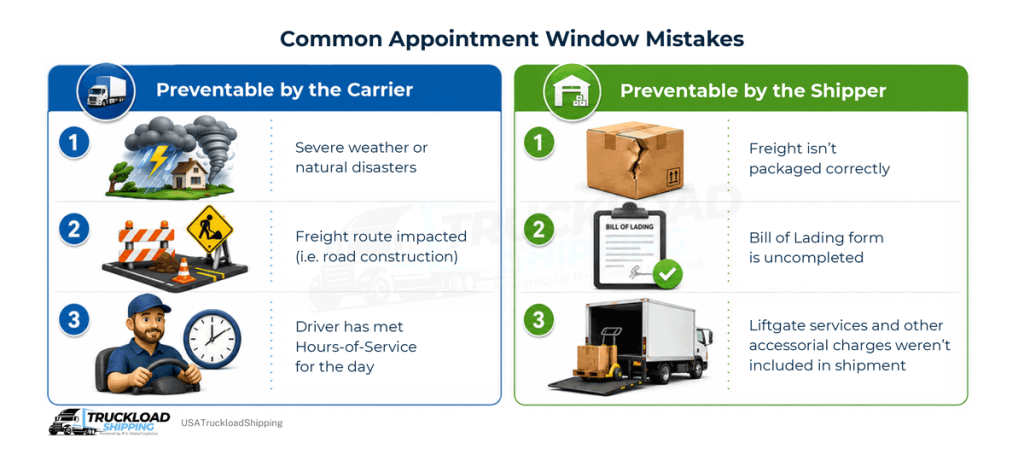
Avoid these mistakes by preparing your load and dock for pickup and completing required documentation that includes appointment date and time to improve OTP.
The FMCSA Cargo Securement Rules helps prevent freight from shifting inside or falling off from trucks. Shippers may employ third-party workers at warehouses and distribution centers to package and load freight onto trucks upon arrival.
Prepare your load for pickup with the following steps:
When freight isn’t ready to load, shippers miss appointments and risk redelivery fees. A redelivery is an accessorial charge added when a carrier cannot complete a scheduled delivery and must return to deliver the shipment at a later date.
Pickup appointments require the following shipping documents to confirm the shipper’s appointment and transportation needs.
Once a shipment is complete, the carrier provides the shipper the Proof of Delivery (POD), the final shipping document to confirm freight was delivered.
Shippers can simplify scheduling a freight pickup with their carrier by having the load and paperwork prepared ahead of time, reducing transportation lead time.
The best freight pickup appointment windows align with carrier capacity, driver Hours-of-Service limits, and dock readiness. Morning slots reduce delay risk, while flexible afternoon windows improve carrier availability and reduce missed pickups.
If you find balancing cost control, dock restraints, and lead time challenging, we’ve created a checklist to help you reduce missed appointments and keep your supply chain on schedule.
Shippers should confirm appointment in two phases:
This confirmation process helps improve time slot management by guaranteeing your carrier has a driver for your load and is en route for pickup. Make sure you have your carrier’s business phone number and email to contact them with any updates.
Exception management is a risk mitigation process for shipment delays. Exception routing allows shippers and carriers to develop backup strategies to pickup and deliver goods when:
A shipper’s strategy should include strategic carrier selection to choose a partner with a carrier who has the capacity, equipment, safety rating, and federal compliance to navigate logistics challenges.
Once your appointment is set, it’s your facility’s responsibility to prepare, package, and palletize freight for pickup once the truck driver arrives. Throughput is the total amount of time inventory or work is fulfilled in a facility during a certain time period.
Throughput allows shippers to improve production in their facilities by monitoring outbound and inbound processes.
Whether your freight pickup is at a warehouse, distribution center, or retail business, use these steps to improve your dock process for pickup appointments.
3 Steps to improve throughput include:
Using these techniques helps shippers prepare outbound freight for efficient loading that doesn’t result in detention. Detention is an accessorial charge added to a freight bill for making a driver wait beyond the two-hour dwell time.
Drivers input dwell time using ELD (Electronic Logging Device) as a part of the shipper or carrier’s TMS. The carrier then bills the shipper for the additional time used, up to $100 every hour truck is delayed or shipping containers are held in the facility.
Our freight experts are happy to work with you on your schedule for freight pickups that are on time, every time. Call us at (866)-353-7178 to speak with our team or submit your freight request for proposal to get started.
Sources:
Hours of Service Drivers Final Rule, FMCSA, 2020
Cargo Securement Rules, FMCSA, 2014
 Copy URL to Clipboard
Did you find this article helpful?
See more of our coverage on Google.
Add usatruckloadshipping.com as a preferred source!

R+L Global Logistics
315 NE 14th St., Ocala, FL 34470
