Shippers can use less-than-truckload to transport a wide variety of commodities, including hazardous materials (hazmat). However, the Federal Motor Carrier Safety Administration (FMSCA), an agency of the Department of Transportation (DOT), has hazmat guidelines that shippers and carriers must follow. We’ll use our shipping experience to break down the best LTL shipping options for hazardous materials.
Key Takeaways
LTL shipping is great for smaller, dense loads, making it a great option for certain kinds of hazmat freight. We’ll walk you through how to get started.
Less-than-truckload (LTL) shipping is reserved for freight that doesn’t fill a full truckload (FTL). With LTL shipments, freight is consolidated onto one trailer but shared with multiple shippers’ freight.
Because you’re sharing a trailer, you pay for the space you use, but your freight will be along for the ride with other shipments en route to each’s final destination.
When you ship hazardous materials on an LTL shipment, you’ll need to know the FMCSA’s regulations to safely ship your hazmat cargo with others on the ride.
Let’s start with the hazmat shipping requirements.
Because hazmat shipments can include everyday items like batteries and cleaning supplies, shippers must be aware of how to identify and label them to abide by state and federal guidelines.
Like FMSCA, Pipeline and Hazardous Materials Safety Administration (PHMSA) is another primary agency of DOT that oversees hazmat transportation. PHMSA created the Hazardous Materials Regulations (HMR) to protect people, property, and the environment from hazmat shipping incidents.
Hazardous Materials Regulations breakdown how to:
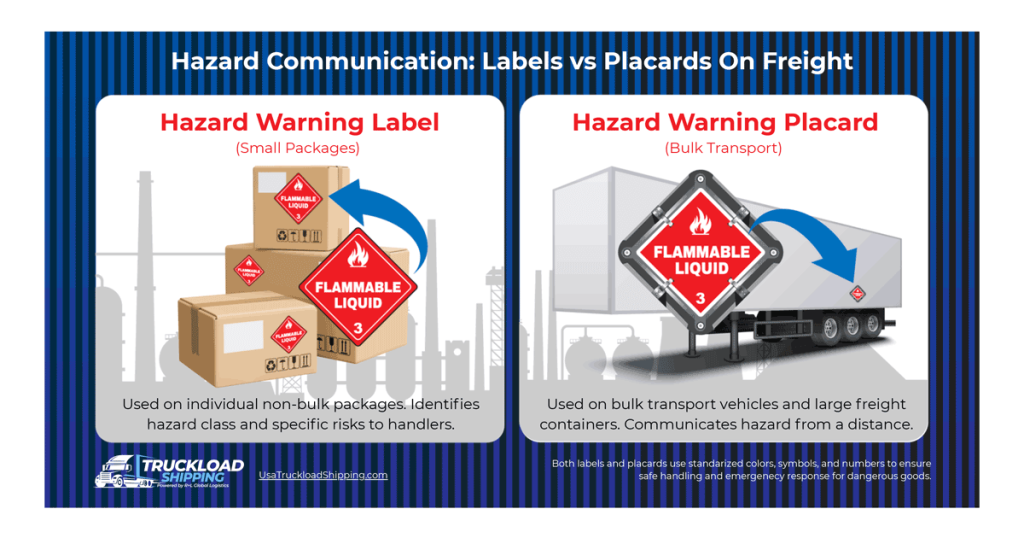
HMR’s packaging requirements include marking your cargo with the appropriate hazard warning label and placards. Your carrier will need this information to ensure your cargo is handled with care and consolidated with items that won’t react unfavorably with the hazmat shipment.
PHMSA also has assigned three Packing Groups to safely identify hazmat shipments and their degree of danger to people or the environment.
Knowing your Packing Group helps you choose the right container for your hazmat for safe transport to avoid spills and other accidents.
You can classify your hazmat and its Packing Group by learning the nine classes of hazardous materials.
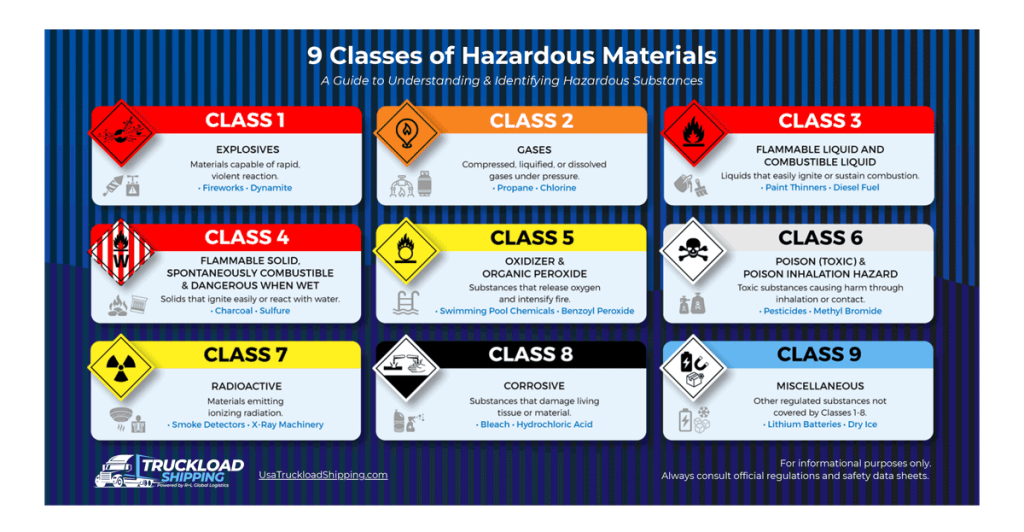
Each class of hazardous materials are divided into subclasses to further classify the type of commodity. This helps carriers better understand how to ship your hazmat freight and calculate the fees.
Related: Chemical Shipping Regulations: A Complete Guide
For example, class 1 covers a range of explosive hazardous materials (usually in Packing Group I), and it’s divided into six subclasses. The first three subclasses are:
Most carriers have a restricted or prohibited hazmat items shipping policy in accordance with federal laws.
Here at USA Truckload Shipping, 100% of our carriers and drivers are hazmat certified. Let’s look at the full scope of FMCSA’s requirements for carriers and shippers.
FMCSA requires both the shipper to comply with hazmat transportation regulations before, during, and after transit.
For Shippers:
Classify your freight as a hazardous material and complete a hazmat Bill of Lading (BoL) (aka shipping papers) with your carrier. This includes properly marking and labeling your hazmat freight with the following:
A hazmat BoL is virtually the same as a standard straight BoL, but it also includes critical hazmat details for your carrier.
Correctly labeling hazardous materials is usually the toughest part of shipping hazmat. It’s this mistake and others, like incomplete emergency response information, that can put you and your business at risk of pricey penalties.
For civil violations, like improper package labeling or missing shipper papers, the maximum penalty is $79,976; or $186,610 if a violation led to property damage, serious illness, or death.
For criminal violations, like illegally disposing hazardous waste or importing restricted chemicals into the US, the maximum individual penalty is $250,000; or $500,000 for corporations.
The safest way to ensure your hazmat freight is compliant is to accurately classify your goods. Our hazmat certified freight brokers can guide you through this step for a smooth LTL shipment.
There are two methods used to classify LTL freight. This applies to hazardous materials that are shipped using LTL services. Carriers will need the hazmat identification number as well as its freight classification.
You can find your freight’s class by measuring your hazmat’s density, liability, and ease of movement.
There are 18 freight classes based on density. The denser your hazmat, the lower the number and cost. The lighter the density, the higher the number and cost. Freight classes are numbered from 50 to 500.
LTL shipments also need a NMFC code to help your carrier identify your cargo to better price it.
When it comes to transporting hazardous materials, we’re here to help. Our team is certified with experienced agents and drivers to deliver your sensitive goods to any location.
Talk with a hazmat freight agent today by calling (866)-353-7178. Ready to book your haul? Submit your request an RFP to get started.

R+L Global Logistics
315 NE 14th St., Ocala, FL 34470
