

See more of our coverage on Google.
Add usatruckloadshipping.com as a preferred source!

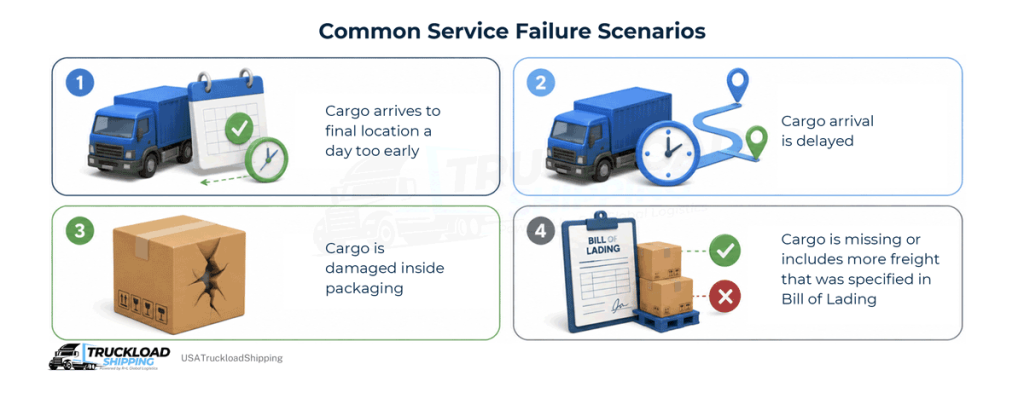
A service failure in freight shipping is a pickup, delivery, handling, or equipment error that disrupts the shipment terms in the Bill of Lading. Common service failures include missed pickups, late deliveries, wrong trailer assignments, and over, short, or damaged freight.
A service failure is any error that prevents a shipment from being completed as agreed in the Bill of Lading (BoL).
We’ve included the most common scenarios that result in service failures in the following graphics.
Motor carriers or third-party logistics (3PL) companies include dispatch management that tender loads and direct drivers to pick up and deliver cargo. Beyond transportation, shippers order truckload services to protect freight in transit.
If carriers send the wrong trailer or service for a load that was outlined in the Bill of Lading, shippers have the right to document these carrier service disruptions and file a dispute for financial compensation from delayed service or damaged goods.
We’ve given some examples of when shippers should take note of service failures.
Example: Incorrect Equipment Assignment
A shipper requests a reefer truck for a FTL shipment of frozen meals headed to Walmart from the shipper’s warehouse. The carrier accepts the load and sends a driver to pick up the load from a temperature-controlled warehouse, but the driver arrives on time hauling a dry van. The shipper must refuse the trailer and transportation is stalled by a day.
Example Two: Missed Freight Pickup
A shipper needs to move two pallets of sneakers to a local sporting goods store. The shipper books an appointment with an LTL carrier to pick up the load from the shipper’s facility at 1 P.M. on Wednesday. The driver doesn’t arrive at all and the shipper calls the carrier to learn dispatch mistakenly booked the pickup for Thursday at 1 P.M., leading to a missed pickup and service delay.
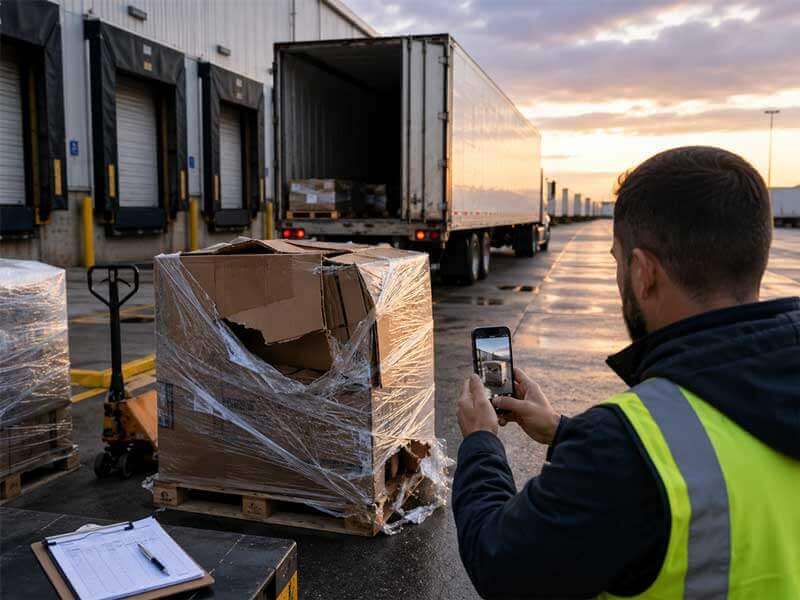
After a service failure, capture appointment times, carrier contacts, freight condition notes, photos, and all shipment documents that support the dispute. This information should be compiled in a freight claim.
According to 49 U.S.C. § 14706 carrier liability rules, shippers must file freight claims within 9 months from the date of delivery. A freight claim is a legal document to request compensation for service failures that include over, short, or damaged (OS&D) claims.
While the Carmack Amendment specifies shippers cannot file claims for logistics service issues beyond a carrier’s control, like acts of war or natural disasters impeding transportation.
Shippers filing freight claims will need the following true and factual information to dispute service errors.
Document the date and time of your carrier appointment along with the date and time they actually arrived, unless the carrier no-showed the appointment. Gather the carrier’s contact information in your dispute, including full name, business names, business address, and phone number.
For OS&D freight, take photo evidence of freight conditions.
This includes:
After inspection, take one to two clear, well-lit photos of freight conditions.
Delivery exceptions are shipping delays that are not at the fault of the carrier. Holidays, missing freight labels and documentation, or severe weather impede delivery even when a carrier was on time to deliver goods.
If your carrier arrives minimally late for a delivery due these circumstances, you can still document it as a service failure and discuss options with your carrier about managing time slots before you file.
To file a freight claim for a service failure, collect evidence, submit the claim to the carrier in writing, and escalate the dispute if the result is unsatisfactory.
We’ll discuss how to file and manage a claim and what to expect during the process.
If your service failure is a time slot issue, document the time your carrier arrived and ensure it matches your appointment and shipment date in the Bill of Lading.
If your service failure is a freight damage issue, take pictures of your freight and include notes such as the Bill of Lading, packing list, and freight bill that includes freight details and special handling instructions.
In an email, written letter, document transfer in the shipper or carrier’s transportation management system (TMS), send your carrier your claim (missed pickup or damaged freight) along with:
Claims are filed with the carrier and not the carrier’s insurance provider. Under 49 CFR Part 370 freight claim rules, carriers must acknowledge a freight claim in writing within 30 days of receipt unless they pay or decline the claim in writing during that period.
Carriers may deny claims due to exclusions under the Carmack Amendment, incomplete missing documentation, or timeline mistakes that do not support the shipper’s claim for late freight or missed pickups.
If a carrier offers to settle your claim for the less than requested amount, or denies the claim altogether, shippers can choose to escalate the claim by working with a legal mediation group to settle the claim.
Carriers will likely work with the shipper before attorneys are necessary as 49 CFR Part 370 states carriers must process claims within 120 days of the file date.
Carrier scorecards help shippers navigate carrier vetting and FMCSA compliance. The Federal Motor Carrier Safety Administration (FMCSA) is a U.S. agency that regulates carrier compliance and safe freight transportation, providing resources like the FMCSA SAFER Web Company Snapshot.
FMCSA’s Safety and Fitness Electronic Records (SAFER) system is a federal database to monitor and audit carrier’s safety ratings and regulations compliance to haul freight. Shippers can reduce transit damage and freight claims by vetting carriers using SAFER to verify the carrier’s service and compliance history.
Need to file a freight claim? Use our claim-ready package checklist to prepare:
If managing delivery failures is challenging and delaying your supply chain management, speak with a licensed freight broker to learn more about risk mitigation and cost control for your logistics strategy going forward.
If recurring service failures are increasing claim frequency and operational costs, working with a vetted 3PL can reduce risk with a carrier who matches your shipping needs. USA Truckload Shipping is a 3PL that partners with over 22,000 vetted and FMCSA-compliant carriers with the service, rates, and mode to move your freight.
Call our freight team at (866)-353-7178 to schedule a freight pickup, or send your questions through our freight shipping contact form.
Sources:
49 U.S. Code § 14706 - Liability of carriers under receipts and bills of lading
SAFER Web, FMCSA
49 CFR § 370 - Principles and Practices for the Investigation and Voluntary Disposition of Loss and Damage Claims and Processing Salvage
 Copy URL to Clipboard
Did you find this article helpful?
See more of our coverage on Google.
Add usatruckloadshipping.com as a preferred source!

R+L Global Logistics
315 NE 14th St., Ocala, FL 34470
