


See more of our coverage on Google.
Add usatruckloadshipping.com as a preferred source!

A sweet potato is a starchy vegetable that can be shipped fresh, canned, or frozen. Sweet potatoes must be transported according to the Food Safety Modernization Act (FSMA), a law enforced by the Food and Drug Administration (FDA). FSMA regulates the vehicle conditions sweet potatoes and all foods are delivered in to prevent contamination and foodborne illnesses. This guide will explain how to ship sweet potatoes by truckload to comply with FSMA.
The U.S. Food and Drug Administration enforces the Food Safety Modernization Act (FSMA), which sets sanitary transportation requirements for food moved in commerce. For sweet potato shippers, that means using clean equipment, documenting handling expectations, and matching trailer conditions to the product being shipped.
Under sanitary transportation rules, carriers and shippers should coordinate on equipment cleanliness, prior-load risk, and temperature needs when a shipment requires temperature control.
FSMA requires carriers to:
While it’s a carrier’s responsibility to ensure their trucks are sanitized and drivers practice food-safe operations during loading and transit, shippers must ensure the product is pest and disease free and packaged for safe shipping.
Sweet potatoes are shipped in high-quantities as fresh, frozen, or canned. In any form, here are the best practices to ship sweet potatoes to maintain quality and remain FSMA compliant.
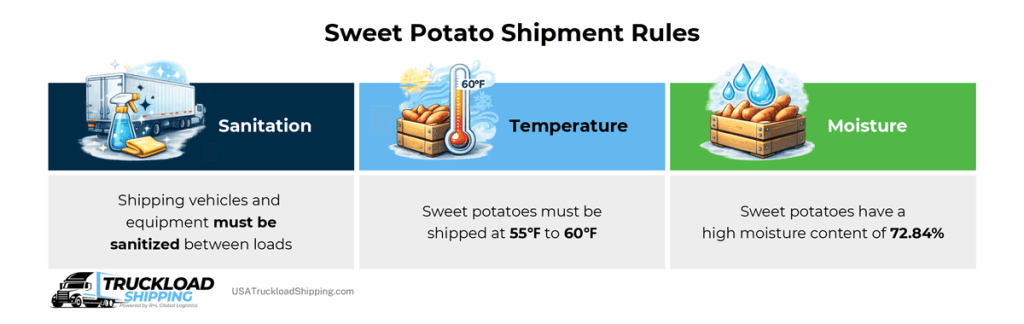
Sweet potatoes have a high moisture content percentage of 72.84%. This makes them prone to bruising and rotting if humidity and temperature levels aren’t stable during transit.
Curing sweet potatoes is a process to extend their shelf life and gives them a sweeter and more full-bodied taste. It also allows the sweet potatoes to heal from any damages incurred from the harvest process.
To cure, sweet potatoes are left in an environment of about 85℉ and 90% relative humidity for several days. After almost a week, the sweet potatoes are then cooled and processed for shipping.
While some sweet potato products, like frozen diced sweet potatoes, require a reefer trailer control temperature, a dry van is typically acceptable for large sweet potato shipments.
The Tar Heel State is a major producer of sweet potatoes. The state's temperate climate means you'll need an experienced partner when shipping freight from North Carolina.
We’ll review the best shipping modes for sweet potatoes in the following next section.
FTL shipping is usually the best fit for high-volume sweet potato freight moving from farms, packing facilities, or food suppliers to distribution centers, wholesalers, or grocery chains.
FSMA requires trucks to be cleaned before and after each shipment to eliminate contamination risks. In some cases, your customers may need a rush delivery to ensure the sweet potato freight arrives in quality condition.
We’ll break down how to use FTL and expedited services to ship sweet potatoes for logistics success.
FTL is a shipping mode that fills an entire semi-trailer (dry van or reefer) with one shipper’s freight. Sweet potato shippers use FTL when they need lower handling, faster transit, and more control over trailer conditions.
FTL shipments are best used for:
Whether you’re shipping bulk sweet potato freight locally or across the U.S. like from Mississippi to Texas, FTLs can haul both a dry van or reefer trailer to deliver your goods safely and remain in FSMA compliance.
Expedited is a shipping mode for FTL and less-than-truckload (LTL) freight. Sweet potato shippers may use expedited service when a retailer has a tight delivery appointment, a replenishment order is urgent, or product quality could decline if transit is delayed.
We offer both shipping modes through our network of over 22,000 carriers who are FSMA compliant and ready to ship your sweet potato freight.
Since some sweet potatoes may require temperature control, we recommend using this checklist to get ready for your next haul:
Now that you know how to protect your sweet potatoes on the road, let’s look at how to process and package them.
A sweet potato grading standard is a food grade shield regulated by the U.S. Department of Agriculture (USDA). This grade shield helps shippers to prepare sweet potato shipments to preserve the quality and avoid foodborne illnesses during transit.
There are five sweet potato grading standards:
For truckload shipping, grading matters because lower-grade products may need tighter inspection and packaging controls to prevent claims related to bruising, decay, or rejected deliveries.
You should ensure a thorough inspection process is conducted to detect signs of mold, decay, and pests before packaging. Once you have determined the grade of your sweet potato freight, you can prepare them for shipping.
Sweet potatoes are commonly packed in cartons, bins, bags, or retail-ready containers before palletization. The right packaging format depends on whether the shipment is bulk produce, retail distribution freight, or a processed sweet potato product.
Palletized freight is a packaging method to transport bulk freight on a sturdy, flat surface. You can stack boxes of sweet potatoes on pallets to optimize the space. Stable pallets reduce handling damage to sweet potatoes, improve loading speed, and make it easier for receivers to unload the shipment with forklifts or pallet jacks.
A 53-foot dry van or reefer trailer often carries around 26 standard pallets in a single layer, but actual capacity depends on pallet footprint, carton dimensions, product weight, and whether double-stacking is allowed.
We’ve created a chart of the packaging materials needed to ship sweet potatoes in high-quantities.
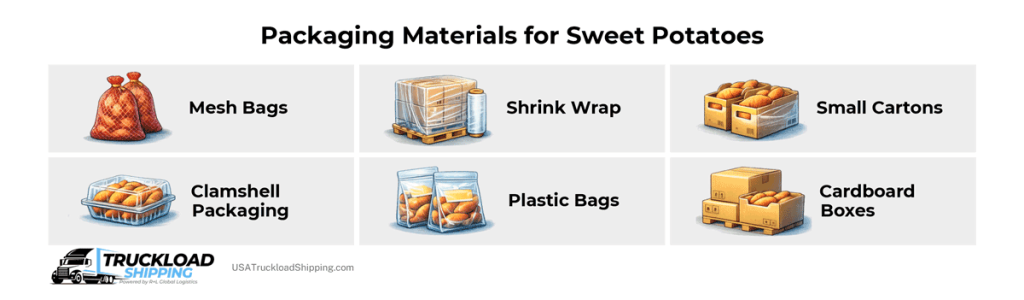
To reduce damage during transit, sweet potatoes shouldn’t have a lot of space to shift around in the box or container. Make sure your containers are going to hold up in high-humidity environments, since things like certain wood and cardboard lose their strength as they get damp.
Your carrier will be able to easier load and unload your palletized freight with pallet jacks or forklifts to speed up the overall transportation.
If you need help shipping sweet potatoes, you can count on us. If you’re ready to start shipping sweet potatoes, or anything else, give us a call at (866)-353-7178 or reach out to us on our contact page.
 Copy URL to Clipboard
Did you find this article helpful?
See more of our coverage on Google.
Add usatruckloadshipping.com as a preferred source!

R+L Global Logistics
315 NE 14th St., Ocala, FL 34470

Do you do shipping overseas?
Sweet potatoes from Papua New Guinea to Australia and New Zealand