

See more of our coverage on Google.
Add usatruckloadshipping.com as a preferred source!

Dwell time is the total time a truck or container remains at a facility waiting to be loaded or unloaded. For shippers, warehouses, and logistics teams, reducing dwell time is essential for avoiding detention fees, improving dock efficiency, keeping freight on schedule, and supporting safer, more reliable supply chain operations.
Shippers can reduce dwell time by preparing freight before pickup, staging docks and equipment in advance, confirming appointments early, and tracking delay patterns with KPI. Faster loading and unloading improves safety, lowers accessorial costs, and keeps carriers moving on schedule.
Shippers should prepare their facilities for the loading and unloading process by staging the receiving location and utilizing cross docking to streamline the routine.
Staging is a process that prepares a facility to receive or dispatch goods to and from a truck. The staging area is in front of the loading docks.
Warehouse equipment that makes staging easier includes:
Another great way to improve staging and load-ready standards is by preparing your facility for cross docking.
Cross docking is a strategy that moves inbound freight to an outbound truck with little or no storage time. The technique is beneficial because it can reduce dwell time. The facility has multiple truck entrances and is divided into outbound and inbound trucks.
We’ve created a flow chart of how to implement cross docking in your facility:
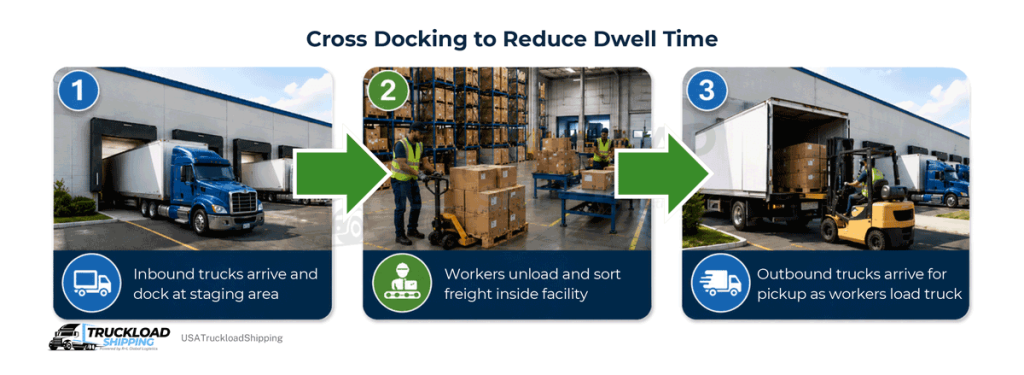
As you can see, cross docking is a great way to strategize your loading process and quickly get your driver back on the road to avoid detention.
Shippers or their freight broker should communicate with the carrier before the scheduled freight pickup at least twice to confirm appointment time. Contact your carrier three days before your appointment and the day before or day of arrival to ensure the shipment is on schedule and free from delays caused by vehicle maintenance, traffic, or port congestion.
A key performance indicator (KPI) is a quantifiable measure of progress to achieve results. Shippers use KPIs like average dwell time, dock utilization rate, and on-time pickup (OTP) to identify causes of dwell time and reduce delays.
Factors like a carrier’s unsafe driving, crash indicator, and driver fitness are KPIs under FMCSA BASICs. Shippers can review this information to vet carrier’s safety ratings and compliance on FMCSA SAFER Company Snapshot. Choosing a reliable carrier with good BASICs KPIs will improve your shipping efficiency.
Dwell time is calculated by subtracting truck arrival time from truck departure time.
Here’s the formula:
Dwell Time = Truck Departure Time - Truck Arrival Time
For example, a truck driver is en route to deliver a shipper’s container of clothing and shoes that the driver picked up from a port of entry. When the truck driver arrives at a shipper’s distribution center at 9:50 AM, the workers have two hours from the arrival time, or 11:50 AM, to unload the container as the driver waits. However, the workers didn't finish unloading the freight until 12:50 PM because of an uncharged electric forklift.
Let’s refer to the formula to find the dwell time.
2 Hours and 40 Minutes = Truck Left at 12:30 PM - Truck Arrived at 9:50 AM
With only two hours of allotted dwell time, the workers exceed this time by two hours and 40 minutes.
Accessorial charges for dwell time usually include detention and demurrage fees when a container or truck is held too long.
Detention is an accessorial charge shippers pay when holding a carrier’s equipment beyond the allotted amount of time. Detention fees range from $80 to $150 every hour past dwell time.
Demurrage fees are an accessorial charge shippers pay for leaving containers inside of a port of entry or terminal beyond the allotted free time. Demurrage fees range from $75 to $300 to deter shippers from using the port or terminal as interim storage.
Shippers can avoid demurrage and detention charges by clarifying the carrier’s dwell time and accessorial fees in shipping documents like the Bill of Lading (BoL) prior to pickup or dropoff.
Dwell time fees occur when loading or unloading exceeds the agreed time window due to delays such as congestion, labor shortages, missed appointments, or unprepared freight. Let’s look at a few more common reasons shippers may encounter detention time in trucking.
Freight pickup scheduling helps carriers to prepare the requested shipping mode and driver. Appointments take place during standard business hours, 8:00 AM to 5 PM, and if shippers miss the appointment, they risk accessorials like detention, TONU, and layover.
Where dwell time delays may be a result of road construction or weather alerts delaying service, shippers face fees if they don’t have freight packaged, palleted, and prepared to load containers for pickup.
A shipper’s warehouse, distribution center, or business will generate dwell time fees if the location doesn’t have adequate staff or loading docks and hinders load/unload. When loading docks aren’t available, most carriers offer liftgate services to accommodate the shipper and easily move freight to and from the location.
We work with over 22,000 FMCSA-compliant carriers across the U.S. to support your supply chain with the right mode, equipment, and capacity to solve dwell time issues before they begin.
Call (866)-353-7178 to speak with our freight team or submit your freight request for proposal to get shipping today.
Sources:
SAFER Web, FMCSA
 Copy URL to Clipboard
Did you find this article helpful?
See more of our coverage on Google.
Add usatruckloadshipping.com as a preferred source!

R+L Global Logistics
315 NE 14th St., Ocala, FL 34470
