

See more of our coverage on Google.
Add usatruckloadshipping.com as a preferred source!

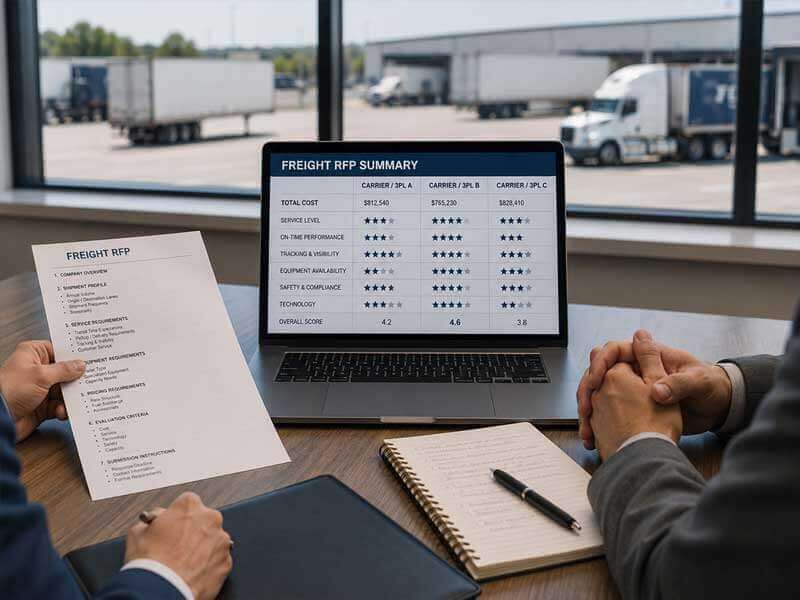
A freight request for proposal (RFP) is a document shippers use to collect and compare transportation solutions from carriers or third-party logistics companies (3PLs). It typically includes shipment volumes, lanes, service requirements, equipment needs, and evaluation criteria so carriers can submit accurate bids to move freight.
Shippers should use a freight RFP when they need to source new carriers, compare bids, rebid lanes, add specialized services, or formalize transportation requirements before the one they want to use.
Freight RFPs help shippers define shipment requirements before selecting a carrier or 3PL. RFPs give providers the information needed to evaluate lanes, service expectations, equipment requirements, and operational fit before submitting a bid.
RFPs also help freight providers understand how to deliver freight, including:
Freight RFPs help shippers organize transportation needs, compare carrier capabilities, and request comparable bids before selecting a provider.
We’ve created a chart of common freight issues RFPs help shippers solve.
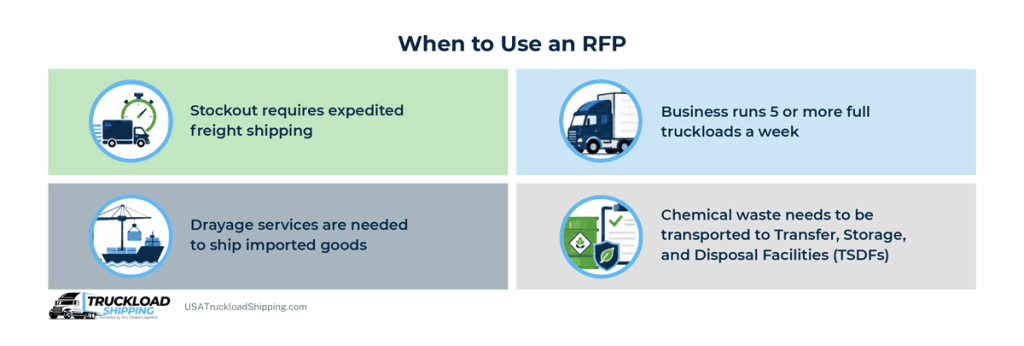
Shippers can send freight requests for proposals to one or multiple carriers to find the best-fit freight expert for their shipment.
A freight RFP should include lanes, shipment volumes, freight characteristics, service requirements, equipment needs, and timing expectations so carriers can price and plan the work accurately.
This includes other logistics services such as warehousing and specialized freight handling like white glove or inside delivery.
Once shippers outline their transportation needs, carriers are able to develop a freight plan to meet them. Shippers then need to review the following data to compare carriers and choose a partner that has the capacity and strategy for their freight.
A lane is a series of freight routes used for truckload transportation. Carriers optimize shipping lanes based on:
Shippers must provide their business’s freight volume in the RFP for carriers to understand the best lanes to move their freight.
Full truckload (FTL) shipments may travel different lanes than less-than-truckload (LTL) shipments to reduce touchpoints or transit time. When comparing RFPs, consider the quality of a carrier’s lanes instead of the quantity.
If one carrier has 20% fewer lanes than another, but can move 80% of your freight volume on those lanes, that carrier may still offer better transit times and lower shipping costs.
Shippers must identify a carrier’s service constraints to ensure they have the capacity for their shipments at any given time.
While freight capacity fluctuates due to factors like weather conditions and truck availability, shippers can include in their RFP their business’s desired transportation schedule to work with a carrier’s operational hours.
Your RFP should also include the freight equipment carriers should have available to load and unload your shipment.
This equipment can be:
Clarifying the resources your freight needs in your RFP simplifies carriers’ plans to assist you in moving it.
Once a shipper has created a freight RFP to send to carriers to bid on, the timeline looks like this:
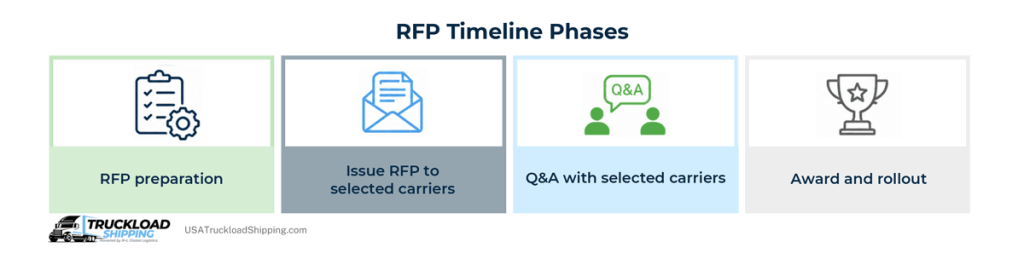
Let’s break down each phase in the following sections.
RFPs include a shipper’s shipment information, including, but not limited to:
The RFP should indicate whether the carrier needs to move an FTL or LTL shipment. Additional service requests, such as a reefer trailer for temperature-controlled goods, must also be clarified in the request.
Shippers send their RFP to the carriers they are interested in partnering with. You can email RFPs to the carrier or submit an RFP form through the freight provider’s website.
If you’re unsure if a carrier is a good fit for you before you send an RFP, vet your carrier by reviewing their Federal Motor Carrier Safety Administration (FMCSA) safety rating and compliance via the SAFER system.
Once carriers bid on your RFP, schedule a consultation with the carrier to discuss the scope of work and potential partnership.
This should include questions like:
Be sure to clarify your business’s pain points and ask questions to understand the carrier’s potential solutions.
Once you’ve accepted a carrier’s bid on your RFP, you can award lanes to start shipping.
The RFP award process includes:
Awarding carriers with a formal letter and ready paperwork starts your agreement with the right tone to build a successful logistics partnership.
Compare bids using both price and operational fit. The best provider is not always the lowest-cost option if service reliability, claims handling, technology compatibility, and capacity support are stronger elsewhere.
Review these metrics when comparing bids:
In the next section, we’ll discuss common RFP mistakes to avoid partnering with the wrong carrier.
Freight RFPs often fail when shippers provide an unclear scope of work, incomplete pricing requirements, or undefined transportation expectations.
Here are a few common mistakes shippers make when preparing and awarding RFPs that could lead to a shaky start of a partnership and ultimately freight transportation needs not being met.
Unclear scope of work creates chaos during the RFP process. If shippers do not clarify shipment details and service expectations, carriers may reject the tender.
Accessorial charges are an additional service fee to complete a shipment. Carriers can apply accessorials to cover fuel surcharges, liftgate, and chassis trailers for drayage. Shippers must ask about a carrier’s baseline accessorial charges to calculate if they fit your budget in the event they are included in a freight bill.
Shippers should use award logic to vet the best carrier for their shipment. The best-fit carrier isn’t always the least expensive. A carrier or 3PL that suits your business needs is one that routinely develops strategies to navigate the freight market and keep your supply chain moving without sacrificing quality service.
Once you’ve defined your lanes, service needs, and bid criteria, the next step is to submit your request to qualified providers or get help building the freight RFP.
There is no single freight RFP template used across logistics providers, but most templates collect the same core information so carriers can submit accurate, comparable bids.
This includes:
If you need help creating a freight RFP template or reviewing carrier responses, our freight team can help you get started. Call (866) 353-7178 with no obligation.
Sources:
National Motor Freight Classification® (NMFC)®, NMFTA
Safety and Fitness Electronic Records (SAFER) System - Company Snapshot, U.S. Department of Transportation
 Copy URL to Clipboard
Did you find this article helpful?
See more of our coverage on Google.
Add usatruckloadshipping.com as a preferred source!

R+L Global Logistics
315 NE 14th St., Ocala, FL 34470
