

See more of our coverage on Google.
Add usatruckloadshipping.com as a preferred source!

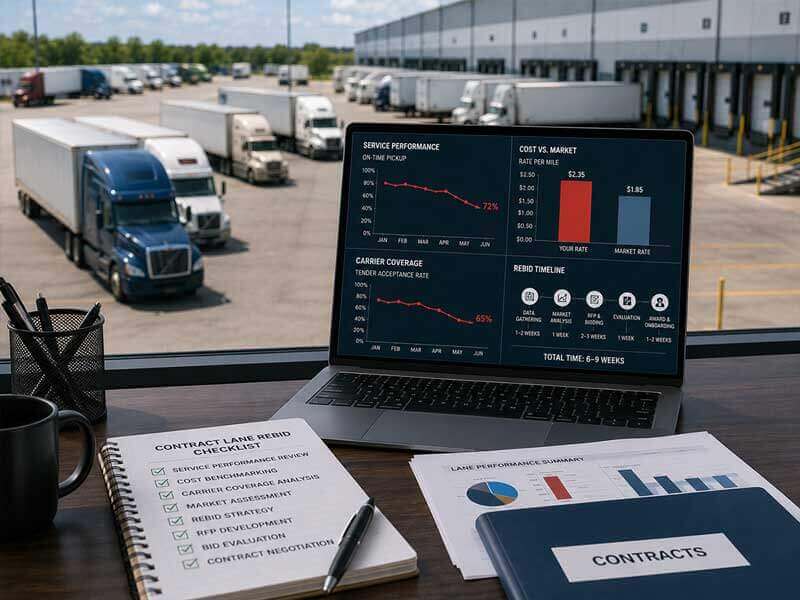
A contract lane rebid is a formal review of your carrier agreement for a specific freight lane. Shippers should rebid a lane when service performance drops, pricing drifts above market, or carrier coverage becomes unreliable. This guide explains the main trigger signals, the data to gather, and how long the rebid process usually takes.
Shippers should rebid freight contracts when service declines, costs exceed market rates, or carrier coverage becomes unstable.
Signals like service quality dips and cost drifts prompt shippers to run contract lane rebids to secure better transportation and rates that match their budget and supply chain management long-term needs.
Let’s review each signal and how it alerts shippers it’s time for a rebid.
Service degradation is the decline in a carrier’s transportation service quality. Carrier scorecards help shippers to monitor a carrier’s service performance, safety rating, and federal compliance using information from the Federal Motor Carrier Safety Administration (FMCSA) SAFER Company Snapshot.
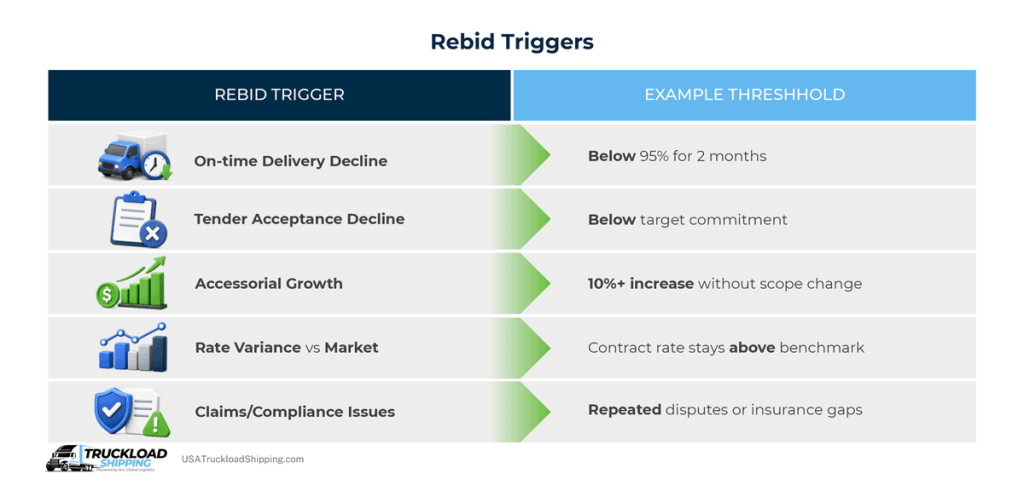
We’ve provided a table showing indicators of service degradation that should trigger a rebid.
All carriers must obtain a Motor Carrier (MC) number and/or U.S. Department of Transportation (U.S. DOT) Number from FMCSA to operate commercial vehicles and comply with federal freight transportation regulations.
Shippers use strategic carrier selection to vet and onboard carriers for compliance and learn their role in a shipper’s supply chain to provide the right mode, equipment, and routes to move goods.
Shippers should initiate a rebid when carrier performance causes late, damaged, or lost shipments.
Cost drift is a gradual increase in freight service fees that exceed the original scope of work. This is in comparison to carriers slowly adding more fees or increasing the rate of established fees that do not align with current market freight rates.
Here are two examples of cost drift vs market rates.
Example One: Accessorial Charges
Accessorial charges are supplemental fees to complete a shipment. Carriers often add accessorials fees like a fuel surcharge or liftgate service fees to a shipper’s freight bill to offset volatile market fuel rates or accommodate shippers whose facilities lack a loading dock.
Fuel surcharges are calculated with this formula: (Current Fuel Price - Base Fuel Price) ÷ Miles-Per-Gallon (MPG) = Fuel Surcharge-Per-Mile
Let’s say the current fuel price is $4.79 per gallon for diesel and you and your carrier have agreed on a base fuel price of $1.75 per gallon. The average truck drives six miles per gallon. Let’s plug these digits into the formula: ($4.79 - $1.75) ÷ 6 = $0.51 as the Fuel Surcharge
Cost drift occurs if your carrier has inflated the market fuel price or their baseline fuel price over time without negotiating this fee with you.
Example Two: Dry Van Rates
Dry van rates are the prices shippers pay to move goods using enclosed dry van trailers. Most freight ships use dry vans, including full truckload (FTL) and less-than-truckload (LTL) shipments. Let’s say your contract includes shipping full truckloads of exercise equipment to big box stores nationwide each month.
Freight data tools like DAT Trendlines National Van Rates report dry van rate trends by U.S. region. You ship exercise equipment exclusively on the Southeastern coast and DAT reports dry van trailers rates are $2.65 per mile.
Your carrier agrees to this rate, however, over the next three months, your freight bill reflects $2.75 and then $3.00. This price creep is unwarranted if you’ve already agreed to a predetermined rate in your contract.
Coverage instability occurs when a carrier can no longer provide consistent, compliant, or financially reliable service on a lane. Shippers should treat repeated claims disputes, insurance gaps, or sudden capacity failures as rebid triggers.
The FMCSA insurance filing requires for-hire carriers hauling non-hazardous freight to carry at least $300,000 in BIPD coverage for vehicles below 10,001 pounds, according to 49 CFR § 387.303. Vehicles 10,001 pounds or more should have $750,000 of coverage.
Under the Carmack Amendment under 49 U.S.C. § 14706, carriers must also have carrier liability insurance. The Carmack Amendment is a federal law that excludes freight claims for scenarios outside of the shipper’s control, like acts of god and acts of war.
However, if your carrier doesn’t carry the federal minimum requirement or uses the Carmack Amendment to decline freight claims that aren’t excluded, shippers have the right to switch carriers to avoid further shipment damage and supply chain delays.
Use your contract history with your carrier and carrier scorecards to determine if you should start rebidding.
Before you open your Request for Proposal rebid, gather this carrier data with your team or freight broker to ensure companies are in alignment with your business goals and budget.
Rate history shows how a carrier’s pricing has changed over time across the services you use, such as full truckload, LTL, hazmat, or expedited shipping. Reviewing rate history helps shippers identify pricing drift before opening a rebid.
This includes transportation fees for modes and services like:
Review your prospective carriers’ rate history to see if their pricing aligns with your supply chain budget.
Carriers bill accessorial charges for one of two reasons:
Review the frequency your carrier charges accessorials and if the costs drift without documentation or explanation.
Tender acceptance is the formal process to confirm freight transportation. Freight market tools like SONAR Outbound Tender Rejection Index (STRI) shows shippers tender rejection rates due to pricing and market conditions.
On-time delivery (OTD) is the rate at which carriers deliver goods by the agreed upon shipment date. A good OTD to have is 95% or above.
When your carrier’s tender acceptance and OTD rates decline, a freight rebid opens the company to new logistics strategies to keep goods flowing.
A freight rebid usually takes three to four weeks once the RFP process begins, with planning often starting 60 to 90 days before the contract end date.
We’ve created a chart that illustrates a simple rebid timeline.
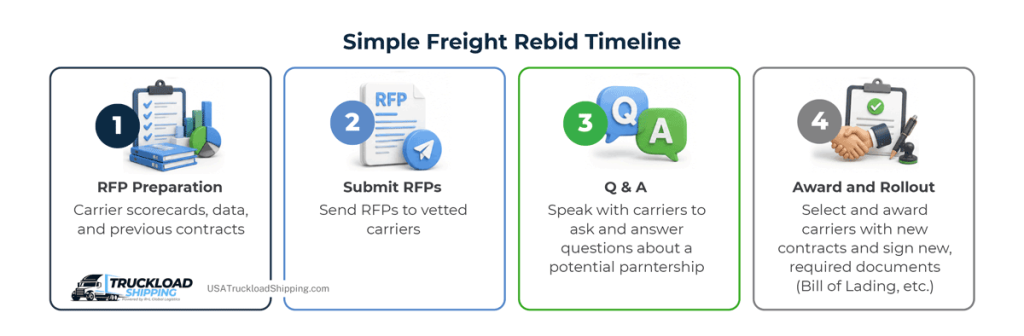
As you can see, rebids take time to redefine your transportation goals, gather data, and strategize the trucking bid process.
Once you’ve sent RFPs to carriers and gotten bids, review them with your carrier scorecards to ensure the carrier meets your logistics strategy.
A freight award strategy determines whether a shipper assigns a lane to one carrier or splits the work across multiple carriers. Single-award contracts simplify communication and accountability, while multi-award contracts reduce coverage risk and create backup capacity.
For LTL awards:
Less-than-truckload (LTL) is a shipping mode that consolidates smaller shipments onto one truck with multiple stops to complete shipments. LTL shippers usually award a single carrier their RFP as they do not ship large volumes of freight that would necessitate more than one truck.
For FTL awards:
Full truckload (FTL) is a shipping mode that dedicates one truck, or a fleet of trucks, to a single shipper’s freight. FTL shippers that move high-volume freight often work with 3PLs because of their expansive network of carriers.
For either mode, shippers award carriers by following this process:
If your team needs support with carrier sourcing, lane analysis, or bid evaluation, our truckload logistics team can help you plan and manage the rebid process with confidence. Learn how our freight services support shippers with long-term lane strategy and carrier procurement.
Sources:
National Van Rates, DAT Trendlines, 2026
SAFER Company Snapshot, FMCSA
Insurance Filing Requirements, FMCSA, 2026
Security for the protection of the public: Minimum limits, 49 CFR § 387.303, 2026
Liability of carriers under receipts and bills of lading, 49 U.S.C. § 14706
Sonar Tender Rejection Index (STRIA) and Outbound Tender Rejection (OTRI), Sonar, 2026
 Copy URL to Clipboard
Did you find this article helpful?
See more of our coverage on Google.
Add usatruckloadshipping.com as a preferred source!

R+L Global Logistics
315 NE 14th St., Ocala, FL 34470
