

See more of our coverage on Google.
Add usatruckloadshipping.com as a preferred source!

Detention is an accessorial fee shippers pay when a carrier’s container or equipment is held beyond the allowed free time outside the port or terminal. This guide is for shippers, freight forwarders, and logistics professionals who need to understand what detention charges are, how they differ from demurrage, and how shippers can reduce or dispute them.
A detention charge is a type of accessorial fee billed to shippers when shipping containers are held at a receiving location beyond dwell time or “free time.” Dwell time is a period of time, usually one to two hours, for shippers to load or unload freight for a pickup or after a delivery.
Truckload drivers are paid detention when shippers or consignees go over the allocated dwell time.This is to reimburse drivers who are forced to wait to return shipping containers to the port of entry. Detention pay is passed on to shippers as a part of their overall freight bill.
Shippers agree to this free time along with scheduled pickup and delivery appointments listed in the Bill of Lading (BoL). A BoL is a legally binding contract between a shipper and carrier to ship freight.
The BOL includes the following freight transportation details:
Detention charges are typically between $35 and $50 an hour for every hour containers are held past free time. Shippers should confirm their carrier’s accessorial fees like detention before signing a BoL. This helps shippers prepare for common trucking accessorial fees that could be included in their freight bill.
Free time and detention billing terms vary by carrier, equipment type, terminal rules, and contract terms. Shippers should confirm how long free time lasts, when billing begins, and whether charges apply to containers, chassis, or driver detention before booking freight.
Detention and demurrage are different charges. Detention applies when equipment is held outside the terminal beyond free time, while demurrage applies when a container stays inside the terminal beyond the allowed window.
Demurrage charges can result from port congestion, equipment shortages, documentation issues, or pickup delays that keep a container inside the terminal beyond free time. It’s the shipper’s responsibility to rent a chassis prior to booking a freight pickup from a port, and they are responsible for accessorial payment as a result.
Shippers can avoid detention charges by preparing the dock before arrival, scheduling appointments accurately, and sharing complete pickup and delivery instructions with carriers. These steps reduce wait time, speed up loading and unloading, and help prevent free-time overruns.
Dock operations should run smoothly to avoid transportation delays and unnecessary fees. This means adequate amounts of labor and equipment must be on site and ready for use when trucks arrive.
Schedule pickups and deliveries well in advance to prepare staff, dock space, and equipment for the truck’s arrival. Doing so will ensure your staff is ready to receive freight within the allotted dwell time.
You should also share the correct pickup and delivery times to help prevent delays. Make sure your carrier has clear instructions regarding check-in, dock assignment, and paperwork.
Another tool that will help you avoid detention charges is a pre-pickup checklist.
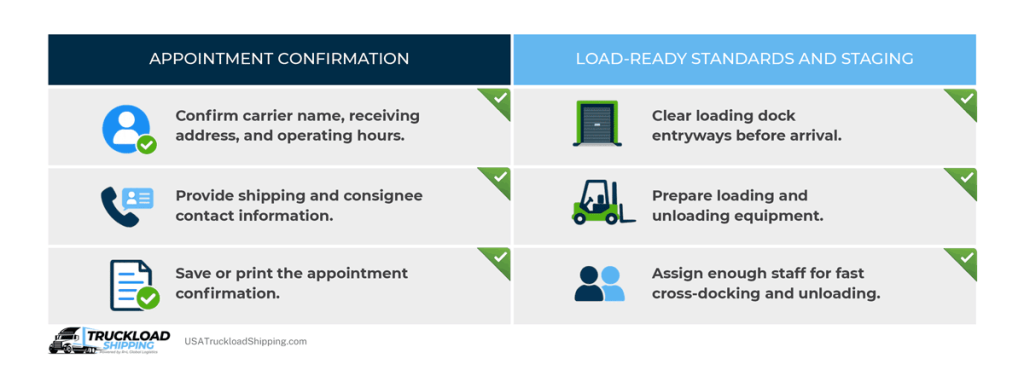
Using this checklist will ensure you receive and unload freight to avoid loading dock delays that lead to accessorials.
Shippers should dispute detention billing errors as soon as they identify them. Strong disputes usually include appointment records, timestamps, shipment documents, and evidence showing when free time began and ended.
We’ve created a checklist to document and present evidence to dispute wrongful detention charges.
Present this information to your truckload carrier or the port terminal that sent your invoice to start your claim.
If you are disputing detention or demurrage charges with an ocean carrier, file your dispute with the Ocean Carrier Equipment Management Association (OCEMA) Best Practice for Detention and Demurrage Process Committee. The OCEMA is a U.S. based association that oversees ocean freight at U.S. ports and rents container chassis equipment to shippers.
Need help reducing accessorial costs? Talk with our truckload team about appointment planning, port coordination, and detention-risk reduction. They’ll also be able to find the best shipping service for your needs.
Call USA Truckload Shipping’s freight experts today at (866)-353-7178 or submit your request for proposal. You can also get in touch with us by sending your freight questions through our contact form.
Who pays detention charges?
The person responsible for delaying the return of a container must pay detention charges. This person can be the importer or shipper.
How long is free time before detention?
Free time ranges between the first two hours of wait time or between five to seven days or more. After this point, detention fees are charged.
Can detention charges be disputed?
Detention charges can be disputed if you find them unreasonable or inaccurate. Winning disputes consists of factual evidence, like discharge timestamps and receipts, that proves you did not exceed the allotted free time.
Sources:
Welcome To OCEMA, Ocean Carrier Equipment Management Association
 Copy URL to Clipboard
Did you find this article helpful?
See more of our coverage on Google.
Add usatruckloadshipping.com as a preferred source!

R+L Global Logistics
315 NE 14th St., Ocala, FL 34470
