


See more of our coverage on Google.
Add usatruckloadshipping.com as a preferred source!

Carrier vetting is an essential logistics strategy, and this guide is for shippers who need to select the right carriers to protect capacity, control costs, and reduce service failures across the supply chain.
Strategic carrier selection is the process of choosing freight carriers based on FMCSA compliance, lane fit, service reliability, equipment availability, and transportation risk. We’ll go over how to strategically select the right carrier for your company to keep your supply chain flowing.
Strategic carrier selection is the process of evaluating freight carriers for service fit, compliance, safety, capacity, and cost. This helps shippers build reliable transportation networks that support long-term supply chain performance.
A freight carrier is a company or person who ships goods with their own vehicles, drivers, and equipment. Shippers rely on carriers to transport goods to and from destinations like:
Carriers must register with the Federal Motor Carrier Safety Administration (FMCSA), an agency of the U.S. Department of Transportation (DOT) to obtain a Motor Carrier (MC) or USDOT Number. FMCSA oversees over 2 million carriers in the U.S. to audit carrier safety and compliance. FMCSA performs these audits to ensure a carrier meets the satisfactory conditions to handle and ship freight.
Carriers can ship goods domestically or internationally. Cross-border hauls are shipped between the U.S., Mexico, and Canada. For domestic transits, carriers deliver goods in two ways:
A logistics network is a transportation system that moves freight between suppliers, ports, warehouses, distribution centers, and end customers. Logistics networks coordinate how goods get to and from ports, warehouses, and other destinations. This includes the vehicles and equipment needed, and carriers provide the following:
The chart below details how carriers operate in a logistics network:
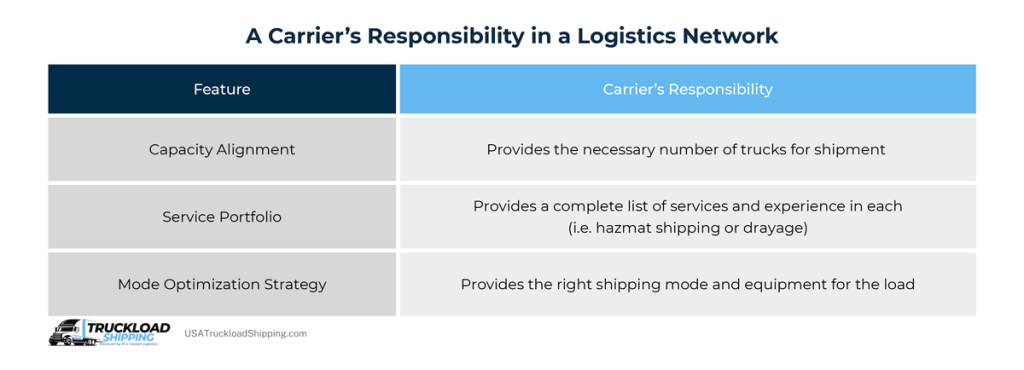
Carriers provide truckload shipping modes like:
Keep in mind that carriers who offer hazmat shipping must meet FMCSA’s Hazardous Materials Safety Permit Program requirements.
Carriers can operate alone or as part of a carrier network within a third-party logistics (3PL) company. When carriers are in a network, shippers can refer to a 3PL’s freight consultant to help with the carrier selection process.
Strategic carrier selection is a process of vetting a carrier’s services, safety rating, and compliance record to match a shipper’s supply chain needs.
A lack of carrier vetting can make or break a supply chain. Choose the wrong carrier and shippers may deal with transportation delays or inconsistent capacity. Choose the right carrier and shippers can benefit from cost-effective shipping and risk mitigation strategies to boost their supply chain’s productivity.
We’ll go over the carrier selection factors that shippers should be aware of in the following sections.
Carriers can offer spot rates and contract rates depending on your transportation needs. If you need a one-time or time-critical shipment, spot rates can be costly and time-consuming as you search for a new carrier each time you need transportation.
However, if you routinely ship large loads, a contracted rate with a carrier you’ve vetted and trust allows you to save money and time with reliable shipping services.
Early carrier planning helps shippers identify the right service model before pickup deadlines tighten.
While the best time to book a load is usually two to three days out from your desired pickup date and time. Carrier selection involves finding a carrier who aligns with your shipping needs.
Booking qualified carriers in advance keeps freight moving through each stage of the supply chain. Whether that’s from the port to the warehouse or from the warehouse to the retail store or customer’s doorstep, vetting and booking a carrier in advance keeps your supply chain resilient.
Shippers who bypass carrier vetting risk freight damage, common FMCSA violations, and delayed deliveries. We’ve made a chart of the most common mistakes in carrier selection.
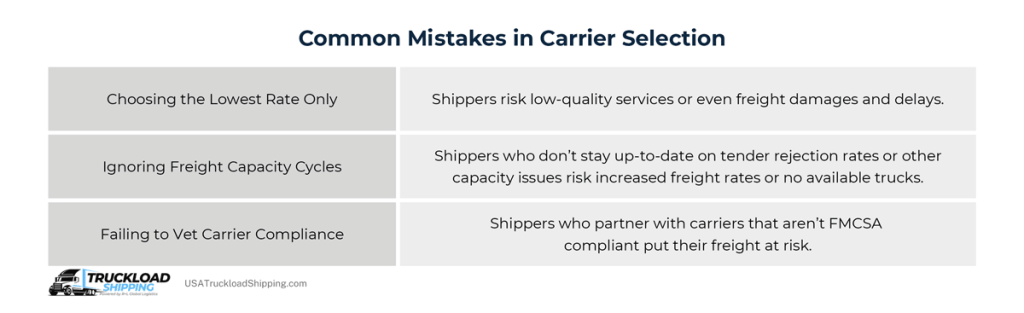
Thorough carrier vetting stabilizes service by reducing compliance risk and capacity surprises.
The FMCSA recommends checking their Safety and Fitness Electronic Records (SAFER) website to verify a carrier’s compliance with safety regulations. You can look carriers up with their DOT or MC number. Once locating them, you can access their safety rating and other compliance-related details.
To utilize carrier selection to find the right match for your next load, use the checklist we’ve provided.
This checklist will help you include the right key performance indicators (KPIs) to find the right carrier for you:
Shippers can use automated tools like DAT’s Carrier Select, a carrier performance analytics platform, or speak with a freight broker to start building a scorecard and compare carriers’ costs and capacity.
You should investigate potential carriers vigorously to ensure you can trust them with transporting your freight.
Any of the following red flags should be disqualifiers:
Even if a carrier offers you a low rate, you should never overlook compliance risks.
Your carrier strategy should reflect the demands of each lane. A high-volume recurring lane may justify contract pricing and long-term carrier relationships. Inconsistent or season lanes may require more flexible sourcing.
If you’re shipping freight over the border and need to transport specialized cargo like hazmat freight, you’ll need a carrier with specific operational experience.
You should use a 3PL for carrier selection when you need reliable freight coverage, but don’t have the time, internal resources, or carrier network to manage and vet transportation providers.
Here are some common situations where using a 3PL can be useful:
Choosing a 3PL will give you access to qualified capacity and reduce the internal burden of carrier vetting.
USA Truckload Shipping is a 3PL with a network of over 22,000 vetted and FMCSA compliant carriers ready to ship your goods anywhere in the United States. Reach out to our freight experts by calling (866)-353-7178 or book a consultation today.
Sources:
FMCSA, Improving the Safety of Motor Vehicles, 2026
FMCSA, Analysis & Information, 2026
FMCSA, Hazardous Materials Safety Permit Program, 2023
FMCSA, Common Violations, 2026
FMCSA, SAFER, 2026
DAT, Carrier Select, 2026
FMCSA, Safety Measurement Search, 2026
 Copy URL to Clipboard
Did you find this article helpful?
See more of our coverage on Google.
Add usatruckloadshipping.com as a preferred source!

R+L Global Logistics
315 NE 14th St., Ocala, FL 34470
