

See more of our coverage on Google.
Add usatruckloadshipping.com as a preferred source!

A truckload shipping mode is the service and trailer type a carrier uses to move freight. Services can include full-truckload (FTL), less-than-truckload (LTL), expedited, and hazmat shipping. Carriers use trailers like dry vans, reefers, flatbeds, and step decks. We’ll use our transportation expertise to help you choose the truckload shipping mode that works best for your haul.
Before you can choose between FTL and LTL, you’ll need to know how they both work.
We’ve made a comparison table to illustrate the shipping differences between FTL and LTL.
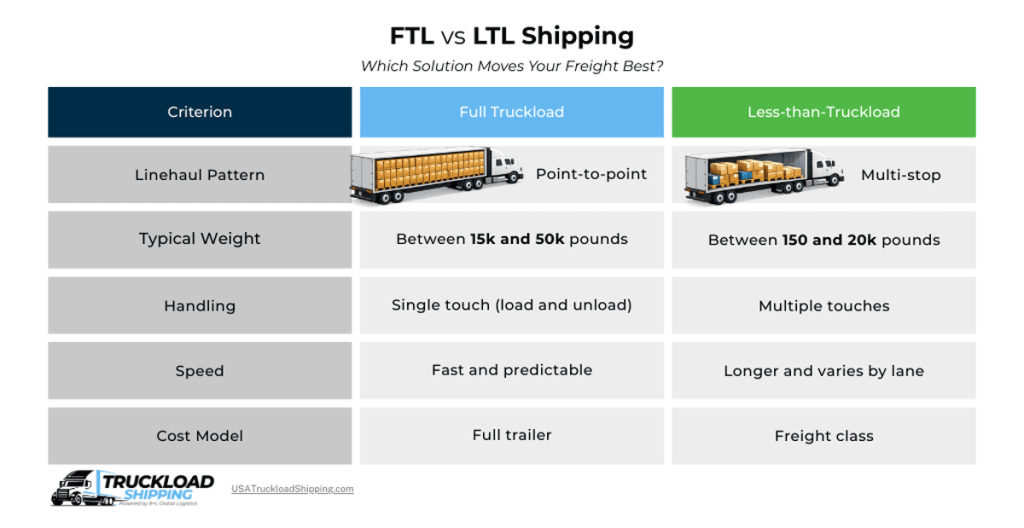
A third alternative shipping mode is partial truckload (PTL). Small loads are consolidated on a truck with multiple stops, similar to LTL. However, these stops are on the same route headed in one direction vs multiple directions like LTL, making for faster delivery.
If you need to ship an entire trailer of freight from one point to another, use FTL. For smaller, non-urgent freight shipments that share space on a trailer, use LTL. Ship with PTL if your load is too large for LTL, but too small for FTL.
A dry van is an enclosed trailer that’s 53 feet in length and protects freight from weather damage like snow, heat, and rain. We’ve provided a table detailing its dimensions, loading equipment, and best use scenarios.
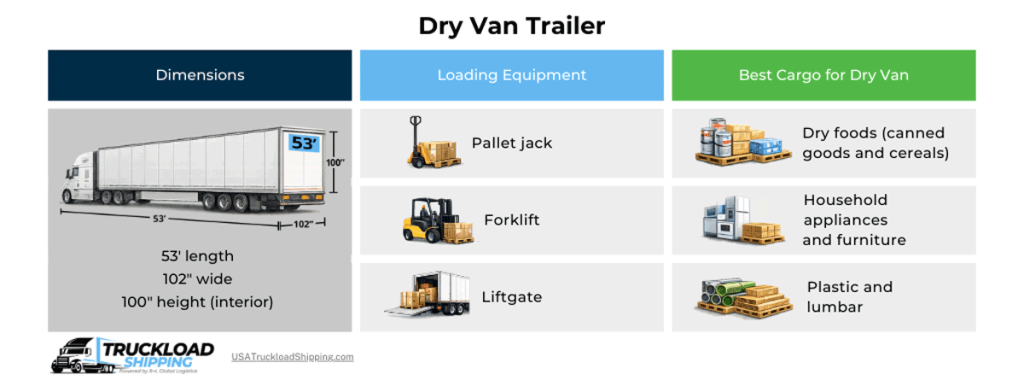
FTL and consolidated LTL shipments are usually hauled by dry vans as they are cost-effective with a high freight capacity. Dry vans (and most trailers) can haul up to 80,000 pounds and provide excellent protection against damage and theft. However, according to Gross Vehicle Weight (GVW), a dry van’s freight can’t exceed 45,000 pounds without a permit.
*Payload varies by axle configuration and state rules.
A reefer is a temperature-controlled trailer with insulation and a refrigeration unit. We’ve provided another graphic detailing the capabilities and features of reefer trailers.
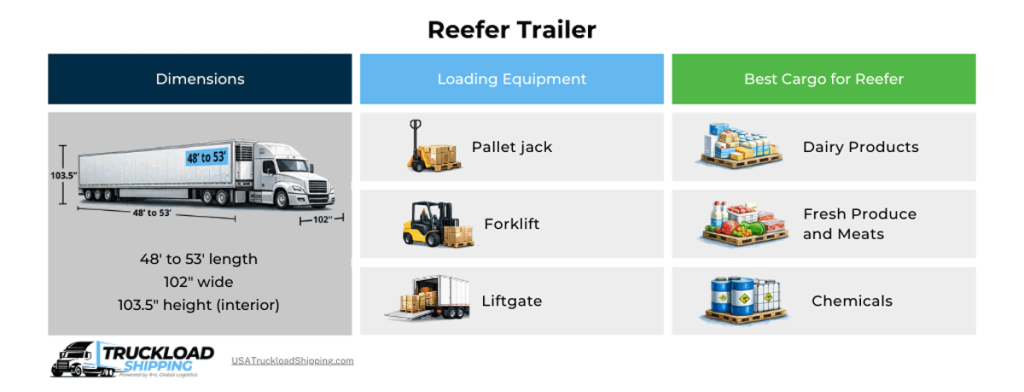
A reefer van’s legal GVW freight capacity is capped at 44,000 pounds to account for its refrigeration unit.
Whether FTL or LTL, reefers are the recommended trucking shipping mode for freight like fresh foods, medicines, and even electronics to avoid spoilage or defections.
*Payload varies by axle configuration and state rules.
A flatbed is an open-deck trailer for freight that can be loaded from the side or above. Here’s a graphic on the features and capabilities of a flatbed trailer.
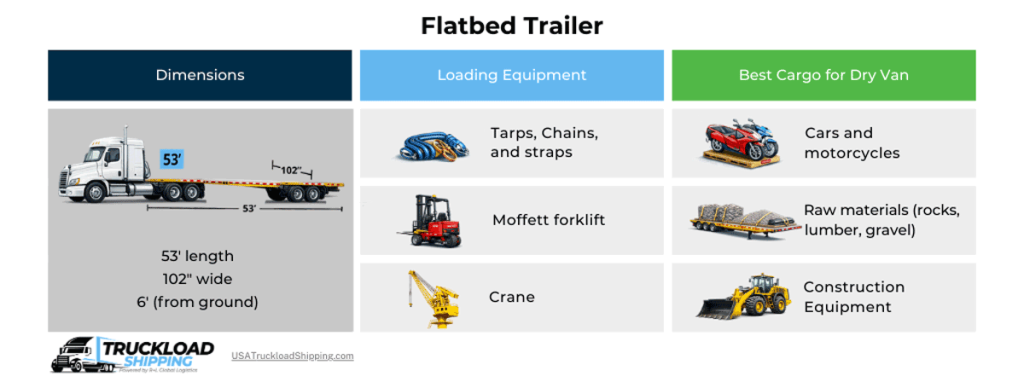
A standard flatbed trailer is best used to haul large or oversized freight that won’t fit the confines of a dry van’s walls.
While flatbeds can haul up to 48,000 pounds, it’s not suited for tall freight because the flatbed trailer is already nearly 6 feet off the ground.
*Payload varies by axle configuration and state rules.
A step-deck is an open deck trailer with a lower main deck that accommodates taller freight. Here’s a graphic on the features and capabilities of a step-deck trailer.
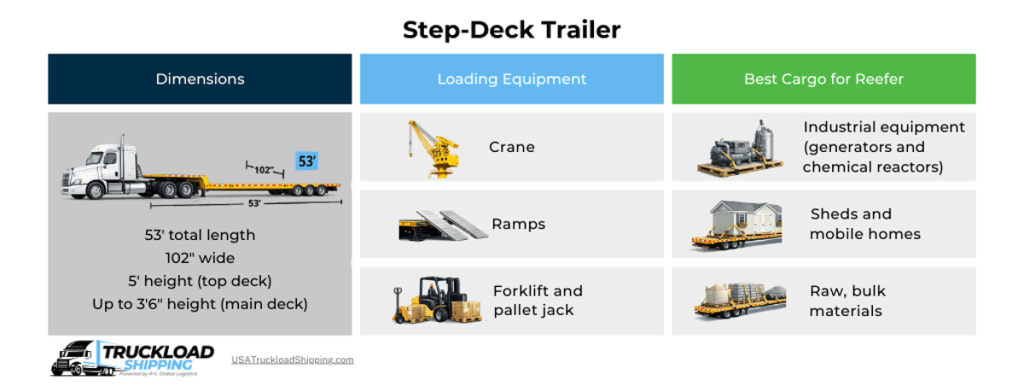
Step-deck trailers, also known as (drop decks) are a type of flatbed trailer. Instead of a singular deck like a standard flatbed, step-decks have two levels: a top deck and a main deck.
The top deck is the smaller space of the two. Shippers can use it to secure freight that’s no more than 11 feet in length. The main deck is the larger space of the two decks, which is typically 43 feet long.
Shippers can move freight that’s up to ten feet tall and weighs up to 45,000 pounds on step-deck trailers.
*Payload varies by axle configuration and state rules.
Intermodal is a shipping mode that uses multiple vehicles to transport freight long-distances. Modes of transport used for intermodal shipping include truck, rail, air, and ocean. The container holding the freight is transferred between modes using a chassis.
Shippers will need a container chassis, a specialized trailer, that allows the container to be connected on each vessel. There are different types of chassis depending on which vessels your container needs to connect to. The most common are the flatbed chassis and gooseneck chassis.

Drayage is the localized transit of freight from a port of entry to a warehouse or distribution center.
Pairing drayage with intermodal speeds up the first mile. Intermodal containers are moved quicker from ports with trucks or rails at the ready to pick up the load and move it to the next point in the supply chain.
Expedited is a speed-optimized shipping mode that increases a shipment’s delivery time for urgent freight. Typical delivery windows are between the same day and three days. Shippers can expedite LTL, FTL, and FTL loads with the arrival time varying if the freight is moving intrastate or coast-to-coast.
Expedited shipping is best for:
Expedited shipping services usually deliver freight between one and three days. Although it’s a fast way to ship, expedited transport is more expensive than standard shipping.
Our network of more than 22,000 carriers is able to expedite your freight anywhere in the US, anytime. We handle every shipment with care with deliveries arriving 99.5% on time.
Our process remains the same, however, the speed at which our carriers and drivers coordinate your freight transport increases.
A drop trailer is a pre-positioned empty trailer staged for loading and unloading at your convenience. Drop trailers aren’t suitable for expedited orders as the freight is loaded or unloaded on the carrier’s schedule while still delivering to the shipper’s final destination in the agreed upon time range.
Power-only trucking is a shipping mode where a shipper rents only the tractor and driver for a haul, but provides the trailer themselves.
Shippers just have to schedule a time and a trailer, which can be dry van, reefer, or flatbed, to load/unload their cargo at their convenience.
Hazmat is a type of freight regulated by the US Department of Transportation (DOT) and the Pipeline and Hazardous Materials Safety Administration (PHMSA).
Hazardous shipments can be ignitable, toxic, reactive, or corrosive and are divided into nine hazard classes.
Common consumer hazmat freight includes items like:
Shippers and carriers must be hazmat certified to package, handle, and ship hazmat.
Oversize and overweight freight is regulated differently by each state’s DOT. Provide the exact dimensions and weight of your cargo so carriers can obtain the correct permits.
Carriers may be required to secure permits and escorts based on their state’s DOT regulations. While oversize/overweight permits are not issued federally, DOT’s Federal Highway Administration provides each state’s permit contact to obtain load permits.
Oversize/overweight is defined as follows:
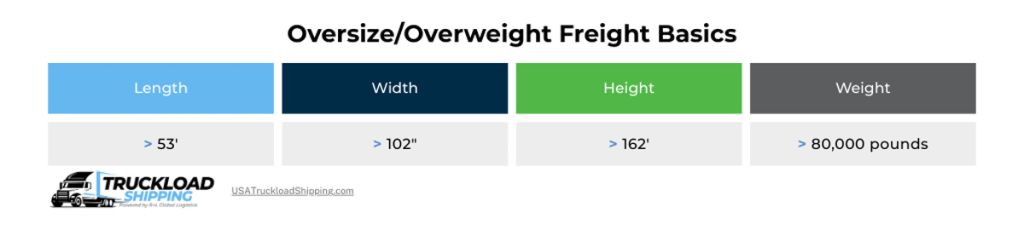
Freight weight isn’t the only factor in oversize/overweight measurements. Safely hauling oversized loads requires adhering to your state’s axle weight limits. The standard axle weight limits are as follows:
If the single axle or tandem axle exceeds its legal weight limit, carriers will be required to obtain permits to transport.
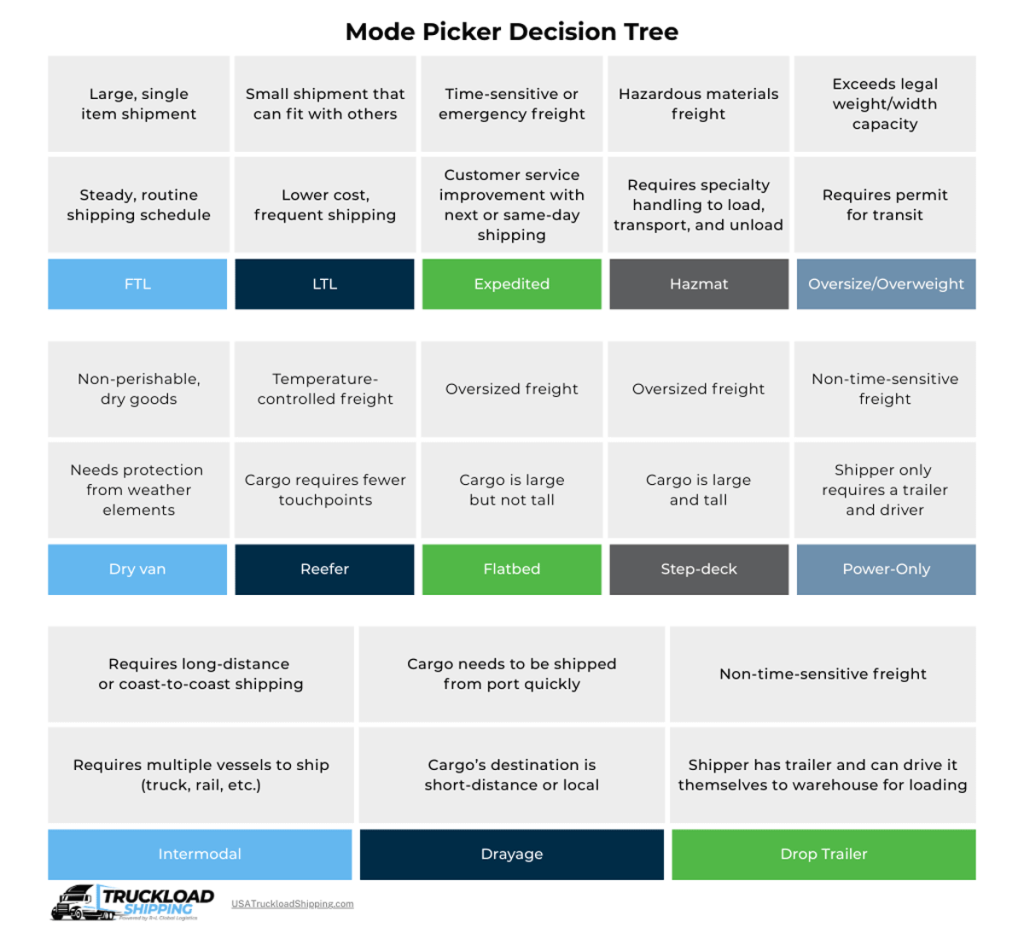
Still not sure which truckload shipping mode is best suited for your freight? We’ve got you covered.
Use our mode picker decision tree below to make the best choice for your wallet and your haul.
No matter what mode you pick, our network of 22,000+ carriers has the equipment, trailers, and trained drivers to help you ship.
We have experience and expertise in every truckload shipping mode to safely handle your freight from pick up to drop off. Get confident about your next freight transit by calling our freight consultants at (866)-353-7178. Ready to get started? Click here to get a free, instant quote today.
FAQ
What types of trailers can freight be shipped on?
Freight can be shipped using dry van, reefer, flatbed, and step deck trailers.
How fast is expedited shipping?
Expedited shipping is fast enough to deliver freight between the same day and three days.
What are the dangers of shipping hazmat?
Hazmat freight can be ignitable, toxic, reactive, or corrosive. It’s divided into nine hazard classes.
How does intermodal and drayage compliment one another?
Drayage can be used to quickly move intermodal freight out rail yards and ocean ports.
What methods can I use to ship my freight by truckload?
You can use FTL for large shipments that take up entire trailers, LTL for smaller shipments that will share space with other loads, and PTL for shipments sized between LTL and FTL.
 Copy URL to Clipboard
Did you find this article helpful?
See more of our coverage on Google.
Add usatruckloadshipping.com as a preferred source!

R+L Global Logistics
315 NE 14th St., Ocala, FL 34470
