


See more of our coverage on Google.
Add usatruckloadshipping.com as a preferred source!

FTL vs LTL freight is a choice between dedicated trailer space and shared trailer space, and this guide is for retailers, ecommerce companies, and businesses deciding which trailer space, transit time, and handling is best for their freight.
Full truckload (FTL) and less-than-truckload (LTL) are two primary freight shipping modes used in trucking logistics. The key difference is whether a shipment occupies an entire trailer or shares space with other shippers.
One misconception is that FTL shipments will fill an entire trailer. This is typically what happens, but it isn’t always the case since FTL freight can be up to 26 pallets. Dry vans and reefer trucks are 53 foot semi-trailers that can fit 26 single-stacked or 52 double-stacked pallets.
By that same token, LTL doesn’t necessarily mean there will be empty space in the trailer. We’ll go over how to utilize space for price control for both FTL or LTL loads.
FTL vs LTL shipping differ in trailer usage, shipment size, pricing logic, transit speed, and handling risk. FTL gives one shipper dedicated space, while LTL combines freight from multiple shippers in the same trailer. We’ll discuss the other differences and help you select the best one for your shipment in the following sections.
Both trucking load types are hauled on the following trailer types:
We’ve created a chart to outline the space each trailer holds for FTL vs LTL freight.
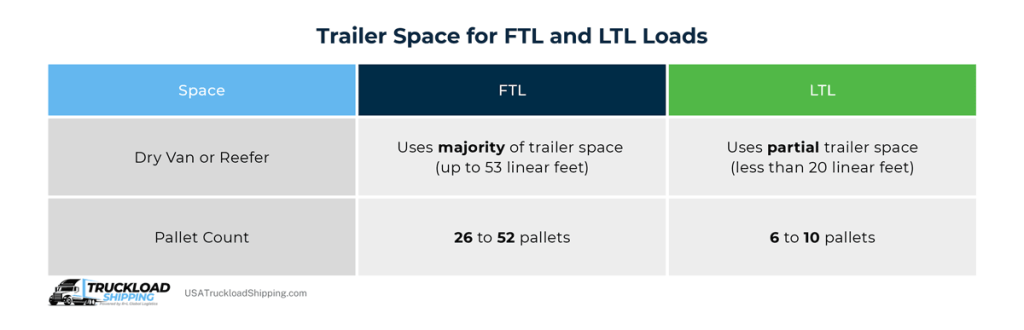
LTL and FTL freight can be either perishable or non-perishable. However, shippers moving perishable freight may opt for FTL because it ships faster with fewer stops than LTL.
FTL and LTL freight are defined by their weight and density. Let’s break down the differences in the chart below.
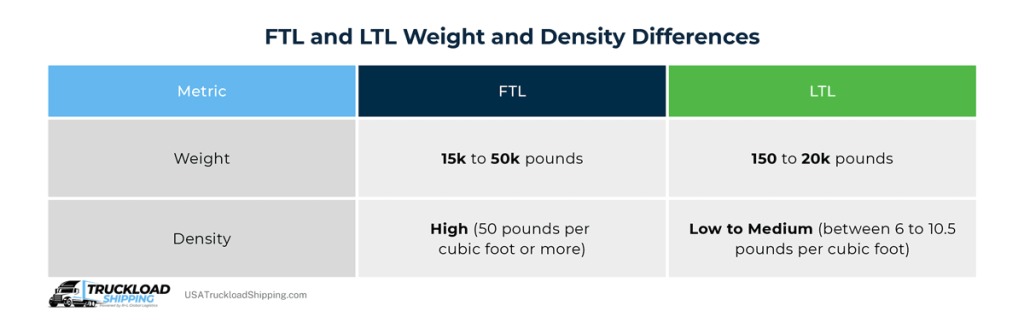
LTL loads can have a higher density and this affects the total costs of shipping. That’s because weight and density determine LTL freight classification and NMFC code, a U.S. freight standard determined by the National Motor Freight Traffic Association (NMFTA).
NMFTA is a U.S. nonprofit organization that standardizes LTL shipping operations. The organization created and maintains freight classification and NMFC codes that factor into LTL freight’s pricing based on density ranges.
According to NMFTA freight classification standards, there are 18 freight classes from 50 to 500, with the lowest class representing the most dense freight and the highest class representing the least dense freight. However, there are thousands of NMFC codes used to identify a variety of commodities.
Shippers should be aware of costly accessorial charges like reclassification and reweighs to obtain the correct freight class and density for its NMFC code.
Density matters more in LTL shipments because carriers price these shipments partly on how efficiently they use shared trailer space. Transportation providers moving LTL freight need accurate densities to ensure they’re using space in the trailers efficiently. If they don't, they could be leaving money on the table.
According to NMFTA, LTL freight class is determined by four primary factors:
Carriers opt to move loads that are easier to handle and stow in a truck. The density typically dictates freight’s stowability and handling, as well as liability if the freight is fragile, oversized, or requires specialized trailers like reefers.
These factors affect how carriers handle LTL freight at terminals and hubs and even how freight is stacked in the truck to maintain 49 CFR (Title 49 of the Code of Federal Regulations) enforced by the Federal Motor Carrier Safety Administration (FMCSA). FMCSA is an agency of the U.S. Department of Transportation (DOT) that oversees safe freight transportation and carrier compliance.
Shippers must verify freight details prior to loading to ensure carriers use the correct route to deliver goods safely.
Both FTL and LTL freight are prone to accessorial charges for a number of reasons.
An accessorial charge is a supplemental fee added to a shipper’s freight bill to complete transportation. The most common accessorial charges for FTL and LTL freight include:
Shippers can avoid these surcharges by confirming their freight’s details, like the weight, density, and commodity.
In the next sections, we’ve put together scenarios that show the advantages of dedicated vs shared trucking capacity at work.
Say you run a relatively small business selling heavy-duty furniture wholesale to retailers. In most cases, your customers prefer to run lean inventories and only order four to eight pallets of goods at a time. These retailers have standing, scheduled orders and rarely require expedited freight shipments.
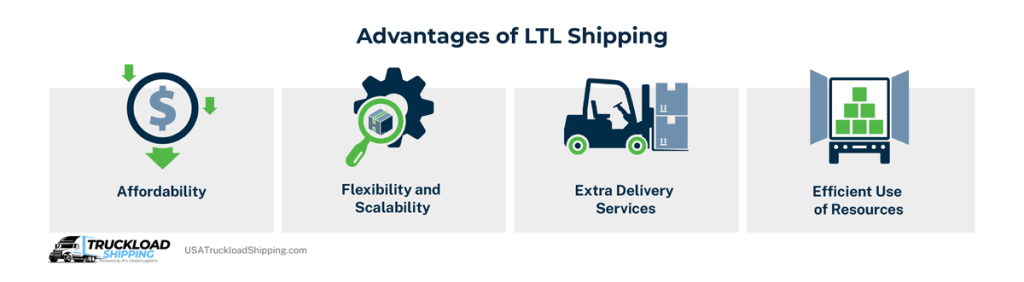
Here are some reasons LTL would outperform FTL under these circumstances:
When time isn’t of the essence and reduced costs are your number one priority, LTL is a great option for shippers. Let’s return to our furniture wholesaler example for a scenario where FTL shipping wins.
In addition to heavy-duty furniture, your wholesale business also offers fragile items such as standing mirrors, glass coffee tables, and chandeliers. One of your customers decides to expand their retail offerings to include such goods, and their initial stocking order will be about 12 to 15 pallets in size. They also want to receive the order within three to four business days to meet projected demands.

FTL will be your go-to option here for the following reasons:
Partnering with a third party logistics (3PL) freight broker can help you choose the best shipping method for your freight on a case-by-case basis.
To help you better decide between these freight shipping modes, we’ve provided some examples of when it’s best to use each. We’ll start with LTL shipping first.
LTL example:
A furniture company located in High Point, NC, wants to restock one of its stores in Atlanta, GA. They need to ship 6 pallets of boxed dining chairs and tables weighing 4,200 pounds. Since the shipment is too small to justify a full dry van trailer and cargo is durable enough to survive transit without major damage, the furniture company uses LTL shipping to transport their freight.
FTL example:
A tech company needs to ship consumer electronics from Reno, NV, to Seattle, WA. They need to ship 24 pallets of fragile boxed electronics weighing a total of 16,500 pounds. The tech company needs an entire dry van trailer and reduced touchpoints to ship their freight. Therefore, they choose FTL transport.
Not sure if your load should ship FTL or LTL? Use our checklist to pick the right mode for your freight.
Take the guesswork out of which shipping mode you need with our checklist:
Using this checklist will help you determine the best transportation method for your shipment.
Fast, Cost-Effective Freight From USA Truckload Shipping
USA Truckload Shipping has access to FTL and LTL carriers across the country, in addition to warehouses and distribution centers. From storage to freight shipping and even final mile delivery, we have the know-how to tackle logistics challenges of all shapes and sizes.
Call us today at (866) 353-7178 or submit a contact form online. You can also send us your questions via our contact page.
Sources:
Freight Class and NMFC Codes, NMFTA
Transportation, 49 CFR, Code of Federal Regulations
FMCSA Regulations and Interpretations – 49 CFR Parts 300-399, FMCSA
 Copy URL to Clipboard
Did you find this article helpful?
See more of our coverage on Google.
Add usatruckloadshipping.com as a preferred source!

R+L Global Logistics
315 NE 14th St., Ocala, FL 34470
