Oil and gas is a popular commodity in the US. That said, transporting it can be a stressful endeavor to undertake. As an experienced 3PL, we’ll use our experience and knowledge to give you the best practices needed to ship this commodity.
Key Takeaways:
We’ll walk you through solutions for oil and gas logistics, including supply chain management and base-to-base logistics.
Moving oil and gas can take special equipment, safety procedures, and regulatory compliance. Logistics services in the gas and oil industry require both visibility and urgency, and the right logistics partner can help you make sense of this complex process.
There are many moving pieces to oil and gas logistics. Activities like trucking and warehousing drive logistics operations, and this means tankers and trucks of oil and gas regularly move across US highways. Many 3PL providers leverage extensive experience in chemicals and hazardous materials to apply their expertise to the oil and gas supply chains.
Oil and gas logistics focuses on providing transportation services and more to this booming industry. The right partner can provide your business transportation and logistics services including:
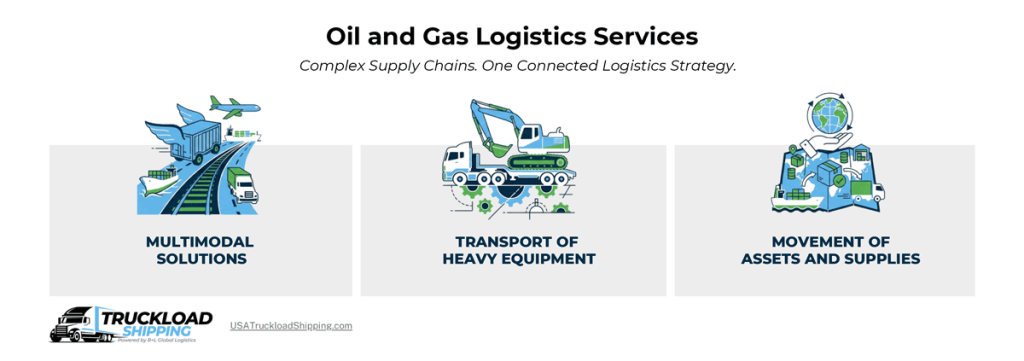
Heavy equipment commonly used to drill and haul fuel are drilling rigs, pipes, and excavators. If you’re moving equipment as well as oil and fuel, make sure you work with your carrier to secure the right trailers for both loads.
Before you can transport oil or gas, PHMSA requires shippers to properly label it with hazmat labels and placards, both on the packaging and the tanker trailer.
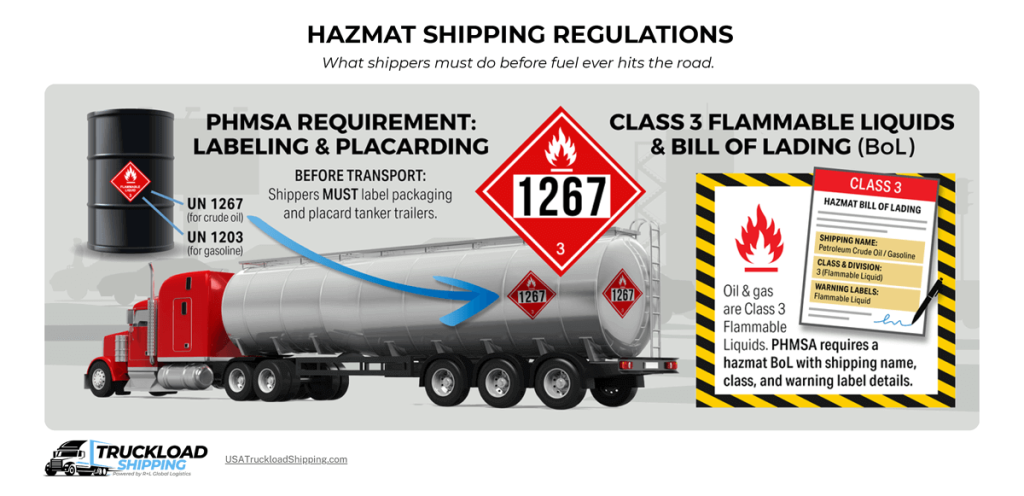
Shippers and carriers are also required to have an International Air Transporters Association (IATA) hazardous materials certification prior to transporting gas and oil.
Oil and gas are flammable liquids and classified as class 3 hazardous materials. PHMSA requires shippers to complete a hazmat Bill of Lading (BoL) that informs the shipper of the cargo’s shipping name, class and division, and warning labels.
Related: How to Use LTL Shipping for Hazardous Materials
While 32 states produce oil in the US, Alaska, North Dakota, and Texas produce the largest quantities.
Colorado, Oklahoma, and California also contribute to the US’s oil supply chain, rounding out the country’s top producers.
When thinking about the US oil supply chain, it’s important to think about how far the product must travel. The oil supply chain process begins at the pump and at the oilhead and ends at the pump at the retail gas station.
The US oil supply chain has several links:
There are two main transport modes for crude oil delivery in the US oil supply chain:
Pipeline transport takes crude oil from the wellhead to the refinery. There is an interstate grid of oil pipelines, which transported 92.4% of the US’s crude oil in 2024. The US has the largest network of oil pipelines in the world, likely because pipelines are the cheapest way to transport oil.
However, truck transport is still necessary. In 2024, there were 83,553 refinery receipts for crude oil via truckload. Tanker trailers are attached to trucks and can ship large volumes of oil, depending on the size of the tanker.
In terms of barrels, the most a tanker truckload can hold is around 250 barrels per load.
In most cases, tanker trucks are used for short-distance hauls of oil and gas. Trucks can carry oil in all forms, from crude sweet oil to gasoline ready to go to the pump at your corner station. Tanker trucks can even deliver fuel straight to the consumer.
You might see tanker trucks transporting oil to a gas station when you fill up your car. You might find that tanker trucks offer the most cost effective way to get fuel from the refinery and to consumers. This is because most gas stations and retail outlets aren’t connected to railways or barge canals.
We offer a vast carrier network and extensive routes for coast-to-coast shipping in the US to get your oil and gas to its destination on time, every time. Check out our freight shipping routes to Florida or any state. We’ll meet you where you are to make transportation a breeze.
Related: What You Need to Know About Shipping Jet Fuel
If you’re looking for a partner to help transport oil and gas products, USA Truckload Shipping is prepared to offer assistance.
With 99.5% on-time delivery, our expert logistics team can get you moving from the pump at the oilhead to the pump at the gas station.
Get in touch with our freight consultants at (866)-353-7178 or submit a RFP today.

R+L Global Logistics
315 NE 14th St., Ocala, FL 34470

To Whom this may concern
I'm looking to work with a company as yourself to bring and deliver oil equipment to and from DFW to major cities to keep the supply chain moving...