


See more of our coverage on Google.
Add usatruckloadshipping.com as a preferred source!

Packaging and shipping corn can be a pretty complex procedure. It must be prepared well enough to survive multiple modes of transport over long distances. USA Truckload Shipping has facilitated the transportation of different types of freight for decades. We’ll use our experience to show you how corn is packaged and shipped through the supply chain.
Key takeaways:
Let’s get into the details of corn shipping.
Although most corn is found on the canned aisles of the supermarket, cold-chain logistics plays a significant role in corn production. Predominantly all harvested corn is utilized to feed livestock, surpassing the ten percent intended for food purposes. The remainder goes into our gas tanks as ethanol. Depending on the purpose of the corn, the supply chain procedure may be slightly different.
Sweet corn should be refrigerated immediately after retrieval or the sugars could quickly turn to starch. Due to the short two-week life span, it is crucial to keep this breed cold even during transit. Local and direct transit or warehousing has to be completed quickly and efficiently to maintain quality. Recommended storage is 32 degrees Fahrenheit with a 98 percent humidity rate.
However, if corn has gone through the dry milling process to feed livestock or for ethanol, it can be stored at room temperature and hauled without refrigeration. In fact, it is good for up to 12 months. If transporting dry corn on a truck, the water content of the corn should not exceed 14 percent. At this point, corn begins to mold and it will produce a sour odor.
Processed corn is less susceptible to warmer temperatures. This includes cornmeal, grits, and corn gluten. Corn of this variety can be shipped in dry van or pneumatic trailers.
Packaging corn is the most simple part of the supply chain process. It is packaged one of two ways, in bags or bulk. Bags can be stacked on a pallet when they are shipped for easy transportation and storing. Bulk totes are used for fresh corn, this method usually requires openings for corn to breathe because the corn can heat internally after sitting for too long.
Sweet corn is packaged differently because this perishable item is packed with ice and water before it’s shipped.
Wirebound crates and fiberboard boxes are the two most popular ways to load sweet corn. Wirebound crates are shipped in rows to allow space for breathing and room for ice. Fiberboard boxes are moisture-resistant, these can be stacked high and topped with ice, as the ice melts it flows between the boxes to cool the entire truckload of corn.
For the past 20 years, the demand for corn has continuously increased. As exports for the U.S. have risen, the acres allotted to farmers has not shifted much. Transportation is the interlink of farms to tables.
The pressure on transportation services spike when production and consumption escalates. A change in agricultural production can result in a shortage or surplus of shipping services.
Short-term problems consist of:
The cost of transportation at the time of shipment can affect what mode the goods will be transported. Trucks are the most common way to transport corn domestically. However, rail shipping might be used in combination with truck transportation. We’ve provided an infographic that compares the two shipping services.
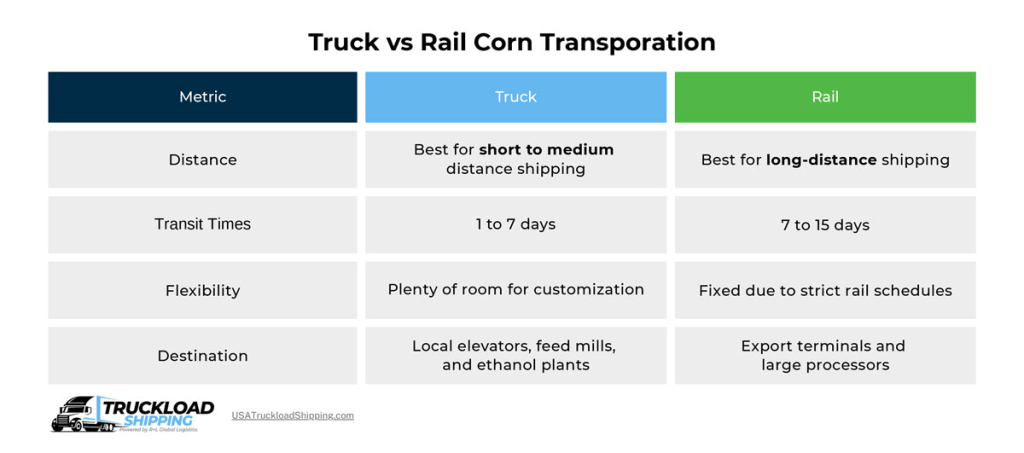
Even if freight is transported by rail, a truck will always be necessary for covering the last mile of the shipment.
Related: The Cotton Supply Chain in Texas
Are you ready to ship your corn? Then contact USA Truckload Shipping today. You can reach us by calling our team at (866) 353-7178 or navigating to our contact page.
 Copy URL to Clipboard
Did you find this article helpful?
See more of our coverage on Google.
Add usatruckloadshipping.com as a preferred source!

R+L Global Logistics
315 NE 14th St., Ocala, FL 34470
