

See more of our coverage on Google.
Add usatruckloadshipping.com as a preferred source!

Numerous amounts of cotton are shipped domestically and internationally from Texas. To ensure this valuable commodity gets to where it needs to go, a smooth and fluid supply chain is essential. As a 3PL that’s helped businesses ship all types of products, we’ll use our knowledge to explain how the cotton supply chain in Texas works.
Key takeaways:
Now, let’s take a closer look at how the cotton supply chain in Texas works.
Most of the US’s cotton is grown in Texas. We’ve provided an infographic that shows how much the state is able to grow annually.

It’s important to note that drought conditions can significantly affect the amount of cotton the state of Texas can produce.
Cotton production occurs in multiple regions throughout Texas. Each one has conditions that are perfect for growing cotton.
Texas regions where cotton is grown include:
From these regions, cotton is shipped to other locations in the US or overseas to different countries.
There are numerous phases of the supply chain that cotton goes through in Texas. We’ll break down each phase in the following sections and explain where logistics services play a role.
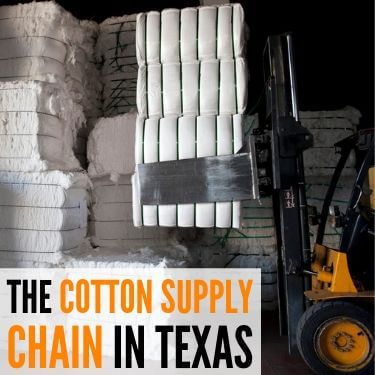
Cottonseeds are planted in the Spring and are harvested in the fall. After being harvested, cotton is ready for ginning. This is when cotton fibers are separated from the seed. The fibers, also known as lint, are compressed into bales for easier handling.
Cotton bales are transported from the farms where they’re grown and ginned by truck. From here, they can be transported to a variety of destinations inside and outside of Texas.
This includes
Efficient transportation and storage of cotton is essential in Texas. The state is very large, which makes intrastate and interstate shipping difficult. At USA Truckload Shipping, our network of carriers can ensure you have the capacity necessary to move your Texas cotton to the next point in the supply chain.
Cotton that’s been loaded into a container at a warehouse makes its way to a US port.
Major Texas ports include:
From here, Texas cotton is exported to countries that are major buyers of cotton, such as China, Vietnam, and Pakistan.
They can travel inside a dry van trailer or secured on a flatbed. Multiple services can be used to facilitate the transportation of cotton. This includes full truckload (FTL) and expedited shipping.
FTL is the perfect option for high-volume shipments because freight fills an entire trailer. This is better than sharing space with other shipments because it reduces the risk of damage. Expedited shipping is expensive, but it’s the service you’ll need if the cotton you need to move is time-sensitive.
While not the safest option for cotton, you can ship it using less-than truckload (LTL) services. However, you’ll need to know the freight class of your shipment.
The Nation Motor Freight Traffic Association (NMFTA), a non-profit for carrier companies, assigns a freight class, or an NMFC code, for every commodity imaginable based on specific qualifications. There are four characteristics that the NMFTA takes into account when determining freight class.
Overall, there are 18 freight classes, they range from 50 to 500. The lower the class the less expensive it will be to ship and vice versa. High-density compact items that are not susceptible to damage will rank lower than low-density fragile items. It is important to know what your freight class is to avoid reclassification by the carrier while your freight is in transit, thus raising the price.
Cotton and fabric are classified based on their density. The weight, dimensions, and type of packaging all play a role in what the freight classification will be. The higher the density of the fabric the lower the freight class.
Related: How Do I Find My NMFC Code
Ready to get your bales of cotton moving? Then contact USA Truckload Shipping today. You can contact our team by calling (866) 353-7178 or by reaching out to us on our contact page.
 Copy URL to Clipboard
Did you find this article helpful?
See more of our coverage on Google.
Add usatruckloadshipping.com as a preferred source!

R+L Global Logistics
315 NE 14th St., Ocala, FL 34470

CAN YOU TRANSLOAD COTTON BALES FROM TRUCKS TO CONTAINERS?