

See more of our coverage on Google.
Add usatruckloadshipping.com as a preferred source!

Retail apparel and footwear freight shipping is the process of moving boxed, palletized, or baled clothing and shoes from ports, vendors, or distribution centers to warehouses, fulfillment centers, and retail stores. This guide explains when to use full truckload (FTL), less-than-truckload (LTL), or expedited freight so you can reduce freight cost, decrease transit time, and prevent store stockouts.
Retail apparel shipments range from one to two pallets going to a boutique store to 20+ pallets replenishing a national retailer, like Walmart or Costco. Your shipping mode depends on pallet count, delivery deadline, handling risk, and whether you need guaranteed pickup/delivery.
No matter where you’re shipping freight clothing, you’ll need a truck to fit your load. You can use either FTL or LTL depending on the size of your shipment.
We’ve made a comparison table to show you the differences between shipping FTL vs LTL vs expedited.
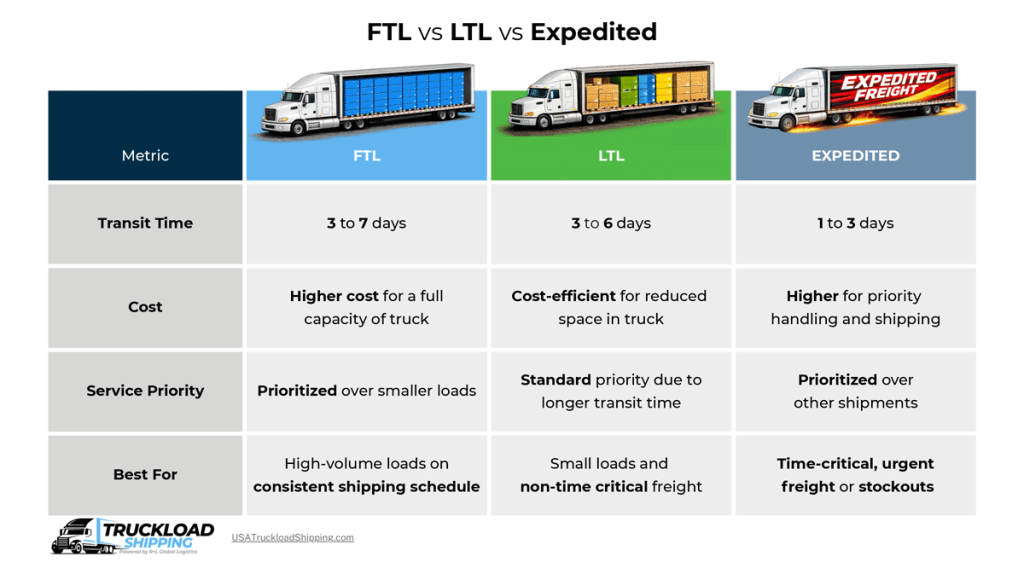
You can use either shipping mode to ship a variety of clothing and shoes to your customers. Whether you ship jeans, shirts, dresses, or heels, we’ve listed below which mode fits best.
Use FTL for:
Use LTL for:
Use expedited for:
Let’s take a closer look at each mode to pick the best one for your haul.
Full truckload (FTL) shipping is a freight mode where one shipper uses an entire trailer for one origin-to-destination move. Retail apparel brands use FTL for high-volume shipments because the trailer typically makes fewer stops, the freight is handled less, and transit schedules are easier to control.
FTL clothing travels on dry van in high-quantities with no unauthorized stops on a point-to-point transit.
Shippers with clothing freight that fits on 26 pallets or more should use FTL compared to multiple small truckloads to reduce shipping costs.
Less-than-truckload (LTL) shipping is a freight mode where multiple shippers share space on the same trailer. LTL reduces cost for small pallet counts, but it usually increases handling because pallets move through terminals and may transfer between trailers.
If your clothing freight is not enough to fill an entire dry van, use LTL to save money on space.
Expedited freight shipping is a priority service level that speeds up pickup and delivery. Expedited shipping can apply to either FTL or LTL, but the key difference is that carriers prioritize capacity and scheduling to meet a deadline.
Shippers can use expedited shipping for rush deliveries to avoid stockouts or improve customer satisfaction with fast deliveries.
In the next section, we’ll review the best ways to package your clothing freight for optimal load/unload and transit speed.
In most cases, freight shipping clothing and shoes for retail involves palletizing your goods. Palleted clothing and shoes is a freight packaging practice that places boxes of apparel and footwear on a wooden or plastic shipping platform for easy transport. Depending on the type of clothing and ultimate destination, clothing might be baled or boxed before being placed on a pallet.
How big is a pallet of clothing? Well, generally speaking, pallets come in two sizes and varieties:
Pallets come in uniform sizes to make transport and storage easy. Once in a warehouse or fulfillment center, pallets are stored on standard size racks. This makes picking orders easy for fulfillment workers.
Pack clothing in boxes with packaging materials such as:
These materials protect clothing in transit once placed in boxes that are then stacked on the pallet. The palletized freight must then be secured with shrink wrap to keep freight upright and stable during loading and unloading.
A shipping label will be affixed to each pallet. This is especially useful for LTL shipments as LTL shipments require a freight class and National Motor Freight Classification (NMFC) code. This is to correctly identify and price each shipper’s LTL freight.
NMFC codes are overseen by the National Motor Freight Association (NMFTA), which is a nonprofit that represents U.S. for-hire motor carriers. A full truckload shipment doesn’t require freight classification or NMFC codes as the load belongs to one shipper vs various shippers.
USA Truckload is able to ship your clothing freight with FTL or LTL anywhere in the U.S. using our vetted team of 22,000 carriers. Whether you need expedited shipping or even warehousing, allow us to streamline your supply chain with our freight experts.
From picking up imported fashion or textiles at the port of entry to delivering them to the fulfillment center, we offer expertise in freight shipping clothing.
Reach out to our freight experts at (866) 353-7178 or submit your Request for Proposal (RFP) to get started today. You can also submit your questions to our contact page.
 Copy URL to Clipboard
Did you find this article helpful?
See more of our coverage on Google.
Add usatruckloadshipping.com as a preferred source!

R+L Global Logistics
315 NE 14th St., Ocala, FL 34470
