


See more of our coverage on Google.
Add usatruckloadshipping.com as a preferred source!

A broker-carrier packet is a document packages brokers use to onboard motor carriers by verifying Federal Motor Carrier Safety Administration (FMCSA) operating authority, insurance, tax forms, and safety records. Shippers use it to confirm a carrier can legally and reliably move their freight.
A broker-carrier packet is a collection of required paperwork to onboard new motor carriers to move goods for a shipper. These packets verify a motor carrier’s authority, insurance, and safety records before onboarding them to transport freight legally in the United States.
A carrier packet typically includes the following documents:
To help you understand how these documents work, we’ve created a graphic explaining what they do.
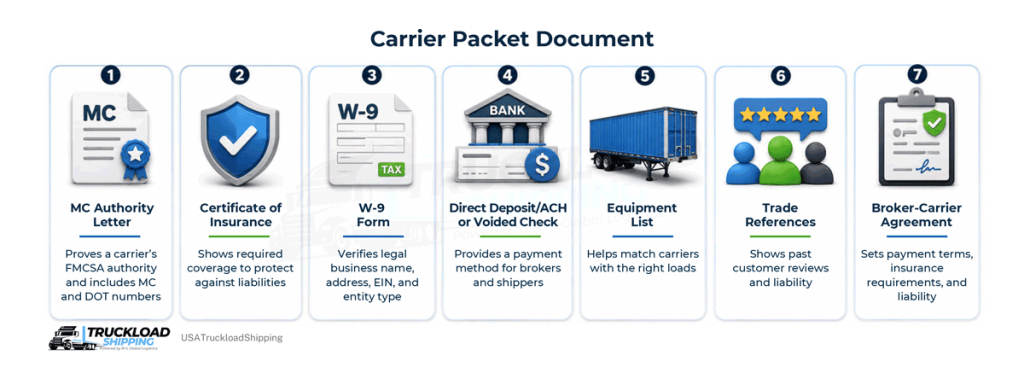
You’ll need to carefully analyze each of these documents when you receive your carrier packet to ensure the transportation provider you’re considering is reliable.
The FMCSA requires a U.S. Department of Transportation (USDOT) number, and MC number. A Hazardous Materials Safety Permit (HMSP) if applicable to their operations. The FMCSA also requires minimum liability coverage from carriers.
A USDOT number is a unique identifier for commercial vehicles. It allows FMCSA and other regulatory agencies to track a carrier’s adherence to safety records and their compliance with federal guidelines.
An FMCSA MC Number is given to for-hire carriers to operate. MC numbers can be between six and eight digits.
The HMSP is a federal credential that allows carriers to transport hazardous materials. To obtain the credential, carriers must complete rigorous safety and compliance standards.
According to the FMCSA insurance filing requirements (2026), for-hire carriers must also maintain minimum liability coverage under 49 CFR Part 387. For example, for-hire property carriers of non-hazmat goods must carry a Bodily Injury and Property Damage (BIPD) insurance requirement of $300,000 for commercial vehicles hauling less than 10,001 pounds.
To vet a carrier before setup, confirm its FMCSA authority, safety record, insurance coverage, contact legitimacy, and operational fit for the shipment. While shippers can search and vet for carriers on their own, brokers prepare setup packets to aid in strategic carrier selection to confirm carriers meet the shipper’s logistics needs.
The packets also help with carrier onboarding once the broker has found the best-fit carrier for the shipper. Carrier onboarding is a process to vet carrier’s FMCSA compliance, safety rating, Operating Authority, and insurance.
Carrier setup includes onboarding to train carriers on the shipper’s business, shipments, logistics challenges, and their role in their supply chain management. In the next section, we’ll review common challenges carriers represent that shippers should review before partnering with one.
Shippers shouldn’t work with carriers just because they have the lowest truckload rates, but because they’ve thoroughly vetted the carrier to comply with FMCSA regulations and create logistics strategies that are best-fit for the shipper.
Here are red flags shippers and brokers should look out for when selecting a carrier:
Avoiding these red flags allows shippers to work with carriers who have proven compliance and safety records, experience shipping their commodity, and maintain reliable capacity when you need it.
Once your broker has completed your carrier packet setup, you’re ready to submit a freight request for proposal to your selected carrier to tender. Use this checklist to prepare your first load and ship with confidence.
Carrier approval through your broker may take a few days, but once it is complete, shippers can book loads with the carrier. If you aren’t sure how to set up your carrier packet, a freight broker will identify federal paperwork needed, carrier compliance records, and shipping rates to ensure the first load goes smoothly.
Get in touch with our freight experts today at (866)-353-7178 to schedule a freight pickup or send your questions to our team through our freight contact form.
Sources:
Company Safety Records, FMCSA, 2023
Types of Operating Authority, FMCSA, 2024
Insurance Filing Requirements, FMCSA, 2026
Receipts and Bills, 49 CFR Part 373
Payment of Transportation Charges, 49 CFR, Part 377
 Copy URL to Clipboard
Did you find this article helpful?
See more of our coverage on Google.
Add usatruckloadshipping.com as a preferred source!

R+L Global Logistics
315 NE 14th St., Ocala, FL 34470
