


See more of our coverage on Google.
Add usatruckloadshipping.com as a preferred source!

The carrier vetting process is the step-by-step review a shipper uses to verify a carrier’s operating authority, insurance, safety record, identity, and compliance with regulations from the Federal Motor Carrier Safety Administration (FMCSA) and U.S. Department of Transportation (USDOT). Shippers who vet carriers with a predetermined checklist of safety and compliance-related questions will find a reliable logistics service provider.
Carrier vetting is the process of evaluating a carrier’s compliance with USDOT and FMCSA regulations, their insurance coverage for carrier liability, and the carrier’s reputation for safety and on-time deliveries.
For instance, a shipper vetting a carrier should ask questions like:
Carriers should provide their USDOT number to shippers during the vetting process. The USDOT number can be referenced on the department’s website to check a carrier’s safety rating.
Inquiring about a carrier’s FMCSA status first will save time in the vetting process, since failure to comply with FMCSA regulations should be an immediate red flag that indicates the carrier is not to be trusted with a shipper’s cargo.
The carrier vetting process is the step-by-step review a shipper uses to confirm that a motor carrier meets legal, insurance, safety, and operational standards before freight is awarded.
A typical carrier vetting process includes the following steps:
This process requires attention to detail, which means you’ll need to complete each step as carefully as possible.
The FMCSA is the government entity responsible for regulating interstate freight movement by commercial motor vehicles (CMV). Carriers must comply with the rules and regulations the FMCSA sets in order to gain and maintain operating authority.
FMCSA outlines three common situations in which operating authority may not be required:
Otherwise, if a carrier does not meet these FMCSA compliance basics, it cannot transport interstate freight.
You can compare freight brokers and asset-based carriers to determine if your freight shipping requirements require more options than a single carrier can offer.
Carrier authority status is an indicator of whether FMCSA has authorized the carrier to transport freight owned by other individuals or businesses across state lines. When carriers apply for operating authority, FMCSA issues an MC Number to the applicant, but this is not sufficient to begin moving freight between states.
The FMCSA requires the following forms to be submitted after they issue the MC number:
The carrier must then wait to receive certification of operating authority before conducting interstate freight transportation.
FMCSA requires carriers to have a qualified inspector examine their commercial motor vehicles every twelve months under 49 CFR subsection 396.17. This requirement applies to the power unit itself and any trailers used in tandem with the unit for freight delivery purposes.
Common violations that preclude a (CMV) from passing inspection include the following:
The carrier must include proof of a successful inspection with all inspected vehicles. A carrier who can’t or won’t provide proof of inspection for their CMV(s) is likely to operate in violation of FMCSA regulations.
As mentioned before, carriers must provide proof of insurance to FMCSA when applying for operating authority. Carriers who can’t prove they have the insurance required for operating authority are not legally permitted to haul interstate freight.
Specifically, FMCSA requires proof of liability insurance. This is not the same as cargo insurance.
Liability insurance is a type of coverage FMCSA requires carriers to prove they have to gain an operating authority license. Requirements for liability insurance are found in 49 CFR 387.303.
A CMV with a gross vehicle weight of over 10,000 lbs must carry $750,000 worth of liability insurance to cover property damage, personal injury, and damage to or loss of freight.
Liability insurance contrasts with cargo coverage because carrier liability covers the three previously mentioned occurrences, while cargo coverage applies to the freight itself.
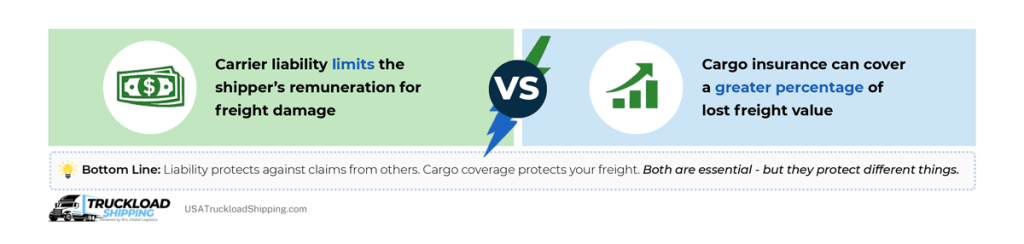
A shipper vetting a carrier can request a copy of the carrier’s certificate of insurance (COI) for inspection during the vetting process.
Red flags on insurance certificates indicate that the carrier’s coverage is insufficient or non-existent. A shipper can look for the following potential red flags when reviewing a prospective carrier’s COI:
While vetting a carrier’s liability insurance, request a freshly printed certificate with you or your company’s name as the requestor. Don’t accept an older copy of the certificate as it may contain out-of-date information.
Shippers can use a carrier’s USDOT number to find out how the carrier ranks compared to others in terms of safety and performance on FMCSA’s website. FMCSA uses the Behavior Analysis and Safety Improvement Categories (BASICs), part of its Safety Measurement System (SMS), to determine a carrier’s compliance with FMCSA regulations.
FMCSA does this by evaluating data from the following:
Shippers can look for high-priority green flags in a carrier’s BASIC history during the vetting process:
In practical terms, a shipper reviewing a carrier’s USDOT/FMCSA profile should feel more confident when the carrier’s record shows low BASIC exposure, no unresolved serious violations, and no recent signs of enforcement attention.
Use this score card during the vetting process to make a decision about whether you should approve a carrier, request more information, or avoid doing business with them.
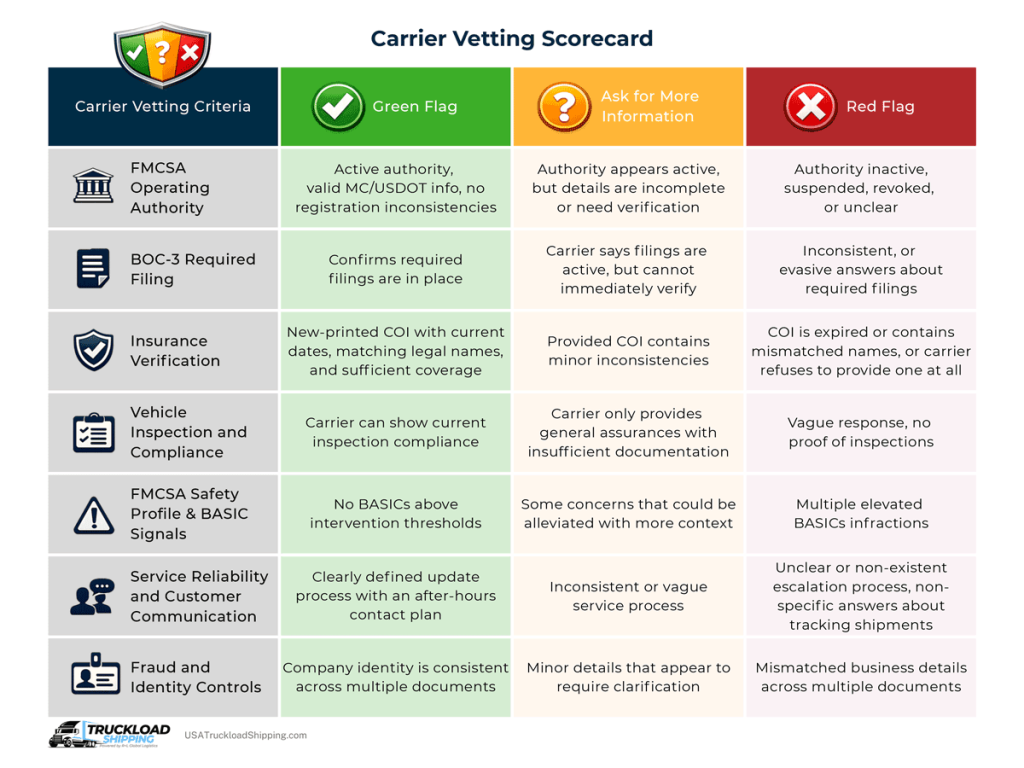
Now that you have a scorecard to evaluate your carriers, here’s when you should approve, seek more information, or reject a carrier based on your findings:
A shipper should never rely strictly on price while vetting a carrier. It’s not uncommon for dubious carriers to advertise lower prices than their fully-compliant competitors.
Our rigorous vetting process is in place to ensure that your freight shipments are only hauled by FMCSA and USDOT-compliant carriers. Give us a call at (866) 353-7178 or fill out a contact form online to find out more about our freight brokerage and third-party logistics services.
Sources:
Regulations, Federal Motor Carrier Safety Administration, 2024
Unlocking Success: The Key Elements of Carrier Vetting and Managing Liability, Transportation Intermediaries Association, Johnson, Andrew, 2024
Get Operating Authority (Docket Number), Federal Motor Carrier Safety Administration, 2026
Newsroom, U.S. Department of Transportation,
Instructions for Form OP-1, Federal Motor Carrier Safety Administration, 2024
Title 49, Subtitle B, Chapter III, Subchapter B, Part 396, Code of Federal Regulations, 2026
Common Violations, Federal Motor Carrier Safety Administration
Title 49, Subtitle B, Chapter III, Subchapter B, Part 387, Subpart C, Code of Federal Regulations, 2026
Certificates of Insurance - What They Don’t Tell You!, Ford Insurance Agency, 2023
Compliance Manual for eFOTM Redevelopment, Federal Motor Carrier Safety Administration, 2021
 Copy URL to Clipboard
Did you find this article helpful?
See more of our coverage on Google.
Add usatruckloadshipping.com as a preferred source!

R+L Global Logistics
315 NE 14th St., Ocala, FL 34470
