

See more of our coverage on Google.
Add usatruckloadshipping.com as a preferred source!

A freight claim is a written demand for compensation when a shipment is lost, damaged, short, or delivered with another transportation discrepancy. This guide explains the main claim types, when shippers can file, what documents they need, and how the claims process usually works.
*Legal disclaimer: All information provided is not to be taken as legal advice.
A freight claim is a formal written request for payment when freight is lost, damaged, short, or otherwise delivered outside the terms of the Bill of Lading (BoL). A shipper doesn’t have to purchase freight insurance to file a freight claim. Claim outcomes depend on carrier liability, shipping terms, and the available documentation.
Freight doesn’t move without a BoL, which provides carriers with their shipper’s freight delivery specifications.
A BOL form is a shipping document that outlines the freight transportation agreement between a shipper and carrier.
When filling out a BoL form, shippers should include the following information to avoid disputes:
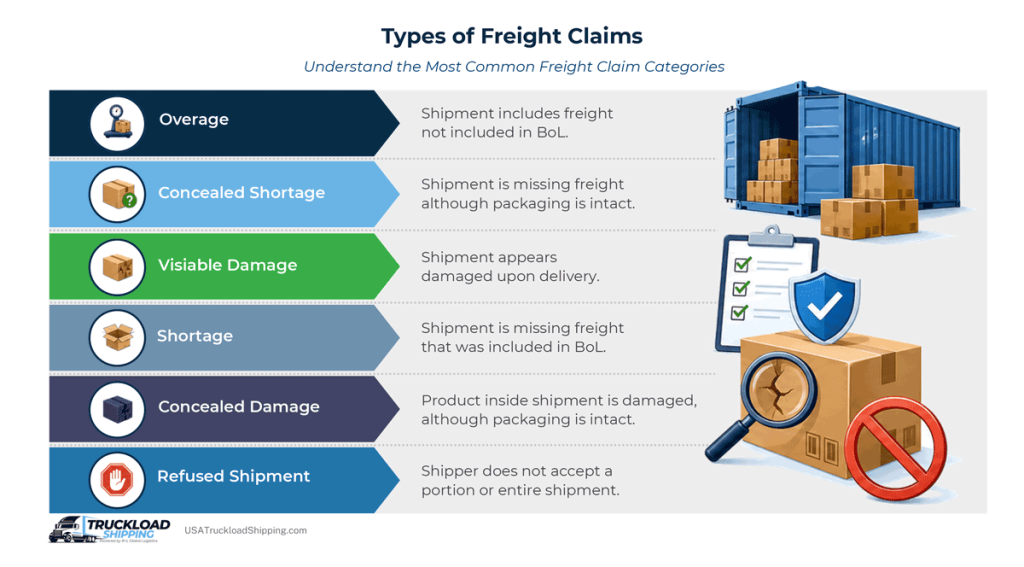
If freight arrives in any condition not agreed upon in the BoL, the shipper may be able to file a freight claim. There are six types of freight claims that we’ve listed in the following table.
According to 49 U.S.C. §14706 (Carmack Amendment), shippers must file a freight claim no later than nine months after the date of delivery.
An over, short, and damaged (OS&D) claim covers freight that arrives over, short, or damaged when compared to what’s listed in the Bill of Lading. Shippers should document the discrepancy at delivery and keep photos, notes, and delivery records to support the claim.
Shippers can refuse a shipment and file a claim when a carrier delivers freight that doesn’t match the information in the BoL, or when freight is visibly damaged.
In the next section, we’ll look at scenarios to illustrate when it’s best to file a freight claim.
The timeline for a freight claim to process varies based on the type of claim and documentation. Freight claims need to be filed within nine months of delivery, but to save time and money, the sooner a shipper files, the better.
Shippers should take note of delivery discrepancies as soon as possible, ideally within 24 to 48 hours. This includes taking pictures of missing or damaged freight.
Once a claim is filed, carriers must respond to it within 120 days to pay, decline, or settle, according to the claim disposition rules in 49 CFR (Code of Federal Regulations) Part 370.
Filling out a freight claim correctly is essential if you want it to be accepted. This includes incomplete or missing documentation, damage not noted at delivery, late filing, improper packaging, lack of evidence of carrier damage, and failure to mitigate damage.
Let’s break down each one:
Avoiding these mistakes is essential if you want to ensure your claim is accepted.
A freight claim usually requires the Bill of Lading, Proof of Delivery, freight bill, invoice, written notice of loss or damage, and photo evidence when available. Missing or incomplete documentation is one of the most common reasons carriers deny claims.
A Proof of Delivery (POD) is a document that confirms a delivery was completed. Shippers can use this document along with photo evidence and notes documenting shipping errors as they discover them to build strong evidence and reduce claim denial.
Common freight claim denials include:
Freight claims may also be denied due to elements of the Carmack Amendment. This rule includes five exclusions that prevent shippers from filing a claim under these circumstances:
In the next section, we’ll review how to file a freight claim step by step.
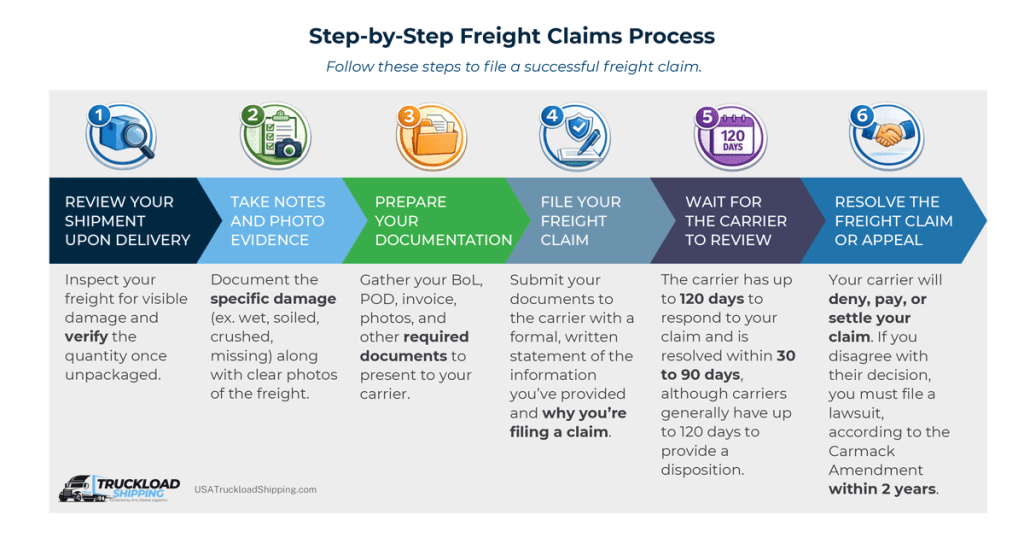
To file a freight claim, inspect the shipment, document the damage or shortage, gather shipping records, submit a written claim to the carrier, and wait for the carrier’s decision or settlement response.
We’ve provided a chart with each step to file a claim with your carrier, including the timeline for payment, settlement, or denial.
Shippers are not required to submit a copy of their freight claim to the U.S. General Services Administration (GSA). While the GSA is a federal agency that manages government property and technology services, only the carrier can process a freight claim.
Freight claims are used to recoup financial losses from shipping mistakes, but shippers can avoid the hassle by working with freight professionals who handle cargo from pickup to delivery with care.
A strong carrier and clear shipping documents reduce the risk of damage, shortage, and documentation errors. If you need help preparing freight correctly, working with an experienced logistics partner can reduce preventable claim issues.
Get in touch with our Freight Experts on a risk-free call at (866)-353-7178 or get an instant quote today. You can also send your questions through our freight shipping contact form.
What are freight claims?
A freight claim is a formal request for compensation when a shipment is lost, damaged, short, or otherwise delivered incorrectly. The carrier reviews the documentation and then pays, settles, or denies the claim.
What is OS&D?
OS&D stands for over, short, and damaged. It refers to a shipment discrepancy in which freight arrives with extra items, missing items, or visible or concealed damage.
How do I file a freight claim?
To file a freight claim, document the problem, gather the Bill of Lading, invoice, Proof of Delivery, and photo evidence, then send a written claim to the carrier. The carrier generally has up to 120 days to respond.
Sources:
49 U.S. Code 14706 - Liability of Carriers Under Receipts and Bills of Lading, Legal Information Institute
Title 49, Subtitle B, Chapter III, Subchapter B, Part 370, Code of Federal Regulations, 2026
Freight Damage Claims FAQs, U.S. General Services Administration, 2025
 Copy URL to Clipboard
Did you find this article helpful?
See more of our coverage on Google.
Add usatruckloadshipping.com as a preferred source!

R+L Global Logistics
315 NE 14th St., Ocala, FL 34470
