


See more of our coverage on Google.
Add usatruckloadshipping.com as a preferred source!

Expedited freight is a shipping mode that accelerates the freight transportation process to meet time-sensitive delivery windows. Expedited freight services generally cost more than standard freight deliveries. This guide is for shippers deciding whether faster shipping provided by expedited freight services is worth the cost.
Expedited freight is a logistics process that delivers cargo typically within one to three days, depending on origin and destination. Expedited shipping services use specialized cargo handling, streamlined lanes, and speedy shipping modes to transport goods quicker without damaging freight or its packaging.
Expedited shipping is best used over standard freight shipping for the following types of freight:
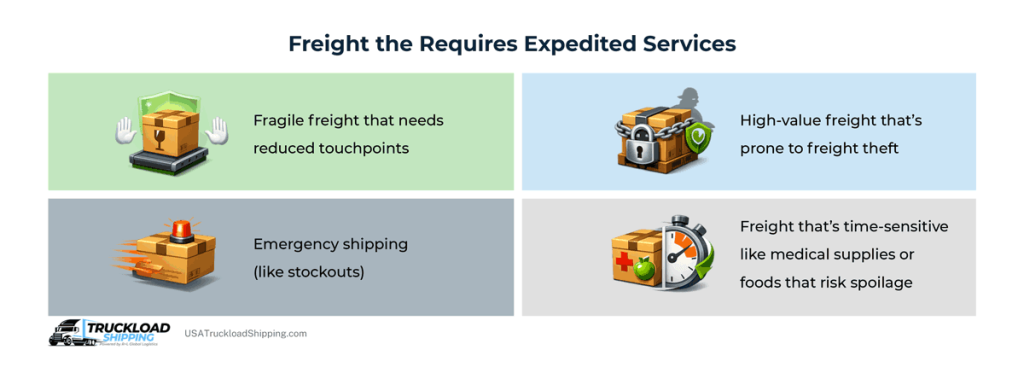
In the next section, we’ll discuss if expedited services are worth the investment.
Expedited freight primarily serves the end user with a quicker turnaround time after purchasing a product. Shippers seeking to improve customer service or meet customer demand should consider expedited shipping services as long as it fits their budget.
Let’s take a look at a couple scenarios when expediting freight could benefit your business.
Service recovery is a process to complete a shipment after unprecedented obstacles delayed the shipment.
These obstacles can include:
When freight is late, expedited services recover lost time and support supply chains.
High-consequence deadlines are situations when freight that isn’t delivered on time causes issues within a supply chain or business. When drivers are delayed en route, businesses that ship time-sensitive freight risk customer dissatisfaction and spoiled or damaged products that are expensive to replace.
Scenarios include:
Shippers can navigate these hindrances with expedited services that utilize priority lanes, specialized handling, and enact emergency protocols to swiftly deliver products.
Expedited freight is commonly used for urgent medical shipments and temperature-sensitive food loads when delay would interrupt care, spoil inventory, or miss a required delivery window. We’ve provided some examples of how expedited shipping would be used in these scenarios.
Medical example:
A regional hospital in Ohio is expecting a next-day delivery of IV pumps, sterile tubing, and emergency wound-care kits ahead of a weekend trauma surge. Late the night before delivery, the original truck is delayed by a highway closure and mechanical issue in Indiana.
Because the shipment supports patient care and the hospital has limited backup inventory, the shipper moves the load via expedited transport using team drivers and direct routing. The replacement shipment is picked up overnight and delivered the next morning in time for hospital receiving.
Perishable supplies example:
A dairy distributor in Pennsylvania is shipping milk, yogurt, and soft cheese to grocery distribution centers in the Northeast during a summer heat wave. Mid-transit, the original reefer unit develops a temperature-control issue that puts the load at risk of spoilage. A reefer unit is a temperature controlled trucking trailer used to transport perishable goods.
To protect the product and meet store delivery appointments, the shipper arranges expedited refrigerated freight with a team-driven reefer truck and a more direct lane. The replacement truck reaches the destination within the required delivery window, preventing spoilage and avoiding empty shelf space at retail locations.
Expedited freight services are more expensive than standard freight transportation because of the measures carriers take to process and handle freight for delivery within a few days or less. We’ve provided a table that breaks down the costs that drive expedited shipping services.
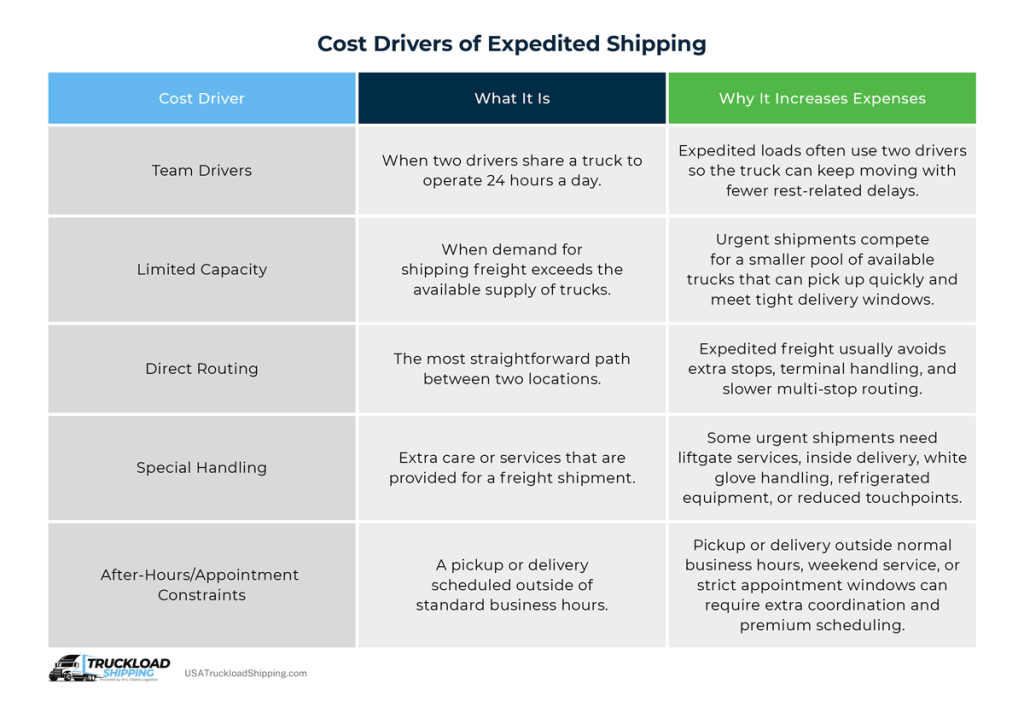
While these factors might drive up the cost of expedited shipping, it’s well worth the expense if you require the service.
Expedited services saves shippers time and improves customer service. However, if it doesn’t fit in a business’s budget, shippers can use alternative modes to deliver freight within tight delivery windows.
Keep in mind that LTL freight requires freight classification and National Motor Freight Classification (NMFC) codes to identify and price freight.
Freight class is an 18-level classification system used by the National Motor Freight Traffic Association (NMFTA) to price LTL shipments. NMFC codes are used to classify commodities based on their density, handling, stowability, and liability.
While LTL could be a great transportation alternative for smaller freight shipments, packaging and shipping documents with misclassification or incorrect NMFC codes can trigger additional fees and delay transit to reclass.
We help businesses coordinate expedited freight for urgent shipments with tight delivery windows. Our team reviews the freight details, transit deadline, and handling needs to choose the right mode, whether that is expedited freight or standard shipping.
Call us today at (866) 353-7178 or reach out to us on our contact page for more information.
 Copy URL to Clipboard
Did you find this article helpful?
See more of our coverage on Google.
Add usatruckloadshipping.com as a preferred source!

R+L Global Logistics
315 NE 14th St., Ocala, FL 34470
