

See more of our coverage on Google.
Add usatruckloadshipping.com as a preferred source!

A hazmat shipping broker is a freight intermediary that helps shippers book hazardous materials with qualified carriers, and this guide helps shippers understand what brokers do, how they differ from carriers, what they charge, and how to evaluate one before booking.
Hazmat brokers coordinate compliance and carrier selection by verifying documentation, insurance coverage, and route eligibility before booking hazardous materials shipments. Use this guide to learn how to choose a FMCSA-compliant broker to move your hazmat load.
Regulatory note: Requirements for hazardous materials shipments depend on the material, the shipper’s role, the carrier’s permit status, and the shipment documentation involved. Confirm current FMCSA and PHMSA requirements before booking.
A hazmat shipping broker is a person or company that helps shippers book hazmat loads with certified-hazmat freight carriers. The broker helps match shipment requirements, review carrier qualifications, review documentation needs, and coordinate booking.
Although brokers do not own vehicles or equipment to transport hazmat freight, brokers may be required to obtain a Motor Carrier (MC) number depending on role under 49 CFR (Code of Federal Regulations) enforced by Federal Motor Carrier Safety Administration (FMCSA). An MC number is a six to eight digit number issued by the FMCSA that authorizes brokers to operate freight services in the United States.
49 CFR regulations define U.S. motor carrier compliance and transportation regulations. FMCSA is an agency of the U.S. Department of Transportation (DOT) that oversees safe freight transportation.
Standard freight brokers don’t often have hazmat identification or hazmat freight coordination experience. A hazmat broker is a specialized broker that has:
Hazmat brokers are required to have hazmat certification when:
The Pipeline and Hazardous Materials Safety Administration (PHMSA), an agency of DOT, defines an “offerer” as a person who offers pre-transportation function for the transportation of hazmat freight.
On the other hand, carriers must obtain hazardous materials certificates before hauling hazmat freight, according to PHSMA.
We’ve created a comparison chart of the differences between hazmat brokers and hazmat carriers:
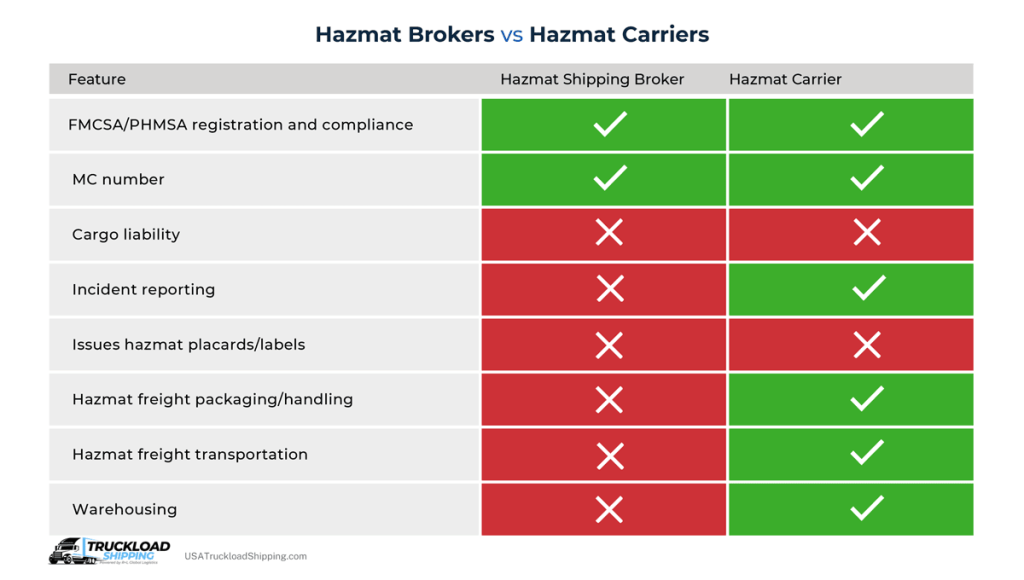
Hazmat brokers don’t handle any hazmat freight, but they must obtain broker authority through the FMCSA.
Hazmat brokers must also carry active broker liability insurance to cover contractual and financial risks. Broker liability insurance is not the same as carrier liability insurance.
Carrier liability and broker liability cover different risks in a freight transaction:
In the next section, we’ll review what factors go into hazmat brokerage costs.
Brokers and carriers with good-standing partnerships allow the broker to negotiate preferred hazmat shipping prices for the shipper.
Hazmat brokerage services costs are based on the following factors:
Certain carriers do not haul Class 1 (explosive) hazardous materials and a hazardous materials broker must verify this carrier qualification standard. This helps the broker calculate the carrier’s hazmat rate that’s added to their freight transportation costs for the shipper.
A hazmat broker helps shippers find qualified carriers, verify insurance, review route requirements, and take emergency protocols. We’ll discuss each of these services in the following sections.
Carrier vetting is a process to verify a motor carrier’s hazmat certification, FMCSA compliance, safety rating, insurance policies, and freight services on the behalf of a shipper.
Resources like the FMCSA Verification of Carrier Hazardous Material Safety Permit (HMSP) and Behavior Analysis Safety Improvement Categories (BASIC) allow brokers and shippers to review a carrier’s records for the following:
Brokers also check a carrier’s compliance, safety, accountability (CSA), FMCSA’s compliance and safety program, to verify a carrier’s hazardous materials compliance, certification, and experience.
Insurance verification is a process to check a carrier’s active insurance policies to cover hazmat freight.
Hazardous materials brokers mitigate risk by ensuring carriers are insured with the right coverage for hazmat freight type and accidents.
Route compliance is a process for brokers and carriers to comply with FMCSA regulations to book and haul hazmat freight in the appropriate lanes.
Hazmat carriers coordinate with their drivers to ensure hazmat freight doesn’t travel the same lanes as non-hazmat freight. It’s the broker’s responsibility to verify the carrier and driver comply with these requirements prior to booking a shipment. This helps reduce the risk of non-compliance, penalties, and insurance claims.
Emergency protocol planning is a safety measure hazmat carriers take to protect drivers hauling this type of freight.
Hazmat brokers assist in emergency protocols by verifying carriers have an emergency plan in place before booking a shipper’s freight.
If you’re looking to partner with a hazmat broker, use our checklist to vet your broker for the hazmat services you need.
Before you book a load with a hazardous materials broker, use this checklist to review their qualifications:
At USA Truckload, our hazmat brokers verify our carriers’ and their drivers’ hazmat certifications and compliance history to guarantee we match you to the right professional for the job.
Before you book a hazardous freight shipment, you should ask your carrier questions to confirm their qualifications. Your ultimate goal is to choose a provider that will transport your shipment legally, safely, and without delay.
Questions you should ask include:
Answers to these questions will give you a better idea of your hazmat broker’s reliability.
Not every hazmat broker is a good fit for hazmat freight. There are red flags you should be on the look out for when evaluating your partner.
A reliable hazmat broker should be able to explain their process clearly, confirm carrier fit and help spot issues before the load is booked.
As a third-party logistics (3PL) company, we have a team of hazmat intermediaries that can help you transport your freight. With our 22,000+ carrier network, we’re experienced in moving hazmat freight or waste anywhere in the United States.
You can book a lane with our hazmat brokers and grab a quote in just minutes. Give us a call at (866) 353-7178 or visit our freight and logistics consultation page to book a 1-on-1 session with a freight expert.
Sources:
FMCSA, Types of Operating Authority, 2024
Code of Federal Regulations, Title 49 Transportation, 2026
Wiseman, Brandon, Who Is Subject To Hazmat Registration and Training Rules? 2023
FMCSA, Hazardous Materials Safety Permit Program (HMSP), 2023
FMCSA, Get Road Smart About the 7 BASICs of Safety
FMCSA, CSA Home Page
 Copy URL to Clipboard
Did you find this article helpful?
See more of our coverage on Google.
Add usatruckloadshipping.com as a preferred source!

R+L Global Logistics
315 NE 14th St., Ocala, FL 34470
