There are a few ways to ship your products by truck, and sometimes it’s not so clear which transportation method is best when you know your freight won’t fill up an entire trailer. At USA Truckload Shipping, we’ve helped numerous businesses find the solution that’s right for them.
In this article, we’ll cover how to determine whether a partial truckload is best for your next shipment, along with the benefits it offers.
Key takeaways:
Let’s start by unpacking the core differences between three popular shipping methods: Partial truckload, less-than-truckload, and full truckload shipping.
In our opinion, PTL is the perfect middle ground between FTL and LTL. Where FTL uses an entire trailer for its cargo and LTL shares trailer space between multiple shippers, partially filled truck shipments also use a shared trailer—but other businesses’ shipments are only included if they are headed in the same direction.
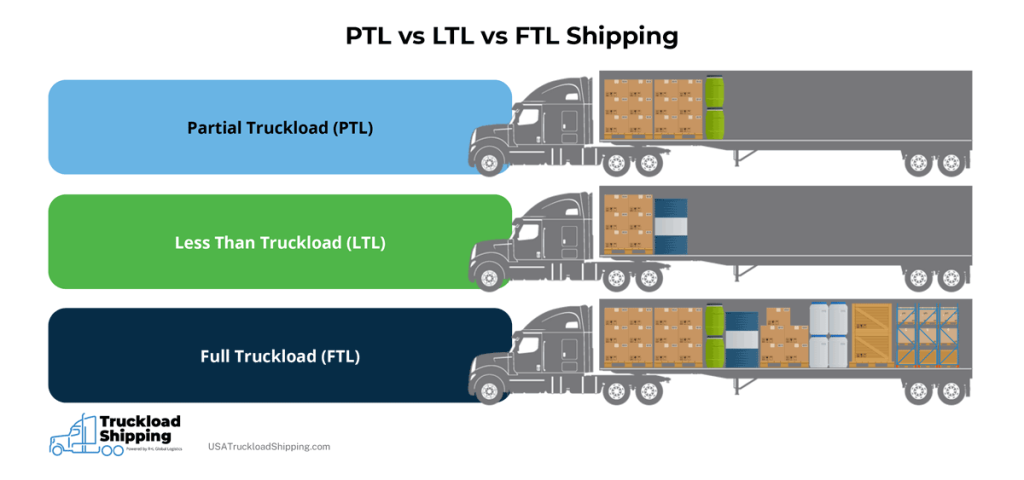
Looking at the image above, it’s easy to see how PTLs maximize truck space. We’ll break down the best cargo to use for partially filled truck shipments a bit later, but for now, keep in mind that PTL shipping is ideal for freight that is:
With that in mind, freight that is not ideal for PTL shipments is:
If your cargo is large but won’t require a full 53’ trailer's worth of space, we believe a PTL is the way to go. Now, let’s dive into how this shipping method can complement your logistics needs.
If your cargo is large but won’t require a lot of space in a truck, we believe a PTL is the way to go.
Now, let’s dive into how PTL shipping can complement your logistics needs.
Related Article: PTL vs FTL Shipping: Key Differences for Shippers to Consider
PTL shipping offers a great deal of benefits when you compare it to LTL or FTL shipping. Here are the top three partial truckload benefits we believe are ideal to take advantage of for your shipping needs.
When it comes to shared truckloads, you won’t have as much truck space as a FTL, but you’ll have more than a LTL. Plus, the price of that space and the weight of your freight is what you pay, versus paying according to freight class. That’s why we recommend going with PTL shipping if you know your freight will not take up a full trailer, or if it’s too large for a less-than-truckload.
Because PTL shipments are around 4 to 20 pallets of freight, often preferred for uneven-sized cargo, you can make the most of the space you occupy in a truck. You only pay for the space that you’re using, so there are no extra fees for transportation.
Since partial truckload shipments include a variety of businesses’ loads headed towards the same destination, this can bring down fees like the cost per mile and freight class if your cargo is large but not heavy. With the freight combined on one truck, this can mean fewer stops and handling, which reduces the chance of your freight being damaged.
If your load needs to arrive at its destination within a particular timeframe, PTL vs LTL shipping offers time-sensitive and swift transfers.
As we mentioned previously, PTL shipments are only grouped together when they’re going to the same destination or general area, minimizing cross-docking and reducing stops at freight terminals. Your freight gets from point A to point B faster and easier.
We mentioned earlier how the shape and weight of your freight can impact the cost of your shipment, so let’s jump into what types of cargo work best for a partial truckload.
While there is an assortment of requirements for freight transportation, such as correctly palletizing your freight or filling out a bill of lading, when you opt for PTL shipping, it’s important to keep an eye on the weight of your freight.
Since there’s no freight class to worry about as you would with LTL shipping, you’ll just need to consider how heavy and large your load will be. Partial truckload shipments are between 5,000 to 40,000 pounds, so let’s take a look at some ideal cargo for partial truckload shipping:
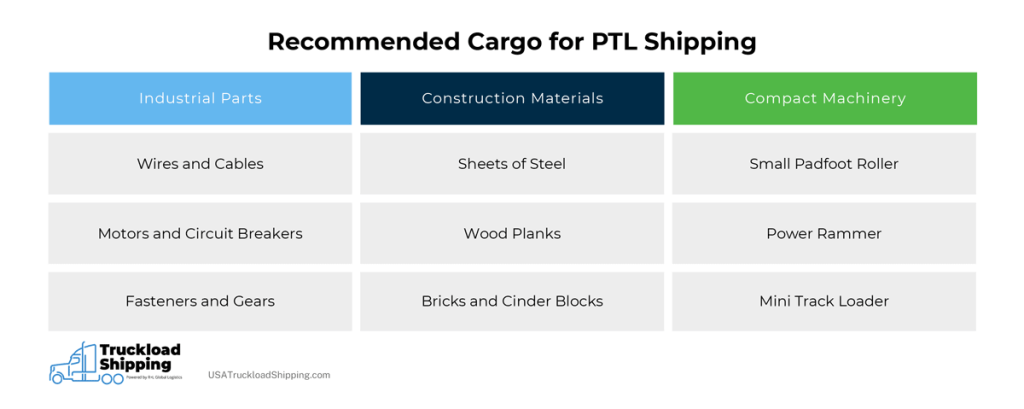
You can save on space and costs by choosing the right packaging for your freight.
This list can include many more types of cargo, however, the goal is low density freight. Think “large and light.”
If you’ve decided that a partial truckload will best suit your shipping needs, you’re already in the right place to get your cargo where it needs to go.
At USA Truckload Shipping, we provide simple logistics solutions that make the most sense for your partial truckload shipment and other shipping needs. This includes expedited, hazmat, and white glove transportation.
We’re ready to help you with your freight transportation—no matter the size of your cargo or business. Give us a call at (866) 353-7178 or get in touch with our team by visiting our contact page to learn about our other services.

R+L Global Logistics
315 NE 14th St., Ocala, FL 34470
