

See more of our coverage on Google.
Add usatruckloadshipping.com as a preferred source!

Drayage is the short-distance movement of shipping containers between ports, rail terminals, warehouses, and nearby distribution points. Businesses use drayage to move freight through the first leg of inland logistics after ocean or rail arrival.
Drayage is a truckload shipping mode to move shipping containers from a port to a local rail terminal or warehouse. Specialized trucks are used to haul containerized goods over a short distance.
We’ve mapped out a standard example of how this process works at a port of entry.
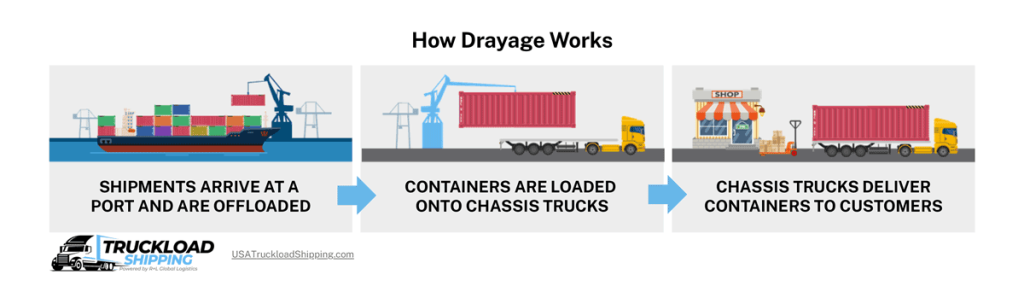
Since drayage usually takes place once a containerized shipment reaches its port destination, it is sometimes referred to as “first-mile shipping.” This contrasts with final mile shipping, which is the last leg of a product’s journey to its end user.
Drayage is a part of intermodal shipping. Intermodal shipping is a transportation mode that connects multiple vehicles (ship to truck to rail or air) to deliver one shipment and often features drayage services for the first mile, known as intermodal drayage.
While over-the-road freight shipping uses semi trucks, trailers, and trains to move goods across long distances, drayage requires specialized equipment to handle container transportation.
Common drayage equipment used includes:
The specific equipment used varies on the type of drayage service. For instance, some chassis trucks are equipped with extra fuel tanks to power refrigerated containers for refrigerated goods in cold chain logistics.
The main types of drayage describe where the container moves and why. Common examples include door-to-door, expedited, shuttle, inter-carrier, intra-carrier, and pier drayage.
The Intermodal Association of North America (IANA), a U.S. organization that represents intermodal freight transportation interests for domestic and international logistics companies, defines six classifications:
Cartage is a similar, short-distance service that delivers goods within a local freight hub. The main difference is drayage transports an entire, unopened container within a metropolitan area and cartage opens and breaks down the contents of the container to deliver to end users in that area.
Drayage is essential to a cost-efficient and fluid supply chain with three three basic benefits:
While the final mile is often considered the most important part of the shipping process due to its customer-facing nature, drayage in the first mile is just as important for timely deliveries.
Drayage cost depends on distance, equipment, container type, appointment timing, and delay-related fees.
Even when the route is short, total cost can rise quickly if demurrage, detention, or chassis split charges apply.
Here’s how drayage rates are calculated:
Like any other form of shipping, drayage rates may fluctuate almost daily based on fuel prices and driver availability. Shippers can use freight data analysis tools like DAT Trendlines to keep tabs on fuel, trailers, and other factors affecting drayage shipping costs.
Demurrage, detention, and chassis split charges are accessorial charges that can raise total shipping cost when containers, appointments, or chassis availability are mismanaged.
Demurrage is a fee for containers being held in a terminal in a port past the allotted free time. Shippers are given a contracted amount of time to load or unload their containers from the location.
When the load/unload process takes too long, shippers are billed demurrage fees up to $300 per container each day it remains beyond the agreed upon free time.
Detention is a fee that’s charged when a shipper or receiver holds onto a carrier’s equipment longer than the allotted amount of time. Equipment can include a carrier's truck trailer or shipping container.
Shippers must load or unload containers within the free time window, usually a few days, and are charged up to $150 each hour the container remains in the terminal.
A chassis is the wheeled frame used to move a shipping container by truck. A chassis split happens when the shipping container and the required chassis are not available at the same location. This adds extra retrieval time and can increase drayage cost depending on terminal and carrier conditions.
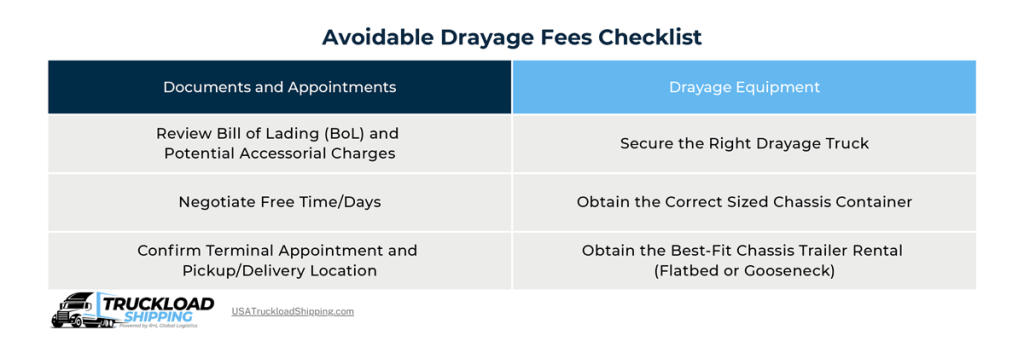
Shippers can avoid drayage accessorial fees by reviewing shipping documents, securing the appropriate drayage truck, and negotiating free time with their carrier.
Refer to our checklist to ensure your next freight bill is free of accessorial fees.
Drayage helps businesses move containers efficiently between ports, terminals, and nearby facilities, but the process requires careful planning around equipment, appointments, and fees.
We provide drayage services to make moving your next load hassle-free. Call our freight experts at (866) 353-7178 or fill out our quote form to share your shipment details.
Sources:
IANA, Intermodal Association of North America
Trendlines, DAT Freight & Analytics
 Copy URL to Clipboard
Did you find this article helpful?
See more of our coverage on Google.
Add usatruckloadshipping.com as a preferred source!

R+L Global Logistics
315 NE 14th St., Ocala, FL 34470
