
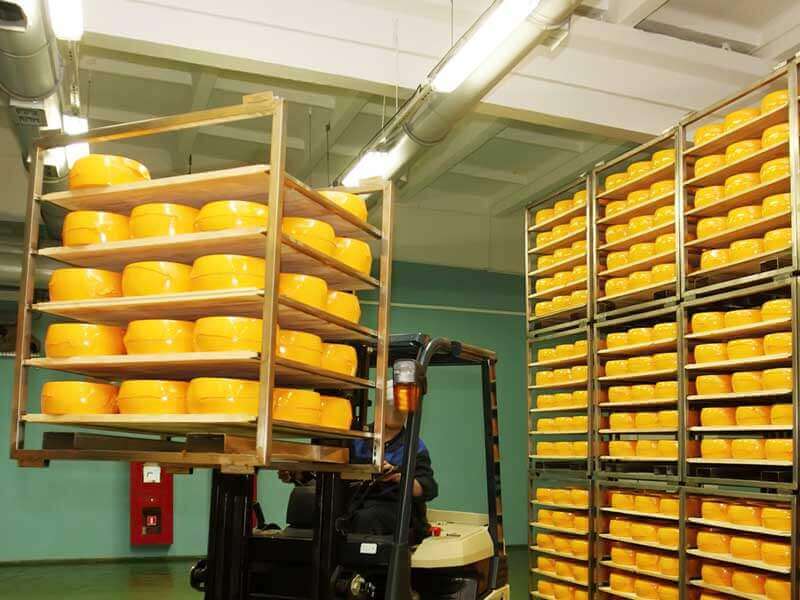

See more of our coverage on Google.
Add usatruckloadshipping.com as a preferred source!

Cheese is a refrigerated or shelf-stable dairy product, and its shipping requirements depend on packaging, temperature and humidity controls, and sanitation. The Food and Drug Administration (FDA) oversees and enforces food safety during transportation through its law, the Food Safety Modernization Act (FSMA). We’ll walk you through how to ship cheese in any form via truckload to maintain FDA and FSMA compliance.
Key Takeaways:
If you need to ship cheese by the truckload, this guide is for you.
The FDA is a U.S. federal agency that enforces the FSMA sanitary transportation rule, which sets sanitary requirements for transporting human and animal food by motor vehicle or rail in the United States. Shippers transporting food for humans or animals must comply with FSMA requirements to package and ship food, like cheese, in sanitized trucks to prevent foodborne illnesses.
To ensure you and your carrier maintain adherence with FSMA requirements, document the following in your Bill of Lading (BoL):
Cheese is produced in a variety of products that range from refrigerated to shelf-stable. Both products must be packaged and shipped with the appropriate equipment to preserve quality and avoid contamination during transport.
Use the checklist we’ve provided to set temperature, reduce condensation, and prevent package damage during truckload transit.
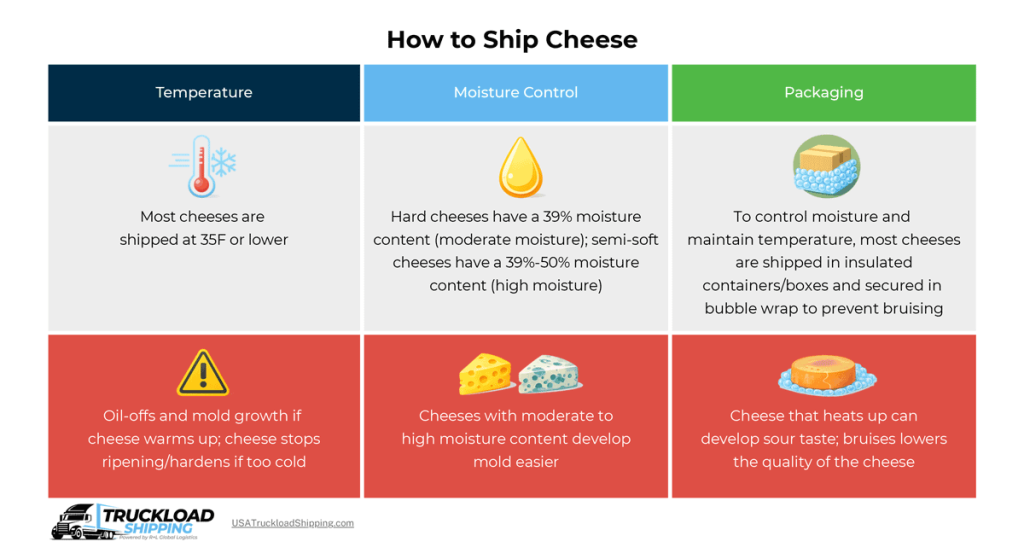
The U.S. Department of Agriculture (USDA) requires chilled cheeses to be shipped at 35F or lower to avoid bacteria, mold growth, and oil-offs. That said, be sure to follow the temperature specification and document it as part of the sanitary transportation process.
Oil-off is when cheese fat separates from the protein matrix after excessive warming. This reduces the appearance and eating quality and can shorten shelf life.
To avoid these cheese damages and maintain FSMA compliance, we’ll go over the equipment and trailer you’ll need to ship cheese safely in the next section.
Cheese that requires temperature control should travel inside a reefer trailer with a documented temperature range and routine in-transit monitoring. Under the FSMA Sanitary Transportation rule, you must communicate the temperature control requirements to your carrier; and carriers should operate equipment to keep food from becoming unsafe during transportation.
Cold chain logistics is a process to safely ship cool to cold to frozen freight. Carriers operate reefer semi-trailers and equipment like pallet jacks to load and unload bulk cheese freight easier and faster to preserve the haul’s quality from pick up to delivery.
Ensure your carrier maintains airflow paths, keeps product off the trailer nose when required, and uses a bulkhead or air chute if your packaging or customer specifications require consistent return-air circulation.
Let’s discuss the trailer and equipment used in cold chain logistics to ship cheese.
A reefer truck is a 53’ semi-trailer with insulation and refrigeration unit to maintain temperatures of chilled and frozen freight.
Cheese must be shipped on reefer trucks for temperature control from load to unload to preserve quality.
Palletized freight is a shipping method to protect freight during transit and seamlessly load and unload bulk freight.
While crating is a suitable method for fragile cheese shipments (such as high moisture cheeses prone to bruising), palletizing freight allows carriers to move freight from the loading dock, into the truck, and from the truck to its final destination faster to prevent cheese freight from overexposure to heat and temperature shifts.
Carriers use the following equipment to load and unload cheese freight:
Reefer trucks can hold 26 or more pallets of high-quantity cheese freight suitable that's for full truckload (FTL) shipments. Shipments that are one to 10 pallets are best shipped using less-than-truckload (LTL) if the cheese can tolerate extra touches and longer dwell time. High-volume cheese shipments with tight temperature tolerance should be transported using FTL as these are faster, point-to-point transits.
Here’s a quick decision guide to follow:
We’ll go over how to choose the shipping mode your cheese freight needs in the next section.
Cheese can be shipped in smaller quantities for local deliveries or in bulk for coast-to-coast shipping to big box grocery stores.
No matter the size of your cheese haul, we’ll give you an FSMA checklist for cheese shippers and review the best truckload shipping mode to transport your cheese freight.
Use this checklist before you tender your cheese truckload shipment:
With your checklist ready, it’s time to look at the shipping modes you can use.
LTL is a shipping mode that consolidates multiple shippers’ freight onto one truck to deliver to multiple locations. Small cheese freight would be consolidated with other shipments requiring cold chain logistics.
Use LTL for shipments that:
LTL cheese shipments also require the shipper to designate the product’s freight class and National Motor Freight Classification (NMFC) code prior to shipping.
Freight class and NMFC codes help carriers price and handle LTL shipments. If you ship cheese by LTL, ask your provider which NMFC item applies to your packaging format and whether the shipment is temperature controlled.
Both the freight class and NMFC help carriers price your load and identify it on the reefer truck among other shippers.
FTL is a shipping mode that delivers one shipper’s freight on a point-to-point transit. This method is typically used when shipping high-volumes of freight.
Use FTL for shipments that:
Shippers using FTL to ship cheese are usually delivering freight to chain grocery stores like Costco or Walmart.
No matter where you’re shipping, USA Truckload is equipped with the trailers and carriers to haul your load anywhere in the US, anytime. Our network of 22,000+ carriers are trained to operate reefer trucks and manage your supply chain with our cold chain logistics strategies for success.
As the nation’s leading cheese-producing state, Wisconsin sends large volumes of dairy products to distributors, retailers and food service operations across the country. When arranging freight shipping from Wisconsin, cheese shippers should select a transportation mode based on shipment size, transit time and the product’s specific temperature requirements.
Refrigerated FTL service can provide the consistent temperature control and limited handling needed for long-distance shipments. Common outbound routes include freight shipping from Wisconsin to Florida, Wisconsin to New York and Wisconsin to Texas. Regardless of the destination, the reefer should be pre-cooled, temperature requirements should be documented and pallets should be staged to minimize time on the loading dock.
Who this guide is for: Dairy distributors and food shippers booking refrigerated truckload moves in the U.S.
How we built this guide: We aligned shipping steps to the FDA’s sanitary transportation framework.
Shipping cheese is easier when the shipping plan is documented before pickup. USA Truckload Shipping coordinates reefer capacity, confirms temperature requirements, and helps reduce risk from dock delays, temperature excursions, and excess handling.
When you’re ready to schedule your shipment or want to know more about our service, give us a call at (866)-353-7178 or get a quote today in just minutes. We’re ready to help make your next cheese shipment smooth and hassle-free.
 Copy URL to Clipboard
Did you find this article helpful?
See more of our coverage on Google.
Add usatruckloadshipping.com as a preferred source!

R+L Global Logistics
315 NE 14th St., Ocala, FL 34470
