

See more of our coverage on Google.
Add usatruckloadshipping.com as a preferred source!

The Pipeline and Hazardous Materials Safety Administration (PHMSA) is an agency responsible for the transportation of hazardous goods. They work alongside the Federal Motor Carrier Safety Administration (FMCSA), who regulates safety guidelines for commercial vehicles, and the Environmental Protection Agency (EPA), who regulates US environmental standards. We'll explain the regulations for each agency you’ll need to follow when shipping hazardous waste.
Let’s start by defining hazardous waste and the other terms you’ll need to understand when shipping this type of cargo.

Hazardous waste can come in the form of a solid, liquid, gas, or even sludge. For this reason, it can’t be handled the same way as regular waste, like food scraps and plastics.
We’ve provided another graphic showing several regular household products that can become hazardous waste.

Hazardous waste is generally a byproduct of industry, like construction, oil refineries, and chemical plants. These types of industries either produce hazardous waste as a byproduct of producing goods or even the products themselves.
Things such as industrial waste or spent batteries shouldn’t be just thrown in the trash, but rather disposed of in a safe manner. Think of the same process for shipping hazardous waste as it needs to be handled according to EPA, PHMSA, and FMCSA regulations.
Hazardous waste transportation can include moving the substances to be recycled, salvaged for parts, or complete disposal. Here at USA Truckload, we understand hazmat regulations can get complex. We ensure our carriers and drivers are certified and equipped with the right resources to transport waste on your behalf.
The EPA classifies hazardous waste by one of four characteristics. We’ve provided a graphic of each category, the danger it poses, examples, and transportation risks.

PHMSA requires shippers and carriers to follow the Hazardous Materials Regulations (HMR) to correctly identify and safely transport hazardous waste by truck, air, rail, or ocean. Reactive, ignitable, toxic, and corrosive waste all fall under the nine classes of hazardous materials and we’ll go over how to safely ship them either on your own or with a 3PL partner.
We’ll discuss each waste with more detail in the following sections.
Reactive waste is unstable under normal conditions and may react with water, give off toxic gasses, or detonate when heated.
It’s good practice to lay out exactly what can happen to reactive waste that can lead it to becoming unstable, especially during transit. Shippers moving reactive waste have to make sure to keep it dry and cool since there is the possibility of the waste exploding or emitting toxic fumes when mixed with water.
Any freight incompatible with the reactive waste should be loaded on another pallet. The same reactions can also occur if the waste is heated or compressed. According to the EPA, there are no ways to test reactive waste to see if they’re in danger of suddenly becoming reactive.
Ignitable waste is a waste that’s hazardous due to its ability to easily catch fire and sustain combustion.
While this might sound like it could be similar to reactive waste, ignitable waste falls under more specific circumstances. This waste has a flashpoint of less than 140 degrees fahrenheit and can be spontaneously combustible. Common examples of this kind of waste include used solvents, waste oils, gasoline, alcohol, and acetone.
Toxic waste is a material that’s harmful when ingested or absorbed. It can directly affect people, plants or animals, or even the ground through groundwater, and landfills.
While many different chemicals or elements can cause toxicity, the ones most routinely present are those containing lead or mercury. Shippers could face penalties up to $186,610 for non-compliance that led to human or environmental damage from improper hazmat transit.
Corrosive waste is a liquid that has the ability to eat through steel and has a pH level less than 2 or 12.5 or more. Battery acid, hydrochloric acid, sulfuric acid, and nitric acid are common examples of what a hazardous material transportation company would expect to ship.
The danger present in transporting corrosive waste is it can eat through containers and cause leaking or spilling of hazardous materials. Make sure you carefully inspect the corrosive materials by checking for leaks prior to palletization.
Your carrier should have durable, hazmat-ready equipment to ship this and all hazardous wastes safely.
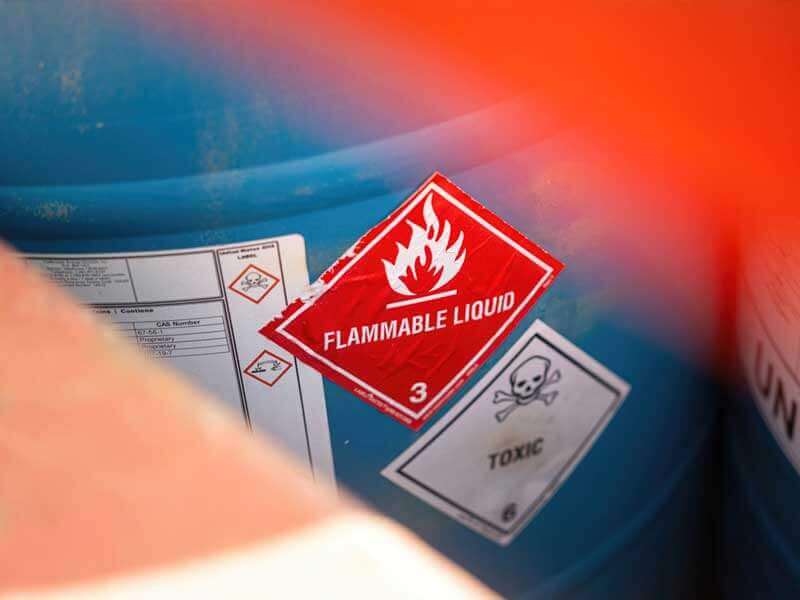
Anything considered to be hazardous waste has to be labeled, stored, and shipped in accordance with FMCSA, PHMSA and EPA’s regulations. This includes warning labels and placards on the packaging of the hazmat cargo and trailer if it’s traveling via truckload.
Shippers working with a 3PL to transport hazardous waste will take it to a landfill or similar facility to recycle or dispose of the products. For more complicated or dangerous waste, Transfer, Storage, and Disposal Facilities (TSDFs) safely dispose of hazmat waste.
Each state has its own guidelines for the proper labeling and marking of hazardous waste but we’ll focus on the DOT’s requirements. No matter what kind of marking you use, it should clearly state that hazardous waste is being transported.
The business or company must also be listed on the marking, as well as the exact date the waste was generated. This is important because hazardous waste can only be stored for a limited amount of time before you’re in violation. Your business’s information should also be listed so anyone who reads the marking can know where it originated from and who to contact in case of an emergency.
The labeling is a fairly standardized process. Using a 4-inch by 4-inch diamond-shaped placard with the correct symbols on it, your container will be clearly labeled. The labels should be fully visible, meaning there should be zero obstructions in viewing any part of them.

Hazard labeling is the standardized system that communicates primary and secondary hazards on a palletized load. Placards extend that signal to drivers and staff responsible for handling the cargo.
If you have multiple labels, like reactive and toxic, these labels should be about 6 inches apart and clearly convey to anyone the hazards it can cause. The secondary hazards should be below and to the right of wherever the main hazard label is.
A hazmat-capable 3PL is a logistics provider that maintains hazmat regulations with trained carriers and accurate documentation. They must have the skill to ensure your hazardous waste doesn’t spill and cause transit damage. Before you consider having your hazardous waste put on a truck, make sure the 3PL in question has plenty of liability insurance for dangerous commodities like this. Most 3PLs are required to have a minimum of about $750,000 insurance coverage for hazardous waste incidents.
If that part checks out, then it’s time to pay attention to the mode of transportation. If a truck is used, it’s important to know the precautions the 3PL will take.
Here’s a checklist to keep when vetting 3PLs to transport your hazardous waste:
A reliable 3PL will satisfy the requirements of this checklist. Also, it’s worth noting that not everyone is certified to handle the transportation of hazardous waste. We at USA Truckload value honesty and transparency, and we’re happy to provide our credentials to securely ship your hazmat freight.
Our carriers are DOT-certified with vast experience in hazardous waste transport anywhere throughout the United States. When you’re ready to undertake hazardous waste transportation, call us at (866)-353-7178 or get a free quote today.
Compliance Note: This guide is purely educational and not legal advice. Verify current requirements with governing agencies before booking a shipment.
 Copy URL to Clipboard
Did you find this article helpful?
See more of our coverage on Google.
Add usatruckloadshipping.com as a preferred source!

R+L Global Logistics
315 NE 14th St., Ocala, FL 34470
