


See more of our coverage on Google.
Add usatruckloadshipping.com as a preferred source!

A freight carrier moves freight with its own equipment, a freight broker arranges transportation through carrier partners, and a 3PL manages broader logistics functions like shipping, warehousing, and fulfillment. The best choice depends on whether you need direct hauling, flexible capacity, or end-to-end logistics support.
A carrier is a company that physically moves freight from one location to another using its own trucks, trailers, drivers, or other transportation assets.
A 3PL is a logistics company that manages part of a shipper’s supply chain, including transportation, warehousing, fulfillment, and freight coordination.
A freight broker is a licensed transportation intermediary that connects shippers with carriers and arranges freight movement without usually transporting the freight itself.
The table below compares ownership, pricing, capacity, and service scope across carriers, freight brokers, and 3PLs.
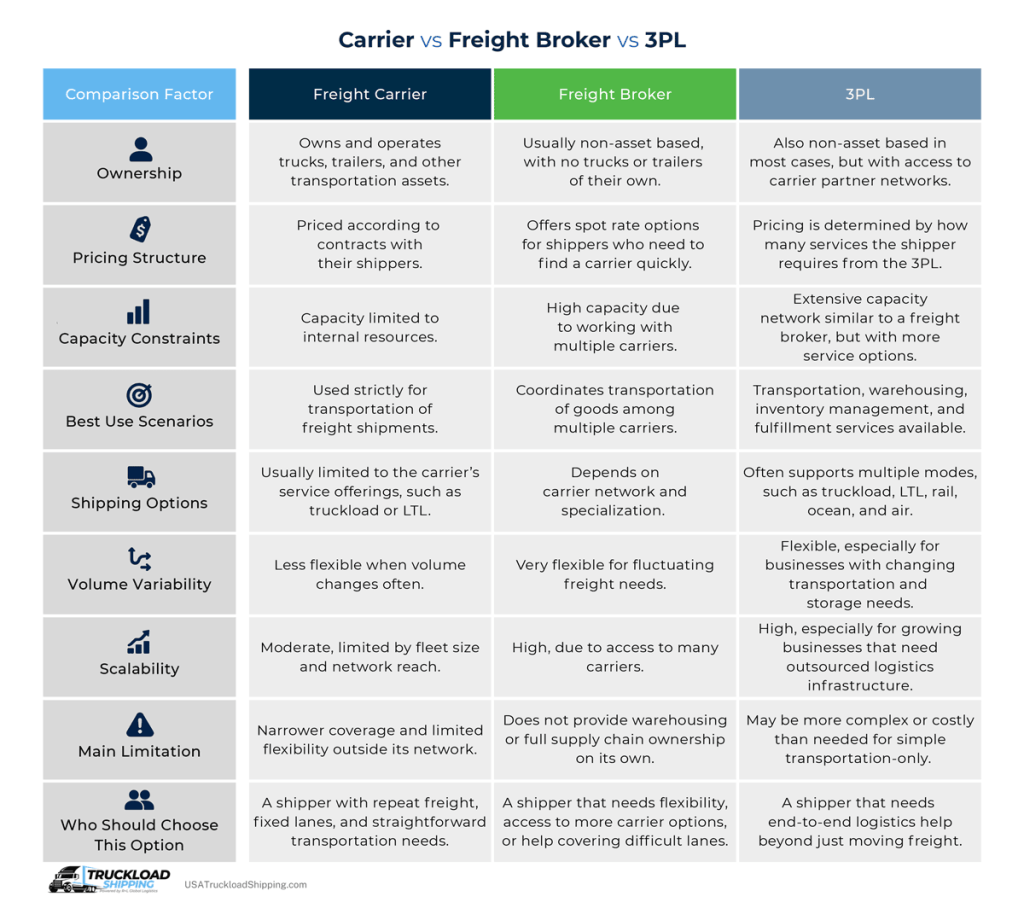
Choosing between these three logistics services is easy once you understand the strengths of each option.
A carrier is often the best fit for shippers with consistent lanes, scheduled freight, and predictable service requirements.
A shipper should evaluate two factors before working directly with a carrier:
I’ll examine these factors in the following section.
A truckload shipping lane is a recurring freight route between where a shipment is picked up and where it is delivered. Stable shipping lanes maintain consistent freight volume and pricing.
If a shipper moves freight on the same lanes each week or month, contracting with a carrier is a proven way to maintain consistent service.
Predictable freight moves on a regular schedule with limited variation in commodity type, dimensions, handling requirements, and delivery expectations.
A basic example would be a manufacturer or supplier who strictly sells engine replacement parts. This type of inventory creates similar shipping requirements from one order to the next when it moves on a set schedule.
When a single carrier cannot cover a shipper’s lanes, timing requirements, or volume needs, a freight broker becomes the better option.
Freight capacity is the amount of freight shipping resources available to a carrier, broker, or 3PL. A carrier is limited to its own fleet, while a freight broker can source capacity from multiple carrier partners.
When a shipper works with a freight broker, the broker compares carrier options to find a service match for the lane, timing, and freight requirements.
Another advantage of working with a freight broker is the shipping coverage they offer compared to standalone carriers. Let’s say you run the auto parts business I mentioned earlier and you secure a contract with a new customer in an area to which your carrier doesn’t ship
The freight broker can secure coverage by sourcing a carrier that already operates in the destination area.
When your logistics service needs go beyond simple freight transportation, it’s time to talk to a 3PL. A broker mainly arranges freight, while a 3PL can own the broader logistics process, including warehousing, fulfillment workflows, returns, and multi-mode coordination.
Since 3PLs offer a comprehensive suite of services, they can provide shipping mode options other than just full truckload (FTL) and less than truckload (LTL) shipping. They can also offer alternate shipping modes, including:
Building on our engine parts example again, consider a scenario in which you need to ship an order to a customer in a country without a physical border with the United States. Such a shipment would likely need to go out via ocean freight for international shipping.
When you reach out to a 3PL for this kind of shipment, they can make arrangements with ocean carriers and freight forwarders to get your goods where they need to go.
A 3PL can manage warehousing, order fulfillment, and pick & pack services on behalf of a shipper. Some 3PLs also offer reverse logistics services, so they can process returns from their clients’ customers.
Use a freight broker when seasonal demand exceeds your regular carrier capacity. A freight broker is often the best fit when your business ships predictable freight most of the year but needs extra trucks during peak periods like holiday demand, promotions, harvest season, or year-end inventory pushes.
For example, a distributor may rely on one core carrier for normal weekly shipments, then need additional coverage when order volume spikes for six to eight weeks. In that case, a freight broker can source extra carrier capacity without requiring the shipper to replace its main carrier relationship.
Use a 3PL when you need storage, order fulfillment, and returns handling in addition to transportation. A 3PL is usually the right fit for ecommerce brands that do not just need freight moved, but also need inventory received, stored, picked, packed, shipped, and sometimes returned.
For example, an online auto parts seller may store inventory in a 3PL warehouse, send daily customer orders to the 3PL for fulfillment, and rely on the same provider to process returns and restock eligible items. That setup reduces the shipper’s internal operational burden and keeps fulfillment, warehousing, and outbound shipping under one logistics partner.
Use a freight broker when you need to move an urgent load outside your normal shipping pattern. A freight broker is often the better option when a shipper has a last-minute load, an unusual destination, or a time-sensitive order that its regular carrier cannot cover quickly.
For example, a manufacturer may need to send one emergency palletized shipment to a new customer two states away after a production recovery. If the regular carrier does not have available equipment or does not service that lane on short notice, a freight broker can find available capacity faster than the shipper could by contacting individual carriers one by one.
To choose between a 3PL, freight broker, or carrier, a shipper should evaluate required services, shipment frequency, lane consistency, customer locations, and storage or fulfillment needs.
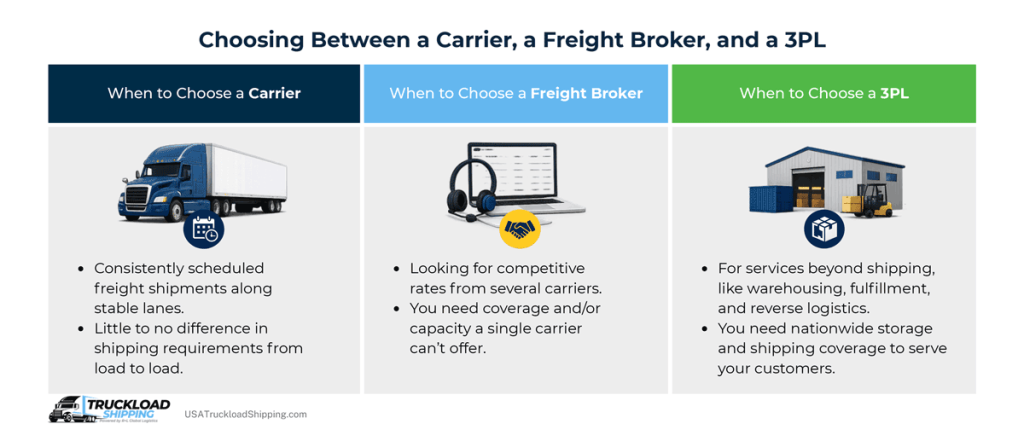
A shipper should also prepare a short qualification checklist before selecting a carrier, freight broker, or 3PL.
Ask the following questions of a 3PL, carrier, or freight broker before committing to any service agreements.
Shippers should also ask these prospective logistic service providers to show, in writing, what responsibility they take for loss, damage, delay, or misdelivery.
If you need a 3PL to move or store your freight, then USA Truckload Shipping is here to help. We have a variety of services that can help you transport your freight anywhere in the country. Call the team of freight shipping experts at USA Truckload Shipping for a risk free quote. You can reach us (866) 353-7178 or visit our contact us page.
Sources:
Do I Need a USDOT Number? Federal Motor Carrier Safety Administration, 2025
What Is Operating Authority (MC number) and Who Needs It?, Federal Motor Carrier Safety Administration, 2023
What Is A Third-Party Logistics Partner? U.S. Chamber of Commerce, 2021
 Copy URL to Clipboard
Did you find this article helpful?
See more of our coverage on Google.
Add usatruckloadshipping.com as a preferred source!

R+L Global Logistics
315 NE 14th St., Ocala, FL 34470
