


See more of our coverage on Google.
Add usatruckloadshipping.com as a preferred source!

Carrier onboarding is the process shippers use to vet, approve, and prepare freight carriers to move shipments safely and compliantly. A strong onboarding process verifies operating authority, insurance, safety status, payment setup, and service expectations before the first load moves.
Carrier onboarding is a process shippers use to vet, approve, and train carriers to provide freight transportation. Shippers vet carriers or third-party logistics (3PL) companies with a freight broker or on their own with the Safety and Fitness Electronic (SAFER) System, which is a Federal Motor Carrier Safety Administration (FMCSA) resource.
The FMCSA is an agency of the U.S. Department of Transportation (DOT) that regulates carrier safety, compliance, and freight transportation. Shippers can use SAFER to verify a carrier has met FMCSA compliance regulations.
The carrier onboarding process typically has two phases:
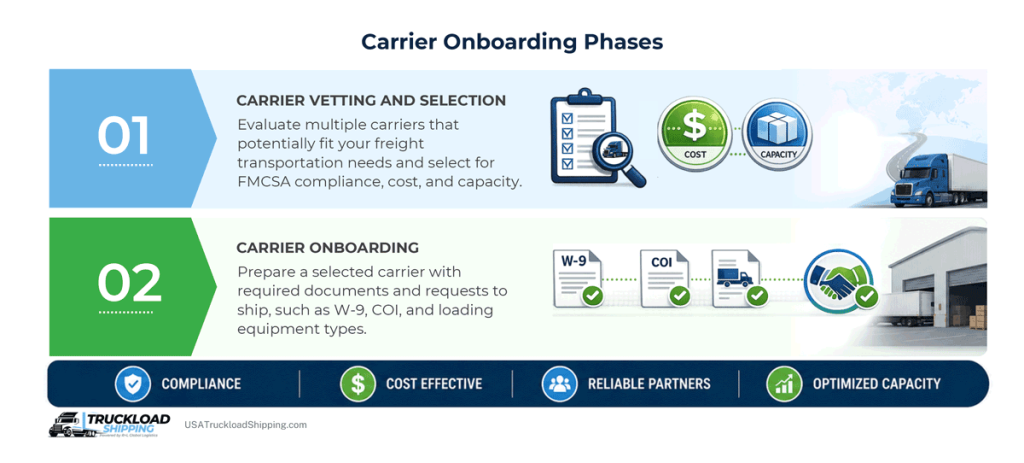
Carrier setup usually refers to the documentation package a carrier submits to a shipper for approval, including operating authority, insurance, tax forms, and contact details.
Carriers are equipped to support a shipper’s supply chain with a shipper’s standard operating procedures (SOPs). An SOP is a step-by-step process for carriers to follow a shipper’s supply chain operations.
SOPs are run with digital software that manages shipping documents and data shared between the shipper and carrier.
A shipper’s SOP can include:
In the next section, we’ll go over why shippers onboard carriers.
Shippers onboard carriers to confirm that a transportation provider is legally authorized, properly insured, operationally capable, and aligned with service expectations before moving freight. This reduces compliance risk, improves execution, and helps build a more reliable carrier network.
Onboarding a reliable carrier can lead to the following benefits:
Effective carrier onboarding reduces avoidable delays, improves compliance control, and makes carrier performance easier to manage over time.
You can check a carrier’s operating authority and safety status by verifying their Motor Carrier (MC) number, U.S. Department of Transportation (USDOT) number, and the FMCSA’s SAFER system.
An MC number can be six or seven digits and is used to verify a carrier’s operating authority. This number proves a company is operating as a for-hire carrier and is transporting federally regulated commodities.
A USDOT number is six to eight digits and assigned to carriers so their safety performance can be monitored. This includes tracking inspections, crashes, and audits. You can use this number to determine how compliant a carrier is with safety procedures.
FMCSA’s SAFER is a free and public database that provides extensive safety records, inspection histories, and compliance data on various carriers. You can use this resource to further investigate your carrier’s adherence to safety.
The documents required for carrier onboarding include a carrier agreement, Certificate of Insurance (COI), W-9 form, and MC/DOT operating authority. We’ll explain each document in the following sections.
A carrier agreement is a legal contract between a shipper and a carrier that defines how freight will be moved, paid for, and managed. In the arrangement, shippers agree to tender freight for transport, while the carrier agrees to move freight under specific terms, pricing, and service expectations.
Carrier agreements usually include:
This document is essential because it provides a formal understanding for you and your carrier to follow.
A Certificate of Insurance (COI) is a document from a carrier’s insurance provider that serves as proof of a carrier’s active insurance. Whether it’s carrier liability, freight insurance, shippers should obtain a COI to verify their carrier’s policies.
A COI should state the following information:
Shippers can request a COI from the carrier or ask for their insurance provider’s information to obtain the document.
The carrier onboarding process includes payment details for shippers to pay their invoices or carriers to pay approved freight claims, if applicable.
Shippers should request the following payment information:
In the next section, we’ll discuss how to keep a scorecard to measure carrier performance.
A carrier scorecard should measure reliability, capacity, service consistency, and equipment fit before approval. Core metrics include on-time pickup, on-time delivery, tender acceptance, transit consistency, capacity availability, and equipment suitability.
The table we’ve provided will explain these metrics and what to measure in more depth.
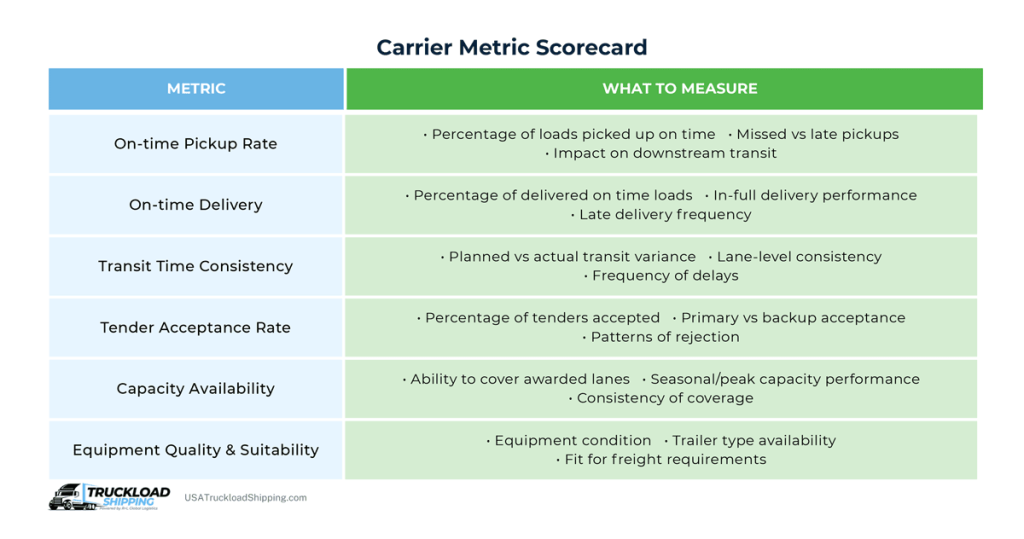
Some scorecard data may come from internal shipment history rather than public carrier profiles, so shippers often need to collect performance details during qualification and after initial loads.
A carrier onboarding checklist should include the carrier’s MC or USDOT number, Certificate of Insurance, W-9, contact information, freight requirements, and TMS or EDI setup details. These items support compliance review, payment setup, and shipment execution. We’ve provided a table so you can more easily track this information as you obtain it.
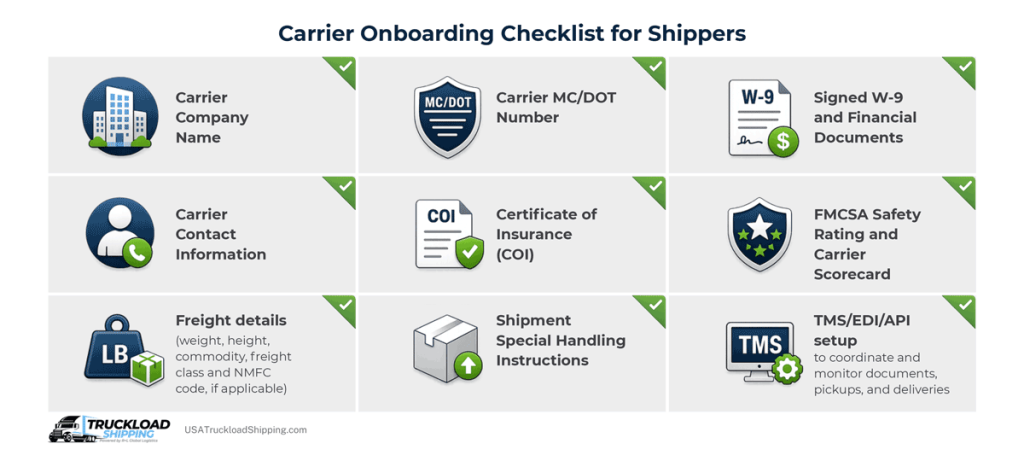
Now that you have carrier vetting process tools, you can select and train the best-fit freight professional to join your team.
If you have systems in place to automate the onboarding process, you’ll be able to finish the process in between a few minutes and a few hours. Standard onboarding processes are typically completed between 24 and 48 hours. However, manual onboarding processes can extend the process for as long as one and two weeks.
We’ll discuss some of the mistakes that can extend the onboarding process in the following section.
Carrier onboarding slows down when documentation is incomplete, workflows are manual, requirements are unclear, or systems are disconnected. Standardized checklists, digital document collection, and early validation checks help reduce delays and improve approval speed.
We’ve provided a list of the most common mistakes that cause these issues:
Shippers can speed up slow carrier onboarding by replacing manual, reactive processes with clear, streamlined workflows supported by technology. This starts by bringing everything into one system (or connected tools) where carriers can submit documents, fill out profiles, and track their status in one place.
Providing clear requirements, upfront checklists, and automatic checks helps catch missing or incorrect information early. When documents, compliance steps, and contracts are handled digitally and in the right order, onboarding becomes faster and more consistent.
Once your onboarding checklist, compliance checks, and scorecard criteria are in place, you can approve carriers faster and reduce avoidable freight risk. Teams that need help with carrier qualification or shipment execution can also work with a freight partner for added support.
Take a look at our services to find the right one for your shipping needs. Get in touch with our team and call (866)-353-7178 or get expert freight consultation to plan your shipment today.
Sources:
Safety and Fitness Electronic Record (SAFER) System, U.S. Department Transportation
Newsroom, U.S. Department of Transportation
What Is Operating Authority (MC number) and Who Needs It?, Federal Motor Carrier Safety Administration, 2023
About Form W-9, Request for Taxpayer Identification Number and Certification, International Revenue Service
 Copy URL to Clipboard
Did you find this article helpful?
See more of our coverage on Google.
Add usatruckloadshipping.com as a preferred source!

R+L Global Logistics
315 NE 14th St., Ocala, FL 34470
